Data Center Load Flexibility Is Now an Equipment Spec
Data center load flexibility trades curtailable load for faster interconnection, and utilities enforce it with owned breakers and relays. The procurement read.
Silicon Valley Power runs one of the densest large-load territories in the country, roughly 58 data centers inside a 20-square-mile footprint. When a new NVIDIA data center wanted a faster path onto the system, the muni set one condition: 100 percent control of the load-side breaker. Not a rate, and not a demand-response credit. Physical control of the switch that opens the customer, held by the utility. That single requirement is the clearest sign that data center load flexibility has stopped being a sustainability talking point and become a hardware specification, and it changes what municipal and cooperative buyers put on their next interconnection bill of materials.
The shift happened fast. Flexibility used to be framed as a demand-response cost play, something a data center opted into for a bill credit. In 2026 it is framed almost entirely as a way to skip the interconnection queue. Cloud revenue grew 28 to 63 percent year over year across the major providers, and Goldman Sachs projects US data center power demand reaching 66 GW in 2027, up from 31 GW in 2025. A gigawatt of firm load can wait years for a study and a build. Load that agrees to be curtailed can often be connected against the headroom that already exists. That is the bargain, and the operational half of it runs on equipment the utility owns and specifies.
The trade: flexible interconnection for speed
The reason flexibility bypasses the queue is that a firm interconnection assumes the worst case every hour of the year. Size the transformer, the switchgear, and the line for peak, order it, and wait for the factory. A flexible interconnection lets the utility interconnect against a lower conditioned peak, because it holds the right to pull the load down when the system is tight. FERC moved this from theory to framework on June 18, 2026, ordering system operators to provide transmission service for flexible large loads, part of the same push that put six RTOs on a 60-day clock to rewrite their large-load tariffs.
The catch is that a right to curtail is worthless without the means to enforce it. That is where the procurement story lives. Flexible interconnection does not remove equipment demand. It relocates and conditions it, moving spend from oversized service transformers toward the control and protection gear that makes curtailment real.
What load-side breaker control actually requires
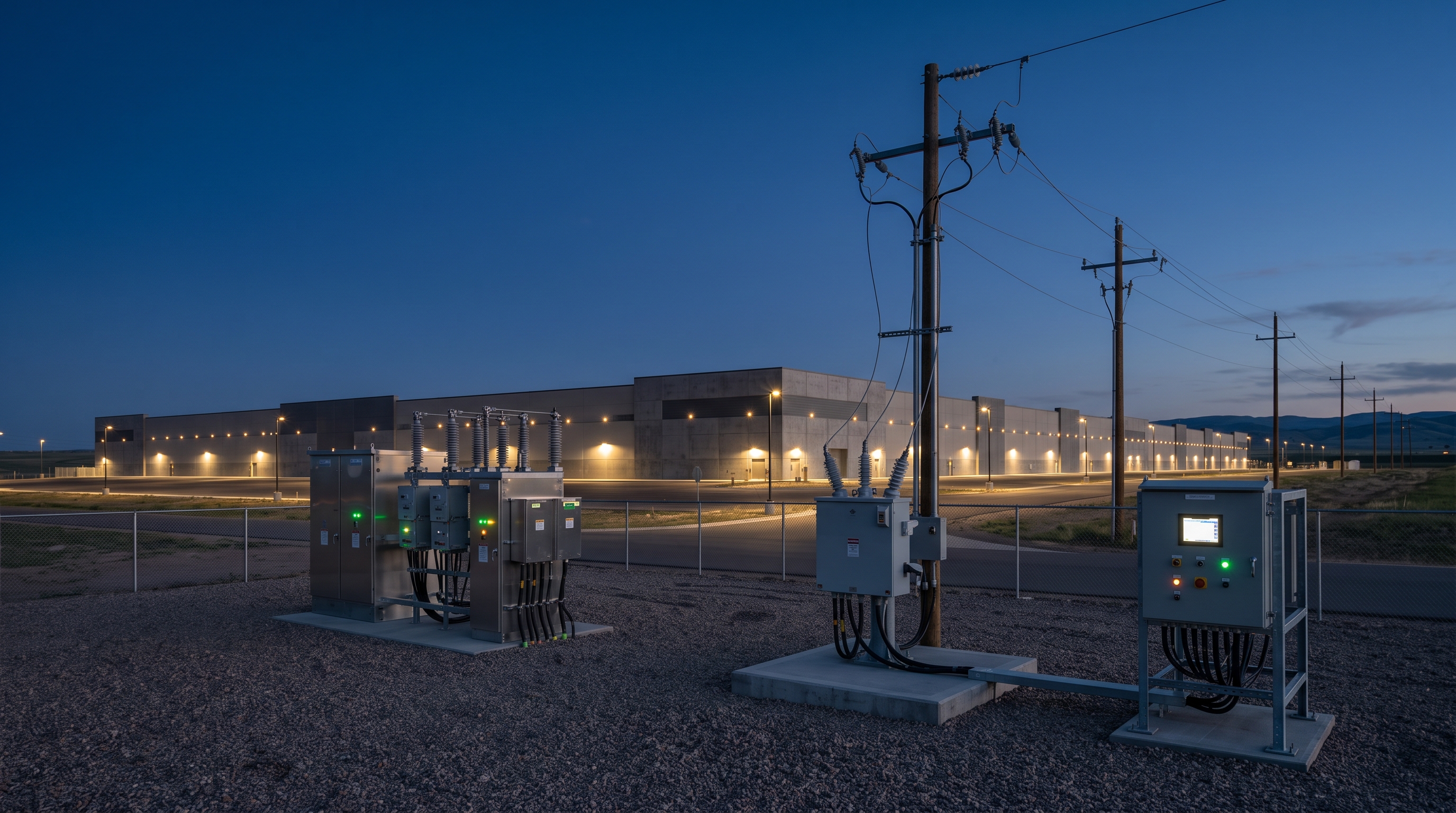
“One hundred percent control of the load-side breaker” is a clean sentence that hides a stack of equipment. To enforce curtailment on a gigawatt-scale customer, a utility needs, at the interface, more than the service transformer and the metering it already buys:
- A load-break switch or breaker under utility control, sized for the interconnection and rated to open the customer under load, not just for a scheduled maintenance opening.
- Motor operators and reclosers so that switch can be thrown remotely and, where the tariff allows, automatically, rather than by a truck roll to the site.
- Protective relays configured for utility-directed load shed, coordinated with the customer’s own protection so the utility can drop the load without cascading a fault back into the campus.
- A remote terminal unit or large-load gateway that carries the curtailment signal from the utility’s control room to the switch, plus the communications path (fiber or hardened cellular) that the SCADA link rides on.
- Revenue and check metering granular enough to prove the curtailment happened, because penalties and priorities in the eventual tariff will be settled on that data.
None of this is exotic gear. Reclosers, motor-operated switches, protective relays, and RTUs are standard distribution inventory. What is new is that they are now a specified line item in a large-load interconnection, sitting alongside the transformer and switchgear package rather than being an afterthought. For a distributor, curtailment-enforcement hardware is a growing category with the same long lead times as everything else at medium voltage. A buyer sees the flip side: a set of SKUs that used to live on a different page of the catalog and now belong on the interconnection order.
The five classes behind large load curtailment
Not all flexibility is equal, and the equipment depth scales with the class of control. EPRI’s DCFlex program, running nine demonstration sites across the US and Europe, sorts flexibility into five classes under its FlexMosaic framework, with the higher classes unlocking the most system value by mitigating local thermal overloads and voltage drops rather than just shaving a system peak. The live pilots show the range buyers are being asked to underwrite. Portland General Electric demonstrated a 20 percent reduction in a simulated emergency. Salt River Project ran a peer-reviewed 25 percent workload ramp across a three-hour peak. Independent work at Boston University put training and inference flexibility at 18 to 55 percent, and a Duke University study found that even a 1 to 2 percent cut in data center peak demand can lower electricity rates 0.5 to 2.8 percent.
The procurement translation is that a class defined only as “shed on request once a year” needs far less at the interface than a class that reroutes workloads on a thermal signal several times a season. That second case implies faster-acting protection, more communications reliability, and switching gear rated for frequent operation. A muni signing a flexibility agreement should know which class it is buying into before it specifies the switch, because the class sets the duty cycle and the duty cycle sets the gear.
The missing standard is the real exposure
The weak point in all of this is that there is still no binding, standardized curtailment agreement. Curtailment priority, penalties, and rates are undefined, and both sides admit they lack common operating guidelines. Data centers resist instantaneous load reduction, citing hardware-damage risk to sensitive equipment, and today’s bill-credit incentives are too small to make an operator curtail a lucrative AI workload voluntarily. Until the terms are codified, every large-load interconnection is a one-off negotiation.
That gap lands hardest on the buyers we serve. Pennsylvania’s first-in-nation large-load model tariff and FERC’s June 18 order are the first templates for standardizing these terms, and the federal reliability backstop is filling in behind them, as the DOE order letting PJM curtail data centers before rolling blackouts shows. But municipal utilities and cooperatives inherit the operational rules without the legal and engineering bench an investor-owned utility brings to a case-by-case fight. A co-op can sign curtailment terms it cannot operationally enforce, or it can specify enforcement hardware for a curtailment right the eventual tariff never grants. Standardized tariffs are the emerging protection, and until they arrive the safest posture is to specify the control gear as if the utility will need to use it.
The takeaway for a buyer is narrow and immediate. When a large load asks for a flexible interconnection, price the enforcement hardware into the interconnection from the start, confirm the flexibility class before sizing the switch, and treat the curtailment terms as an engineering document, not a rate footnote. Which enforcement SKUs, at which lead times, against which flexibility class, is the crosswalk our procurement intelligence work maps, and it is the difference between a curtailment right on paper and one the control room can actually exercise.
Want the research behind this?
The five-part enforcement stack above is the spec; the SKU-by-SKU crosswalk against each EPRI flexibility class and current lead times is the deeper reference our members work from. The Insider library holds the deeper version: topic deep-dives, manufacturer and utility dossiers, the RFQ and spec template set, and the full report archive. Membership runs $9.99 a month and opens all of it.
Related reading
- FERC Large Load Interconnection Order: 6 RTOs on the Clock
- Pennsylvania Large Load Tariff: ‘But For’ Cost Allocation
- DOE PJM Data Center Curtailment Order: Procurement Impact
Free RFQ templates. Weekly digest. Yours.
Free Member tier. Pick your topics. Get a weekly digest filtered to what you actually buy.