CAISO Large Load Requirements: A PMU at Every Transformer
CAISO large load requirements leave rates alone and add a PMU, DFR and SCADA at every main power transformer. Comments close September 2.
The CAISO large load requirements published on August 12 are the third answer to FERC’s show-cause order, and they split cleanly down the middle. On money, CAISO refuses to move. On hardware, it asks for more than either of the other two grid operators that have answered so far. Comments close September 2, which means the version of this document that is true today has about a day left before the record starts changing it.
Most of the coverage has read the first half and stopped. That is understandable, because the rate language is blunt. CAISO wrote that it “does not believe changing the transmission access charge is necessary at this time,” and it declined to revise its behind-the-meter generation or gross load constructs. Read only that far and the story is a refusal.
The second half is a bill of materials.
What CAISO declined, and the reason it could
The Commission’s preliminary finding was that CAISO’s tariff lets large loads shift costs onto everyone else. CAISO’s answer is that the existing tools already cover it: financial security, minimum demand charges, exit fees and similar mechanisms available to the participating transmission owners. It believes there is enough flexibility in those to address the concern without touching the access charge.
The mechanical argument underneath is worth holding onto, because it is the part that travels. CAISO distinguishes itself from PJM on billing determinants. PJM “calculates and assesses its transmission charges based on certain peak demand figures,” so a behind-the-meter generator that runs at system peak can mask transmission usage. CAISO assesses its transmission access charges 24 hours a day against the gross load of each utility distribution company or metered subsystem. A generator behind the meter does not hide from a 24/7 gross load measurement the way it can hide from a peak-coincident one.
That is a real difference rather than a rhetorical one, and it is why CAISO can decline the PJM remedy without simply declining the Commission.
One correction on the reporting, because it inverts the meaning. CAISO’s line that “no stakeholder has requested” the service attaches to non-firm transmission service, which is the thing CAISO refused to build. Developers told CAISO they want firm service and will accept temporary flexibility only to connect ahead of long-lead network upgrades. The two new offerings, Flexible Interim Load Interconnection and Flexible Load Interconnection in Perpetuity, are interconnection services offered instead of that non-firm transmission service. CAISO is not adding options nobody asked for. It is substituting a smaller instrument for a larger one it declined to create, and then asking stakeholders whether the second of the two is worth pursuing at all.
The large load interconnection requirement is written per transformer
The straw proposal repeatedly incorporates a second document that has drawn almost no coverage: the Large Load Technical Requirements Straw Proposal, Revision R0, dated June 15, 2026, written by a working group of CAISO, PG&E, SDG&E, SCE, Valley Electric Association, Silicon Valley Power and GridLiance West. Section 2.5 is where the procurement content lives:
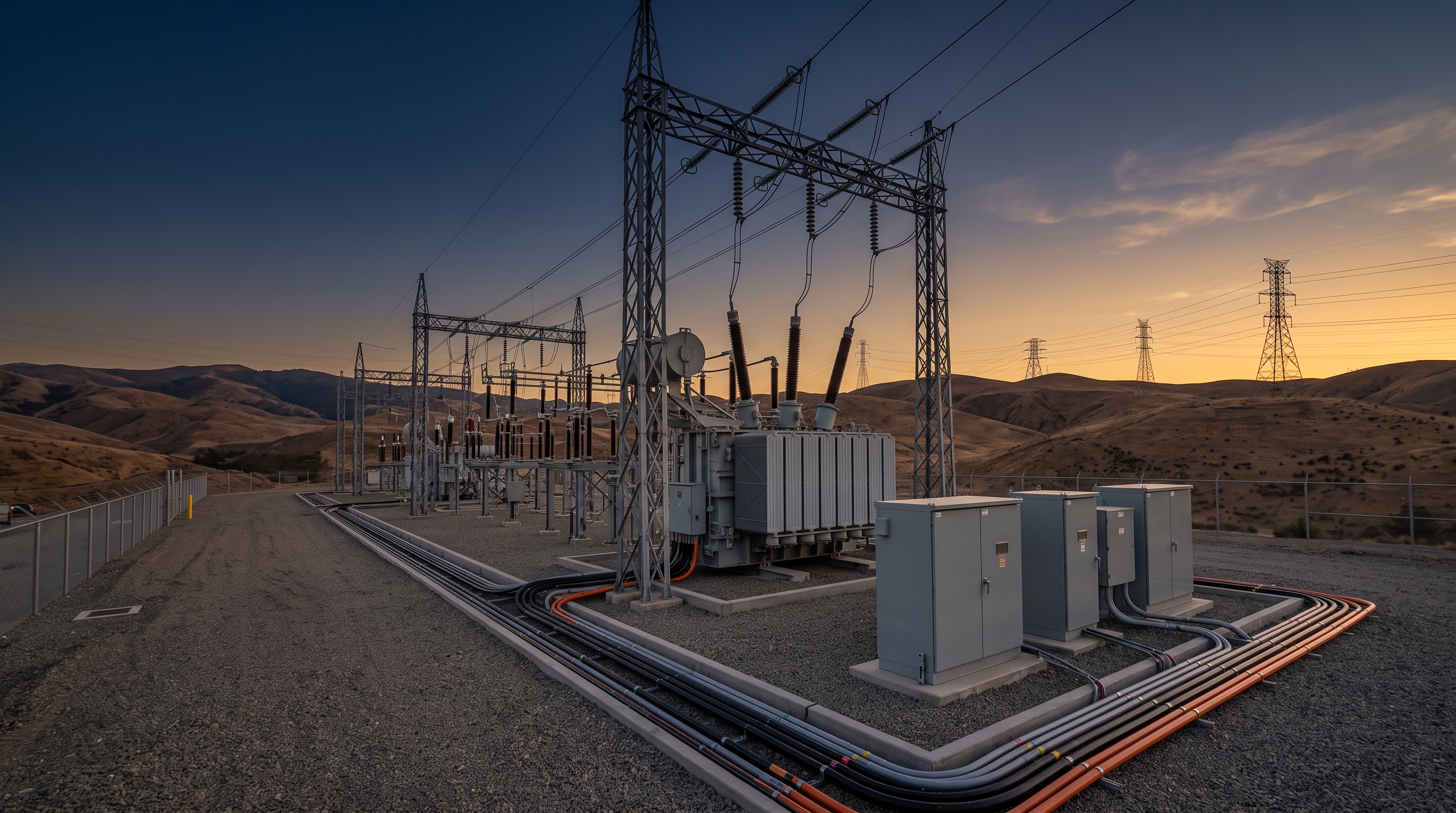
“High-resolution monitoring and telemetry equipment, including Phasor Measurement Units (PMUs), Digital Fault Recorders (DFRs), and SCADA systems shall be installed at each Main Power Transformer (MPT) associated with the large load interconnection.”
The unit matters more than the list. This is written per main power transformer, not per site, so the count scales with transformer count. That is a quantity a buyer can actually estimate from a one-line diagram, which is not true of most requirements written at this stage of a stakeholder process.
The attached conditions are where the scope grows past the devices themselves. PMU and SCADA measurements stream in real time to the interconnecting transmission owner. DFR measurements are retained a minimum of 30 days and produced to the transmission owner within 10 days of a request. And interconnection studies may require additional monitoring, control or protective systems, expressly including “automated schemes designed to reduce or disconnect portions of the large load during abnormal system conditions.”
The August document then adds four operational requirements that the June technical document had not fully covered. CAISO proposes adopting all four, and the first one carries the cost assignment in its own text: installation of PMUs or similar high-speed monitoring equipment, “with associated costs assigned to the transmission customer.” The other three are hourly forecasts and telemetry, remote disconnect capability for CAISO, and maintained communication channels.
Who pays for the PMU, and where the switch actually lives
The remote disconnect requirement is the one most likely to be misread as a CAISO tariff term, and CAISO says plainly that it is not:
“The CAISO notes that it does not have direct control of switches, so the PTOs would need to make sure they have control at the right level. In other words, these requirements would be implemented at the PTO rather than at the CAISO level.”
CAISO lists the implementation paths it expects: changes to the CAISO tariff, participating transmission owner tariffs, utility interconnection handbooks, business practice manuals, or future NERC reliability standards. For anyone specifying equipment, the interconnection handbook is the document that will govern, and it is the one nobody watches. A requirement that arrives through a handbook revision has no docket, no comment period and no press coverage.
This is the same pattern we wrote about when data center load flexibility became an equipment spec: the obligation is written in a market document and lands in a hardware scope. It is also why the islanding case turned out to add utility-side protection rather than remove it. The customer-side device list is the visible half. The utility-side scope to receive, time-synchronize, stream and retain that data is the half that shows up in a substation communications budget.
The numbers that now have a public source
The more durable value of the technical document is not the mandate. It is that a set of large-load specifications now exists in a citable public file, benchmarked against four other jurisdictions by name.
| Requirement | CAISO proposal |
|---|---|
| Ramp rate | No more than 20 MW/min, averaged over a rolling 10-minute interval |
| Frequency ride-through | Continuous operation between 58.8 and 61.2 Hz, measured at the high side of the main power transformer |
| Outside that band | 299 seconds; may trip above 61.8 Hz or below 57.0 Hz |
| Monitoring | PMU, DFR and SCADA at each main power transformer |
On ramp rate the document prints its comparators: ERCOT at 20 MW/min, ATC limiting any change above 50 MW to 0.5 MW/s, AESO at 10 MW/min, and Southern Company at 20 MW/min with a top-quartile test layered on. That is four grid operators converging on the same order of magnitude, published in one table, free to open. Anyone writing a large-load interconnection requirement in a state with no such document now has a drafting reference, which is how specifications spread.
Frequency measurement is specified at the high side of the main power transformer, over a 3 to 6 cycle window, and single-point measurements are explicitly disallowed for protection or control action. That is a metering-class and time-source requirement hiding inside a ride-through table.
Three postures, one order
Set beside the other answers, the shape of the disagreement gets clear. PJM’s filing moved megawatts, conditioning service on a physical curtailment obligation. SPP moved money, reaching for credit and collateral. The CAISO large load requirements move neither and move instrumentation instead, asking for visibility into the load rather than a claim on it.
None of the three is obviously right, and the Commission will not get a single answer to compare. We covered the original show-cause order to six RTOs when it issued, and the six resource adequacy filings that followed. The pattern across all of it is that grid operators are answering the same question with instruments drawn from whichever part of their own tariff already works.
What is not settled
Four cautions, because the temptation to treat this as a spec sheet is real and it is early.
The CAISO large load requirements are a straw proposal. Not a filing, not a tariff. Comments are due September 2, a draft final proposal is scheduled for September 21, and the Board of Governors takes it up October 28. Everything in it can move.
The technical document is Revision R0, and its own section 3 lists what is still under development: low and high frequency cycling, constant-power-mode limits, power quality including harmonics and flicker, power factor and dynamic reactive support, phase-angle-jump ride-through, and protection requirements. Dynamic reactive support is the one to watch. That is the line between a monitoring scope and a compensation scope, and they are not the same size.
The large load definition is unsettled by CAISO’s own admission. It proposes “an End User located at a single site interconnecting to the CAISO Controlled Grid, and that has a peak load of 50 MW or greater,” and says that may shift while NERC develops overlapping computational load terms. Note that CAISO deliberately dropped the voltage threshold from the Commission’s suggested definition, which was a peak load of 50 MW or greater interconnecting above 69 kV. CAISO’s view is that specifying interconnection to the controlled grid already establishes that the load is transmission-connected. If you have been carrying “50 MW and above 69 kV” as the working definition, that formulation is the Commission’s suggestion, not CAISO’s proposal, and it is not SPP’s either.
And nothing here is procurable today. What is usable today is the vocabulary. PMU and DFR per main power transformer, 20 MW/min, 58.8 to 61.2 Hz at the high side. Those phrases now have a public citation behind them, which is what you need to ask a question in a room where the answer has not been written yet.
The buyers with the most at stake are not the hyperscalers. They are the participating transmission owners and the municipal utilities and co-ops adjacent to them, who will be asked to receive and retain synchrophasor and fault-recorder data from customer-owned equipment on a 30-day floor with a 10-day production clock. That is a data historian, a time synchronization source and a communications path, and it lands on the utility side of the meter regardless of who buys the PMU.
Requirements like this one arrive in stakeholder documents months before they reach a handbook. The Feeder is our free weekly briefing on what changed in the record and what it means for equipment timing. Sign up here.
Related Reading
- FERC Large Load Interconnection Order: 6 RTOs on the Clock
- Large Load Resource Adequacy: What Six RTOs Told FERC
- Data Center Islanding Interconnection Is the Harder Case
Frequently Asked Questions
What monitoring equipment do the CAISO large load requirements call for?
The Large Load Technical Requirements Straw Proposal states that phasor measurement units, digital fault recorders and SCADA systems shall be installed at each main power transformer associated with the large load interconnection. PMU and SCADA measurements stream in real time to the interconnecting transmission owner, and DFR records are held at least 30 days and produced within 10 days of a request.
Who pays for the PMUs under the CAISO proposal?
The August 12 straw proposal adopts four operational requirements from the FERC order, and the first one reads that PMU or similar high-speed monitoring equipment is installed with associated costs assigned to the transmission customer.
Did CAISO change its transmission access charge?
No. CAISO wrote that it does not believe changing the transmission access charge is necessary at this time, and it declined to revise its behind-the-meter generation and gross load constructs. It distinguishes its own charge from PJM's on the ground that CAISO assesses transmission access charges 24 hours a day against gross load rather than against peak demand figures.
Is this a filed tariff?
No. It is a straw proposal in a stakeholder process. Comments are due September 2, 2026, a draft final proposal is scheduled for September 21, and the CAISO Board of Governors takes it up October 28. The technical requirements document is Revision R0 and several of its sections are still under development.
What ramp rate does CAISO propose for large loads?
An average active power ramp rate measured over a rolling 10-minute interval that does not exceed 20 MW per minute. The document benchmarks that against ERCOT at 20 MW per minute, ATC at 0.5 MW per second for changes above 50 MW, AESO at 10 MW per minute and Southern Company at 20 MW per minute.
Track this beat without paying per report
Free Member tier. Pick your topics. Get a weekly digest filtered to what you actually buy.