Data Center Substation Design Is a Procurement Decision
Data center substation design now decides the bill of materials. Footprint, schedule, and storage choices are reshaping what utilities buy and when they buy it.
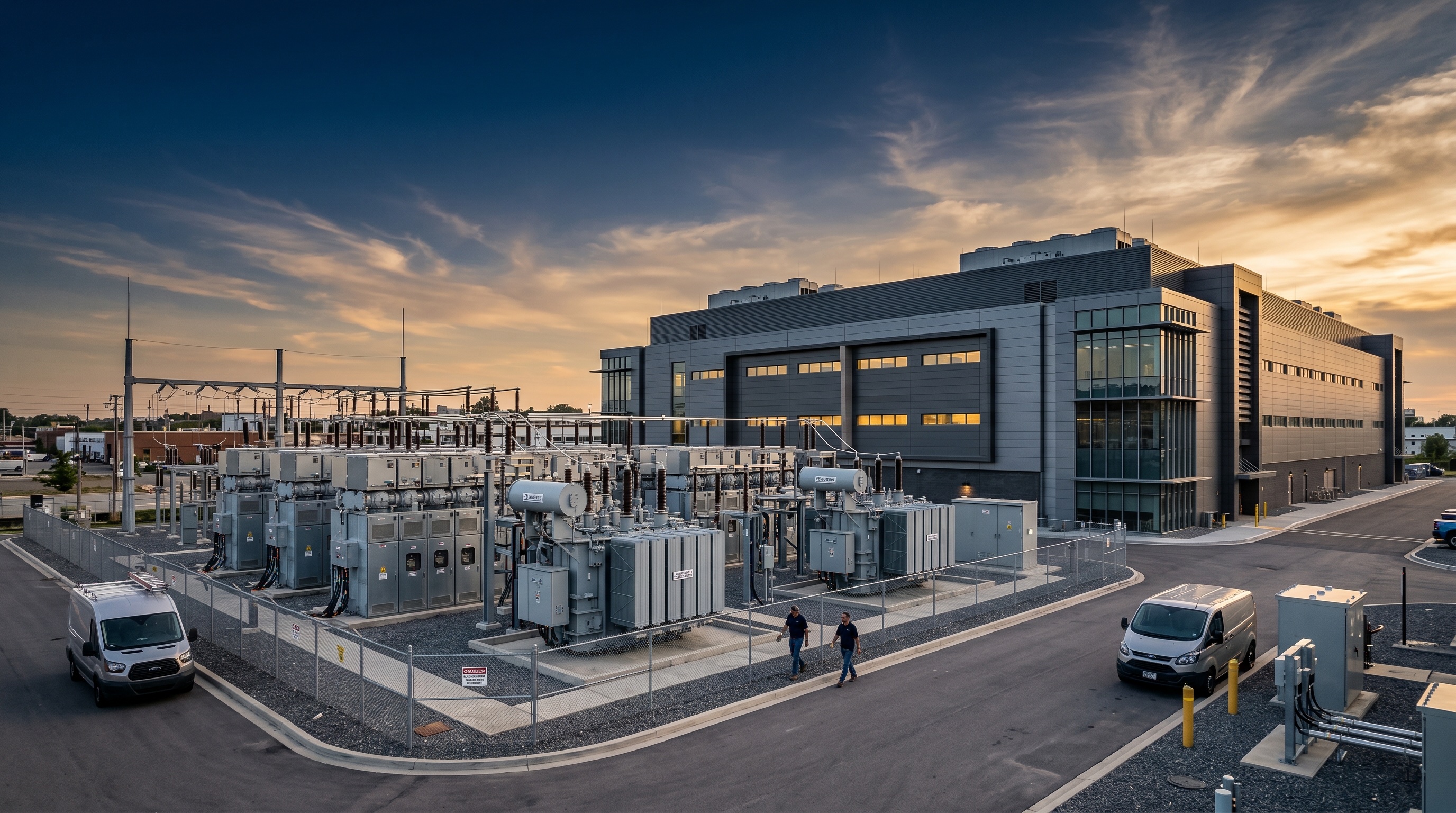
For most of the last forty years, a substation was an engineering output. Load forecasts went in, a one-off design came out, and procurement bought whatever that design specified. Data center substation design has flipped that order. The concentrated, high-density loads coming off hyperscale campuses are forcing utilities to settle the buying decisions first, then draw the substation around them. The design is now the procurement plan, and three choices made on the drawing board decide most of the bill of materials.
This is not a story about whether demand is real. We have covered that in 50 GW of data centers rewriting grid procurement. The harder question for buyers is what the substation itself should look like when transformers run past two-year lead times and a single campus can ask for the capacity of a small city.
How data center power demand changes the footprint math
The first design lever is land. Air-insulated substations (AIS) have been the US default because land was cheap and schedules were forgiving. Neither holds near a data center corridor.
Denton Municipal Electric, a Texas muni serving roughly 74,000 customers, built its Hickory substation around a Siemens 138/13.2 kV gas-insulated system. It sits on 2.1 acres. The equivalent air-insulated build would have needed about 7 acres. The new station doubled the capacity of the 1960s-vintage 69 kV station it replaced, and the distribution circuits feeding it went underground in the same project.
Gas-insulated switchgear (GIS) used to be reserved for transmission-class urban sites in places like New York and San Francisco. A mid-sized muni adopting it at the distribution-substation level is the signal worth tracking. When a data center wants firm power inside an existing service territory, the available parcels are small and the neighbors are watching. GIS turns a 7-acre problem into a 2-acre one. That choice also pulls a different switchgear supply chain into the order, with its own lead times and its own SF6-free compliance questions that did not exist on a conventional AIS yard.
Designing the substation against hyperscale power requirements and lead times
The second lever is schedule. One-off substation engineering assumes you can wait for whatever you specify. You cannot. Large power transformers are quoting 128 to 144 weeks, and switchgear waits have stretched toward 36 months. Wood Mackenzie projects that hyperscale demand alone could push padmount transformer and medium-voltage switchgear unit volumes to roughly six times their current levels by 2030, all queued through the same handful of factories.
That math changes how a data center substation gets designed. Utilities under real schedule pressure are moving from one-off layouts to repeatable, standardized blocks: a fixed transformer-plus-switchgear configuration that can be ordered, permitted, and replicated instead of re-engineered each time. The design freeze becomes the moment you place the long-lead order, not a milestone you reach months later. Get the standard block right once and you are buying against allocation; get it wrong and every campus restarts a 144-week clock. Blocks ordered in 2026 with 128 to 144 week lead times will arrive in 2028 or later, which means the transformer spec in that block must already clear the DOE 2029 transformer efficiency floor before the design freeze — the April 2029 deadline falls inside the delivery window for orders placed today. The same lead-time discipline we laid out for pad-mount transformer procurement now applies to the whole substation as a unit.
The design choice that avoids a substation
The third lever is the most overlooked: deciding not to build the full station at all, at least not yet. Front-of-meter storage on the distribution system is becoming a deliberate design alternative to a conventional substation buildout. A 1 to 10 MW battery sited at a stressed substation or feeder can interconnect in 6 to 18 months, against the roughly eight years a transmission-connected project waits in the queue.
For procurement, that is a different basket of goods. Distribution-class storage is a medium-voltage buy: padmount transformers, 15 kV metal-clad switchgear, protection relays configured for battery interconnection, and feeder reclosers. It deploys on a timeline data center developers can actually use, which is why this option keeps gaining ground in state policy fights. The design question for a utility is no longer only “how big a substation,” but “substation, storage, or both, and in what sequence.” Each answer points at a different supplier and a different order date.
What this means for buyers
The common thread across all three levers is that the substation is no longer a one-off engineering project that procurement reacts to. It is a configurable template, and the configuration is a purchasing strategy. Pick the footprint and you have picked a switchgear supply chain. Set the schedule standard and you have decided whether to order against allocation or against a multi-year backlog. Settle the topology and you know whether the order is a substation or a fleet of medium-voltage storage blocks. Utilities that treat these as one decision instead of three sequential ones are the ones holding firm delivery dates.
The teams getting this right are settling the design and the order at the same meeting. The ones treating substation design as an engineering deliverable to be procured later are discovering that “later” is now measured in years.
Our Quarterly Deep Dive ($149) maps the substation equipment supply chain in detail: current GIS and transformer lead times by class, the supplier base behind the standardized-block shift, and where storage is displacing conventional builds. See the full report on our services page.
Related Reading
- 50 GW of Data Centers Are Rewriting Grid Procurement
- SF6-Free Switchgear Has Crossed the Commercial Threshold
- Pad-Mount Transformer Procurement: Why 2026 Budgets Are Already Broken
Free RFQ templates. Weekly digest. Yours.
Free Member tier. Pick your topics. Get a weekly digest filtered to what you actually buy.