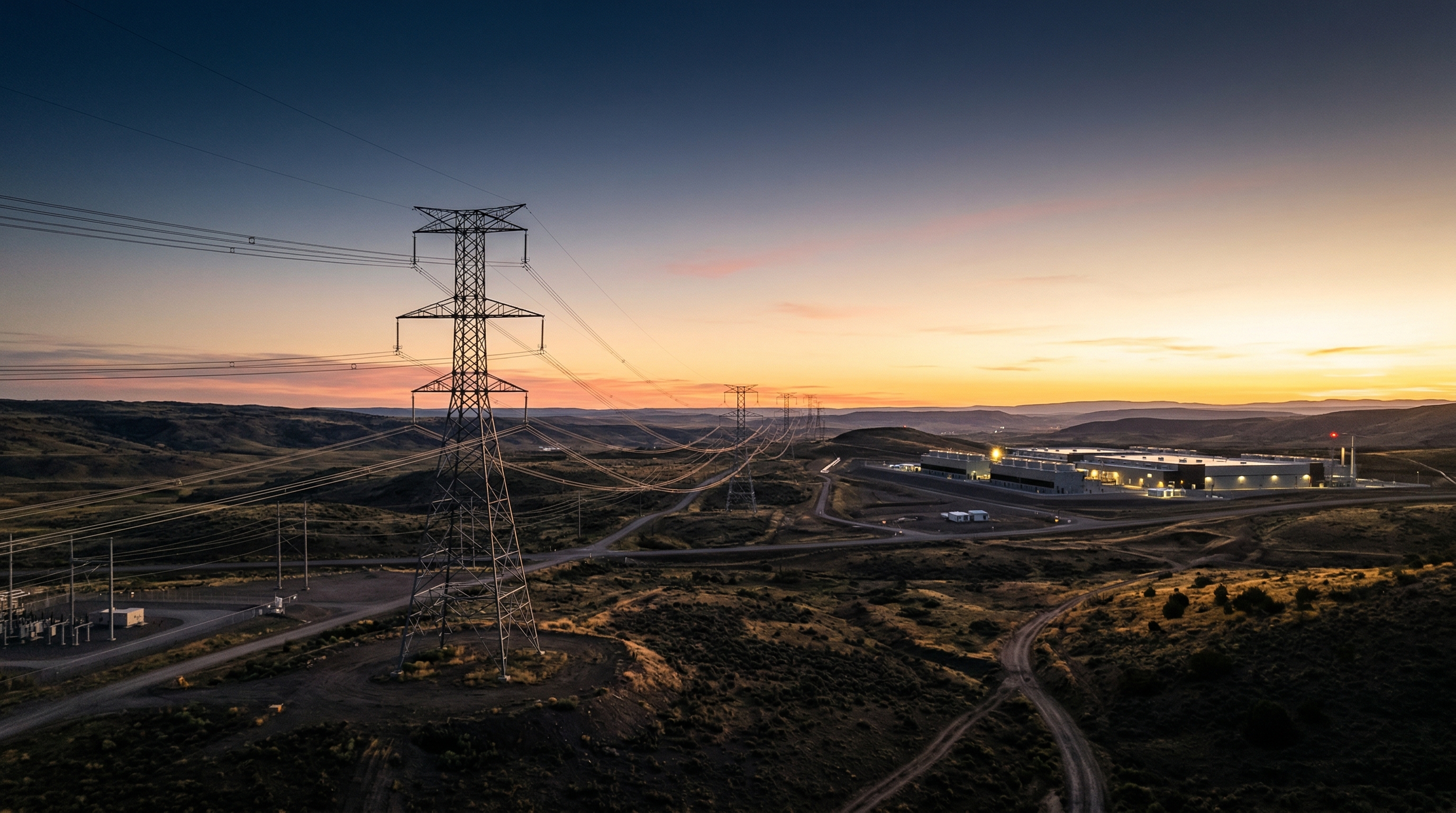
50 GW of Data Centers Are Rewriting Grid Procurement
Data center demand is forcing utilities into a procurement race against multi-year transformer lead times, aging fleets, and a persistent supply shortfall.
More than 50 GW of data center capacity was operating in the U.S. at the end of 2025. That number, from FERC’s 2025 State of the Markets report released in March 2026, represents 24% compound annual growth since 2020. It means data center grid infrastructure demand has moved from a niche planning input to the single largest force driving utility capital budgets, equipment orders, and regulatory fights across the country.
This post connects the dots that our individual coverage has examined in pieces: the demand data, the policy response, the infrastructure stress, and the procurement squeeze that ties them all together.
Data Center Power Demand Keeps Getting Revised Up
The EIA’s April 2026 Short-Term Energy Outlook projects U.S. electricity consumption will set records in three consecutive years. 4,195 billion kWh in 2025. Then 4,244 billion kWh in 2026. Then 4,381 billion kWh in 2027 (EIA STEO, April 2026).
That 2027 figure is roughly 3% year-over-year growth. The last time power demand rose four years running was 2007.
The revision that matters most: EIA bumped its commercial sector growth forecast from 2% to 5%, and cited data centers by name as the reason (EIA STEO, April 2026). That is not an inference or a hedge. It is the federal government’s energy agency saying data centers are rewriting the demand curve.
BloombergNEF projects U.S. data center power demand reaching 106 GW by 2035 (BloombergNEF, September 2025). Grid Strategies’ 2025 National Load Growth Report ties roughly 90 GW of 166 GW in forecast peak load growth to data centers, making them the dominant driver for the third straight year (Grid Strategies, December 2025).
Even the skeptics confirm the signal. Grid Strategies published a review of NERC’s 2025 Long-Term Reliability Assessment in March 2026, arguing that NERC’s 90 GW data center forecast through 2030 is likely overstated. Their estimate: closer to 65 GW, after adjusting for double-counting, interconnection delays, and supply chain constraints (Grid Strategies, March 2026). The gap between 65 GW and 90 GW is real. But 65 GW of new data center load still requires thousands of transformers, hundreds of substations, and billions in grid spending.
Average Facility Size Tripled in Five Years
The demand story is not just about more data centers. It is about bigger ones.
Average data center size grew from 25 MW in 2020 to nearly 80 MW for facilities coming online in 2025, per the FERC report. A 3.2x increase in five years. An 80 MW campus requires 3-5x the switchgear, transformers, and medium-voltage distribution gear of a 25 MW facility.
And rack-level power density keeps climbing. Nvidia’s GB200 pushed rack density to roughly 132 kW. The next-generation VR200 is projected at 240 kW per rack. A single training cluster can produce eight power swings of 60 MW within one minute, according to TerraFlow Energy, creating load variability that existing distribution equipment was never rated to handle (Utility Dive / TerraFlow Energy, February 2026).
That variability accelerates transformer aging through thermal cycling, shortens service lives, and increases replacement frequency. It is a second-order demand driver that most procurement plans still do not account for.
29 States Responded with New Tariffs in a Single Year
The regulatory response has been fast. FERC’s large load interconnection rulemaking is the federal piece, but the state-level action is where the volume is.
According to the SEPA DELTa database, 29 large load tariffs were approved by state regulators in 2025 alone, compared to just 14 total from 2018 through 2024 (Utility Dive / SEPA DELTa, March 2026). As of March 31, 2026, 77 large load tariffs are pending or in place across 36 states.
The pattern across these tariffs is converging on a few shared features:
- 15-year minimum contract terms, up from the 3-year terms that were standard in prior generations. More than a dozen tariffs include this requirement.
- Take-or-pay provisions in roughly one-third of tariffs, requiring minimum payments whether or not the customer stays operational.
- Collateral and credit protections in more than half, filtering out speculative interconnection requests.
DTE Electric in Michigan filed a 19-year primary supply agreement for a 1.4 GW Oracle data center. A single campus at 1.4 GW needs transformer and switchgear procurement comparable to building a mid-size utility from scratch (Utility Dive / SEPA DELTa, March 2026).
For procurement teams, each approved tariff with a 15-year term and take-or-pay provisions represents a locked-in equipment demand pipeline. These contracts guarantee that the substations, transformers, and protection systems will get built regardless of economic cycles.
FERC Docket RM26-4 Has an April 30 Deadline
At the federal level, DOE Secretary Chris Wright invoked Section 403 of the DOE Organization Act in October 2025, directing FERC to create standardized rules for how loads greater than 20 MW connect to the transmission system. It was only the third time the agency has used that authority (DOE Section 403 Directive, October 2025).
FERC established Docket RM26-4-000 and faces an April 30, 2026 deadline for final action.
The 14 guiding principles in the DOE directive include two that directly reshape procurement:
Loads bear 100% of network upgrade costs. Data center developers, not ratepayers, fund the transmission equipment needed for their interconnection. This creates a directly funded procurement pipeline backed by hyperscaler balance sheets.
Option-to-build for load customers. Data center developers gain the right to build their own transmission facilities, the same right generators have. This opens a new customer segment for equipment distributors: hyperscalers buying transmission-grade transformers, switchgear, and protection systems directly, outside traditional utility procurement channels.
Legal analysts expect FERC may issue a Notice of Proposed Rulemaking by April 30 rather than a final rule, extending the full timeline into late 2026 or 2027. But even interim guidance shapes utility planning and equipment ordering decisions.
Grid Capacity Was Already Strained Before Data Centers Showed Up
None of this data center grid infrastructure demand is landing on fresh equipment.
The ASCE downgraded U.S. energy infrastructure from C- to D+ in its 2025 Report Card, the sharpest category decline in the entire report (ASCE, April 2025). That grade means “infrastructure in fair to poor condition, mostly below standard, with many elements approaching the end of their service life.”
The numbers behind the grade:
70% of power transformers are over 25 years old. 60% of circuit breakers are past 30 years. 55% of in-service distribution transformers are over 33 years old (ASCE 2025 Report Card; POWER Magazine, January 2026).
The interconnection queue tells the same story from the other direction. 2,600 GW of generation and storage capacity was sitting in queues as of end-2023, more than twice the entire U.S. installed generating capacity. The average study process now takes 35 months. Full timeline from request to operational facility has grown from under 2 years to over 4 years (LBNL Queued Up 2025 Edition; ASCE 2025 Report Card).
LBNL’s 2025 data shows some moderation: active queue volume dropped 12% from the 2.6 TW peak, driven by high withdrawal rates. But natural gas capacity in the queue surged 72% year-over-year, a direct response to data center baseload requirements (LBNL Queued Up 2025 Edition).
Ohio Is the Test Case
Ohio puts every one of these forces in a single state.
A $33 billion data center campus in Pike County needs 10 GW of new generation. A $1.1 billion joint venture between FirstEnergy and AEP’s Transource Energy is building 300+ miles of 765-kV transmission and multiple substation upgrades in central Ohio (Utility Dive, March 2026). The Ohio Consumers’ Counsel is fighting the project’s 10.8% return on equity at FERC, arguing that 60% of costs fall on Ohio ratepayers while data centers are the primary beneficiary.
Ohio electric demand is growing at 10 times its historic rate. AEP’s served load could nearly double within five years (Renewable Energy World, March 2026). PJM approved an $11.8 billion total RTEP transmission expansion for 2025, with the Grid Growth Ohio project as one component.
The regulatory outcomes in Ohio, on cost allocation, on ROE incentives, on who controls procurement, will set precedent for Virginia, Texas, Georgia, and every other state competing for data center investment.
The Equipment Math Does Not Work
Here is where every thread of data center grid infrastructure demand converges into a single procurement problem.
Demand is accelerating. EIA projects record consumption through 2027. Data centers are the primary driver, with commercial sector growth revised from 2% to 5%.
Supply remains constrained. Power transformer demand has risen 119% since 2019. Prices are up 77-95%. Lead times sit at 128 weeks for power transformers and 144 weeks for generator step-up units. The power transformer supply shortfall is running at 30% (POWER Magazine, January 2026).
The existing fleet is aging out. 55% of distribution transformers are over 33 years old. Replacement demand is compounding on top of new-build demand. Utilities spent $7.5 billion on distribution transformers in 2023, a 23% increase from 2022 (ASCE 2025 Report Card).
Policy is locking in long-term commitments. 15-year tariff terms and take-or-pay provisions mean utilities cannot defer equipment orders. The FERC rulemaking will formalize cost allocation rules that trigger billions more in transmission procurement. Legislation like the REWIRE Act would accelerate transmission reconductoring projects, adding to the procurement queue.
The triple squeeze we outlined last week, where record demand, tariffs, and storm damage all hit at once, is not a temporary convergence. Data center load growth is structural. The aging fleet is structural. The supply shortfall is structural.
Manufacturers know this. Hitachi Energy, Siemens Energy, and Eaton have committed nearly $2 billion in manufacturing expansion since 2023 (POWER Magazine, January 2026). But new factory capacity takes 2-3 years to come online, and the demand curve is not waiting.
What This Means for Procurement Teams
Procurement managers feeling the effects of data center grid infrastructure demand, whether directly or through a connected territory, need to recalibrate timelines. The standard playbook of ordering equipment when a project reaches a certain stage does not work when lead times exceed two years and the queue has 2,600 GW in it.
Three things matter right now:
Track the tariff map. Each of the 77 large load tariffs in the SEPA DELTa database represents a committed equipment pipeline. MISO territory is seeing the fastest growth at 43% CAGR since 2020 (FERC 2025 State of the Markets). Know which tariffs are approved in your service territory and what MW commitments they represent.
Watch FERC Docket RM26-4. The April 30 deadline may produce a NOPR rather than a final rule, but the direction is clear: loads bear costs, and load customers gain option-to-build rights. That means new procurement decision-makers entering the market.
Assess your transformer fleet age. With 55% of distribution units past 33 years and 70% of power transformers past 25 years, replacement needs are already in motion. Data center load growth is not creating this problem. It is making it impossible to defer.
DistroForge reports cover this topic in depth, with manufacturer capacity analysis, regional lead time tracking, tariff-by-tariff equipment demand estimates, and procurement strategy recommendations for the affected equipment segments. See the report catalog, or subscribe to The Feeder for the free monthly read.
Track this beat without paying per report
Free Member tier. Pick your topics. Get a weekly digest filtered to what you actually buy.