DOE Transmission Loans: The $3.26B AEP Texas Close
The DOE transmission loan to AEP Texas covers up to 80% of project costs at sub-market rates. What federal financing means for equipment buyers through 2028.
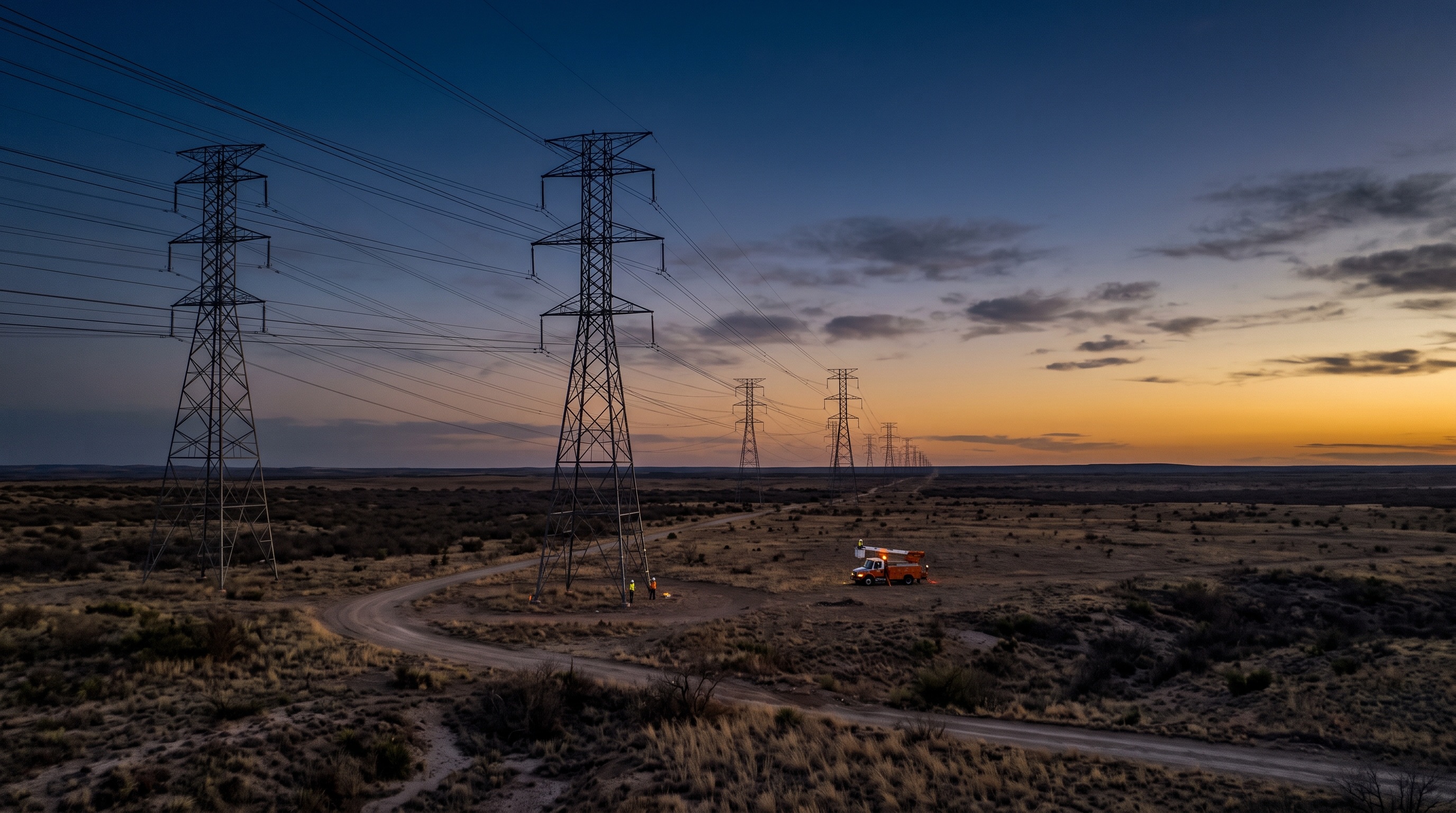
On July 8, the Department of Energy closed a loan of up to $3.26 billion to AEP Texas. It is the third utility financing completed through DOE’s Office of Energy Dominance Financing, and the largest DOE transmission loan aimed squarely at the wires themselves: roughly 100 projects covering about 2,800 miles of new construction, rebuilds, and reconductoring across a 100,000-square-mile stretch of south and west Texas. DOE and AEP both put the customer savings at about $685 million over 30 years for more than a million Texans.
The headline is the dollar figure. The story underneath it is that the federal government is now a structural source of cheap capital for the transmission buildout, and that changes who can buy equipment, how fast, and at what cost of money.
What $3.26 billion buys in south and west Texas
AEP Texas holds letters of agreement supporting up to 41 GW of potential new load through 2030, driven by data centers, advanced manufacturing, and Permian Basin oil and gas electrification. The backdrop is extreme even by Texas standards. ERCOT is staring at roughly 368 GW of demand requests by 2032 against an all-time peak of 86 GW. Nobody expects all of that to materialize. Even a fraction of it outruns the existing wires.
The loan’s structure matters more than its size. Only 8 DOE-approved anchor projects are finalized today. The remaining 92 or so are still pending federal review, which means the material orders release in waves as DOE signs off, not as one demand shock. Expect a rolling cadence of RFQs and purchase orders through 2026 and 2027. For suppliers and distributors, the anchor-project awards are the tell. Whichever conductor, structure, and hardware manufacturers land those first 8 will be holding factory allocation everyone else wants.
Energy Dominance Financing is the program to watch
The Office of Energy Dominance Financing is the current administration’s rebrand of the Loan Programs Office’s Energy Infrastructure Reinvestment program, restructured under the One Big Beautiful Bill Act with the emissions requirements stripped out. The terms are the point: a DOE transmission loan under this program can cover up to 80 percent of eligible project costs at sub-commercial interest rates.
AEP Texas is not an isolated case. AEP’s parent company took a $1.6 billion loan guarantee in October 2025 for transmission work across Indiana, Michigan, Ohio, Oklahoma, and West Virginia. Southern Company closed a $26.5 billion facility in February 2026 spanning gas, storage, and transmission. DTE Gas closed $1.6 billion in June. At the same time, DOE is de-obligating $29.9 billion and revising another $53.6 billion in Biden-era loan commitments. Read those two motions together: the office is unwinding the old book while actively writing new utility paper. Federally subsidized transmission capital survived the administration change. It is a durable feature of the 2026 through 2028 market, not a holdover.
That has a direct bearing on how much equipment gets bought. A utility financing 80 percent of a program at sub-market rates faces a very different go/no-go math than one funding the same miles on its own balance sheet. Cheap debt converts marginal projects into funded ones, and funded projects into conductor, structures, breakers, and transformer orders.
The advanced conductor signal inside the loan
DOE states the program will double the power-carrying capacity of upgraded lines. In practice that phrase points at one thing: reconductoring existing rights-of-way with advanced conductors, the high-temperature low-sag and composite-core designs that carry roughly twice the current of conventional ACSR on the same towers. AEP has not published its conductor spec yet, and no suppliers are named. Watch that disclosure.
The reconductoring lane was already getting crowded before this close. The REWIRE Act would fast-track exactly this class of upgrade with a NEPA categorical exclusion, and utilities were fighting over composite versus steel conductor economics well before a federal loan program started underwriting the work at scale. Advanced conductor is a thin manufacturing base. A 2,800-mile program drawing on it, layered on nationwide grid-hardening and data-center transmission work, tightens a segment that was never loose.
What this means if you are not AEP
Most of our readers do not compete with AEP Texas for anything directly. The effects arrive anyway, through two channels.
The first is upstream. Transmission programs at this scale pull on the same aluminum, electrical steel, insulator, hardware, and skilled-labor base that distribution-class projects draw from. The American Society of Civil Engineers graded US energy infrastructure D+ in 2025 and put the investment gap at $578 billion by 2033, with 70 percent of power transformers already past 25 years in service. Every federally accelerated transmission program adds demand to that ledger without adding near-term supply. Lead times stretch system-wide, including for buyers who never touch a 345 kV line. That is the same dynamic we traced in the $1.4 trillion utility capex wave.
The second is the cost-of-capital gap. Investor-owned utilities are now stacking federal debt at sub-market rates against 80 percent of project cost. Municipal utilities and cooperatives finance at whatever the market gives them. When both groups chase the same constrained factory slots, the buyer with the cheaper money can order earlier, hold inventory longer, and absorb escalation that would stall a public-power board. Public power has tools of its own, including tax-exempt issuance and joint-action agencies, but the spread just widened. Co-op and muni procurement teams should treat IOU mega-programs like this one as a schedule input: your equipment queue position now depends partly on when the next DOE transmission loan approvals land, starting with the 92 AEP Texas projects still in review.
Three moves follow from the structure of the thing. Track the anchor-project awards, because they telegraph supplier allocation for 2027. Put order placement ahead of design freeze on anything sharing a supply base with conductor and transmission hardware. And if a reconductoring or hardening project of your own has been sitting in the maybe pile, note that the financing environment for wires work is the best it has been in years, and the equipment market is the tightest.
Related Reading
- The REWIRE Act Would Fast-Track Transmission Upgrades. Here’s What That Means for Equipment Demand.
- Steel or Composite? The Transmission Conductor Debate Is Missing the Right Cost Metric
- SPP Western Interconnection Expansion: The Procurement Read
Federal financing closes, interconnection rule changes, and equipment lead-time signals move fast. The Feeder is our free monthly brief that puts the month’s procurement-relevant grid news in one place, written for the people who buy the equipment. Subscribe at distroforge.com/feeder.
Track this beat without paying per report
Free Member tier. Pick your topics. Get a weekly digest filtered to what you actually buy.