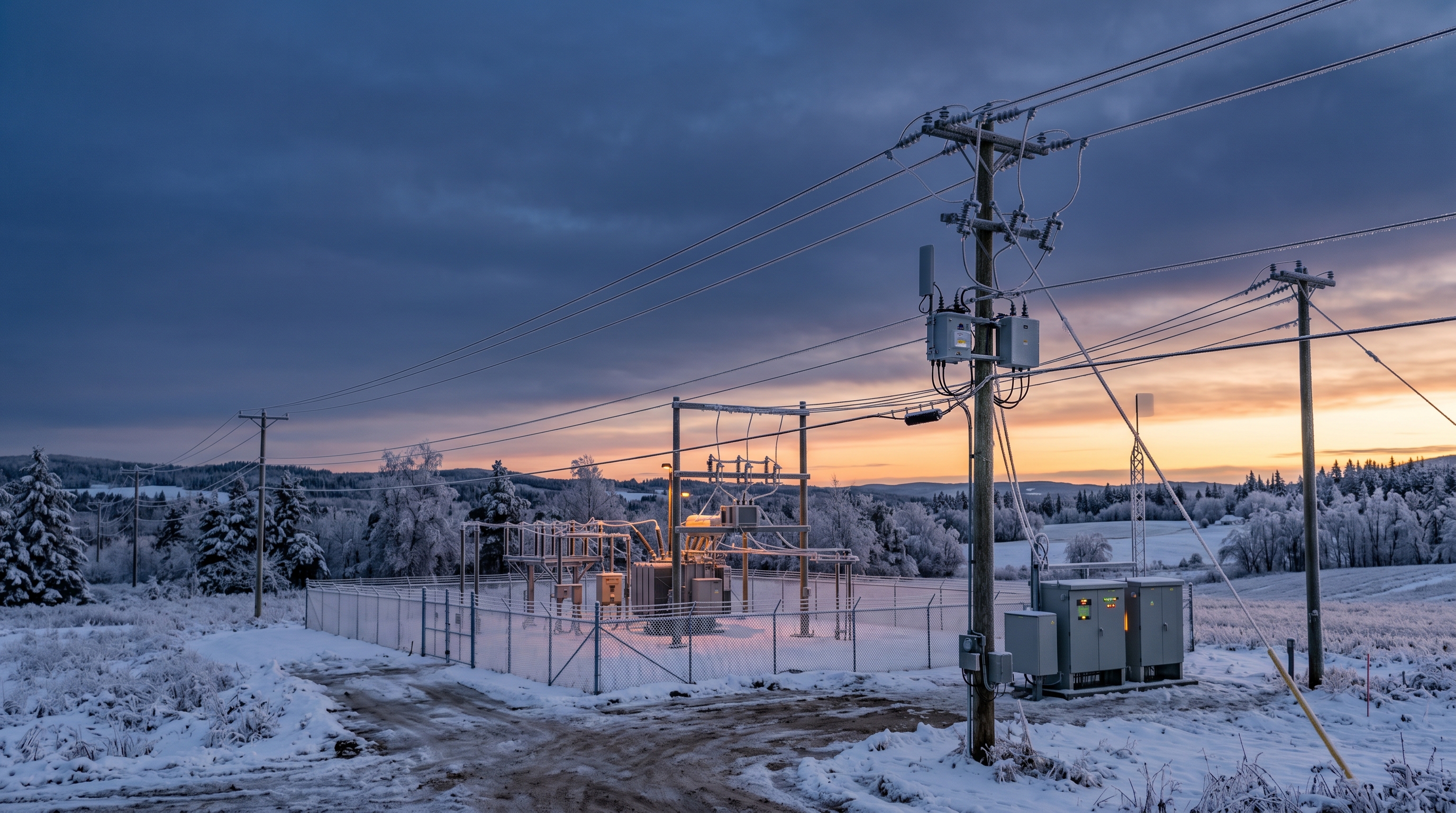
Grid Resilience Monitoring Investment After Storm Fern
Winter Storm Fern destroyed poles, transformers, and substations across 34 states. Here is why grid resilience monitoring investment is the procurement story that follows the rebuild.
Winter Storm Fern broke the distribution grid in January, not the generation fleet. Across 34 states, the failures that left two million customers in the dark were poles, wires, transformers, and substations. Rebuild costs ran past $4 billion. The quieter procurement story is what utilities buy so the next storm costs less, and that story is a grid resilience monitoring investment cycle now moving from regulator filings into purchase orders.
Two utilities tell the whole story. Entergy Louisiana lost more than 700 poles, 2,300 wire spans, 170 transformers, and took 60 substations out of service. Nashville Electric Service broke more than 800 poles and dropped 230,000 customers. Replacement demand for those categories is immediate, and it lands in a market already short on transformers and poles. We covered the hardware crunch in the pole and conductor procurement crunch and the padmount transformer shortage. This piece is about the layer above the steel.
Why monitoring spending follows the damage
Restoration speed decided which utilities took political heat after Fern. Crews with pre-staged inventory and good situational data restored service in four to five days. The ones without it took nine to ten. That gap is the entire argument for monitoring spend, because regulators noticed it and ratepayers felt it. A pole costs the same everywhere. Knowing which pole failed, in real time, before a truck rolls, is the difference utilities are now paying to close.
The money behind this is not small. Global grid spending rose from $300 billion in 2020 to $480 billion in 2025, with cumulative investment projected near $5.8 trillion through 2035 (J.P. Morgan, January 2026). In the U.S., roughly 63 percent of that flows to distribution. Digital grid technology, the sensors and software that sit on top of the wires, is projected to draw about $700 billion of the total. Utilities are spending close to 10 percent of revenue on modernization. The damage from one storm did not create that trend. It accelerated the part of it that procurement teams can act on this budget cycle.
Smart grid sensors utilities buy first
Here is the data point that reframes the whole category. More than 80 percent of grid events are line disturbances, short transient faults that precede the failures customers actually see (Hubbell/Aclara, 2025). Most utilities cannot see them. Medium voltage line sensors change that. The current generation operates inductively in currents as low as three amps and runs battery-free, which removes the maintenance objection that stalled earlier deployments.
Sensors are the cheapest hardware in the rebuild and the fastest to pay back. A utility that maps disturbance patterns on a feeder can stage inventory, pre-position crews, and pull failing equipment before a cold snap turns a hairline fault into a multi-day outage. After Fern, the smart grid sensors utilities reach for first are fault indicators, medium voltage line monitors, and power quality meters at the substation. The procurement signal is volume, not novelty. These are catalog parts now, and the question is fleet coverage rather than pilot approval.
ADMS and DERMS deployment is the coordination layer
Sensors without a brain are just more data. The coordination layer is where the larger dollars sit. The advanced distribution management system market runs from $3.52 billion in 2025 to a projected $7.41 billion by 2030, a 16 percent annual rate (GlobeNewswire, May 2025). Distributed energy resource management software grows from $780 million to $2.76 billion by 2033 (Grand View Research). EV charging load management is the fastest-growing slice inside that.
The procurement trap with ADMS and DERMS deployment is treating it as a software buy. It is not. Every software seat pulls physical equipment behind it: remote terminal units, intelligent electronic devices, communications backhaul, and the modern protection relays the platform actually commands. A utility that signs an ADMS contract without budgeting the field hardware to feed it ends up with a control room that cannot see or touch half its system. The coordination layer sets the equipment specification for everything downstream.
Distribution automation investment is now a line item
National Grid reported that its fault location, isolation, and service restoration systems prevented more than 80,000 customer interruptions in 2025. That is the number that moves distribution automation investment out of the pilot budget and into the standing capital plan. FLISR runs on intelligent reclosers, automated switches, and sectionalizers that talk to each other and to the control center. The Fern restoration-speed gap is exactly the problem these systems solve, and post-storm commissions across the Southeast are writing them into mandated hardening plans.
This same automation push shows up on the West Coast for a different reason. Wildfire liability is forcing utilities to buy reclosers that support remote disable and relays with remotely settable thresholds. We mapped that demand in the Western distribution hardening super-cycle. Different driver, same bill of materials. The reliability case from Fern and the wildfire case from California converge on the same shopping list, which is why these categories are tightening faster than buyers expect.
What it means for procurement teams
Three things are true at once after Fern. Replacement steel competes for constrained transformer and pole supply. The monitoring layer that prevents the next failure is a separate, sustained spend that does not end when the lights come back on. And the equipment that earns regulatory cost recovery is increasingly the gear that can prove it prevented an outage, not just restored one.
Dynamic line rating sensors are the adjacent category most buyers underestimate, and FERC Order 881 is already pulling them into RTO compliance timelines. We broke down that procurement path in the FERC Order 881 analysis.
The harder questions, which vendors hold which voltage classes, where lead times are stretching across the monitoring stack, and how per-customer modernization spend compares across peer utilities, are exactly the detail a distribution buyer needs before committing a budget. That sits in our research, not in a free post.
Related reading
- The Pole and Conductor Procurement Crunch
- Padmount Transformer Procurement Crisis
- Western Distribution Hardening Super-Cycle
The free weekly Feeder tracks lead times, supplier capacity, and the regulatory shifts that reset procurement timelines, written for the people who actually place the orders. Subscribe to The Feeder and read the next storm before it files a rate case.
Know what changed before your next quote
Free Member tier. Pick your topics. Get a weekly digest filtered to what you actually buy.