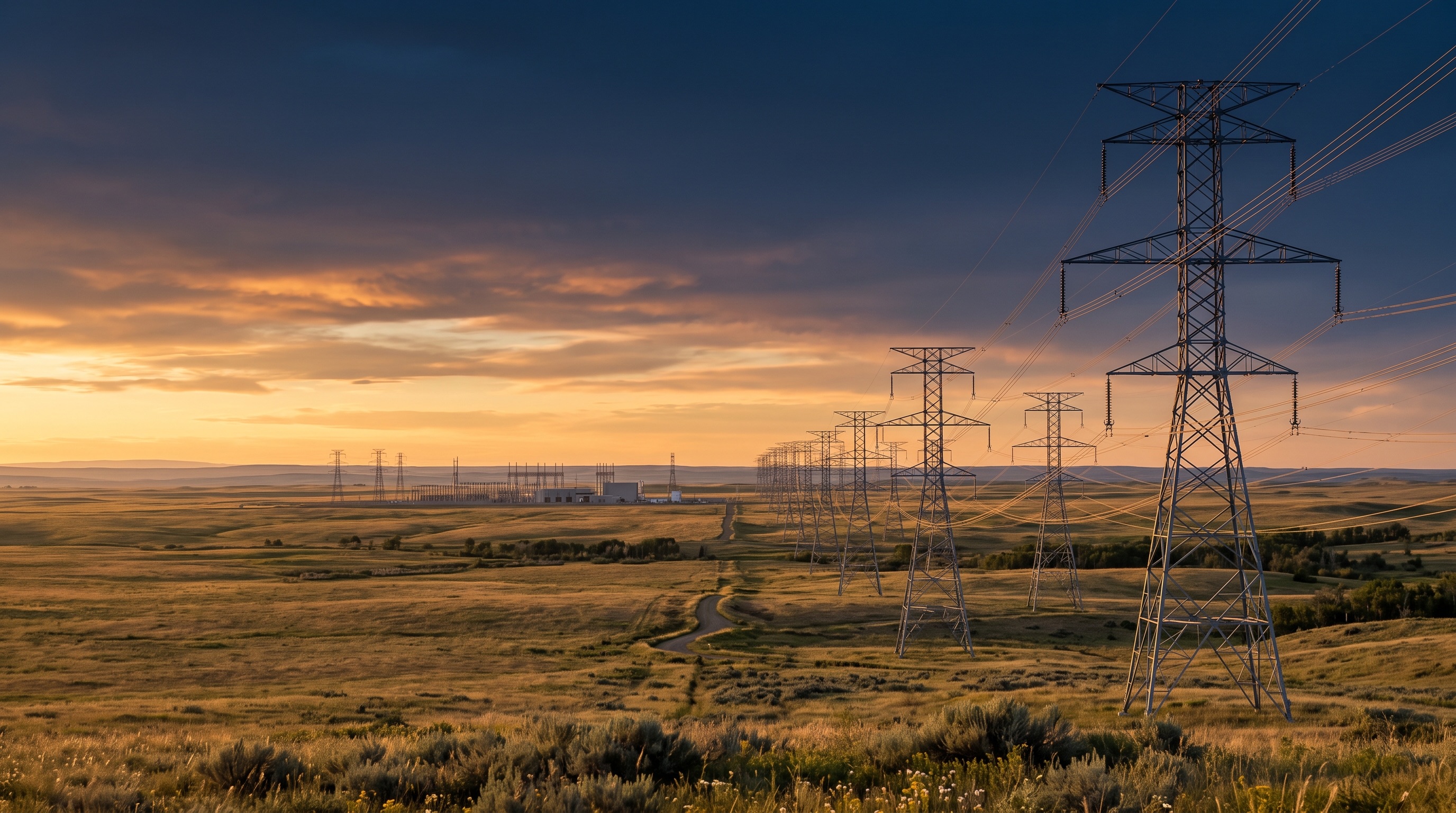
Interregional Transmission Just Had Its Proof Week
In one July week, interregional transmission got its federal case, a nearly subscribed three-market HVDC flagship, and an operational stress test. Here is what utility equipment buyers should take from it.
For two decades, interregional transmission has been the grid’s perpetual white paper: everyone agrees the country needs more ties between its power markets, and almost nobody builds them. Roughly 150 miles a year get constructed, against a system of more than 526,000 miles. Then came the second week of July 2026, when the case stopped being theoretical. Within about four days, the buildout picked up a federal price tag, a flagship project close to fully subscribed, and a live stress test that showed exactly where the grid now fails.
Signals rarely stack like this. Each one is worth a read on its own. Together they mark the point where interregional transmission moved from planning-conference material to a procurement pipeline with dates on it.
The federal case: DOE’s draft Needs Study puts congestion at $12 billion
On July 9, DOE’s Office of Electricity published the draft 2026 National Transmission Needs Study, the triennial assessment required under the Federal Power Act. The headline: grid congestion added about $12 billion to wholesale power costs in 2024, and cross-market transfer capacity is the highest-value fix. Berkeley Lab analysis in the draft puts average price differentials at ERCOT’s borders at $31 to $48 per MWh, and the median value of a cross-interconnection link at roughly $35 per MWh, more than double the value of links inside a single market.
Two findings matter more for buyers than the congestion math. First, the voltage mix. Of the 85,000 circuit-miles of new, upgraded, or rebuilt lines energized since 2016, 66 percent were 69 kV or 138 kV sub-transmission. Only 4 percent were 500 kV or above. The transmission boom, as actually built, is substantially the voltage class that municipal utilities, G&Ts, and their distributors buy for: ACSR conductor, 69 and 138 kV breakers, disconnect switches, steel poles, and substation transformers. Reliability and aging infrastructure drove nearly 60 percent of it, which makes the demand replacement-cycle and compliance driven rather than policy exposed.
Second, the air pocket. Energizations collapsed to roughly 3,600 circuit-miles in 2024, down from a run rate of 8,700 to 12,500 miles a year, at the exact moment the largest approved portfolios in history stack up behind the lull: MISO’s $21.8 billion Tranche 2.1, SPP’s $7.7 billion 2024 plan, and Texas’s $33 billion Permian 765 kV program. That is a coiled spring. When those portfolios hit construction in 2027 through 2030, the buyers who waited will meet the worst of the large-transformer and breaker queues at once. Comments on the draft are due September 7, and the docket will show which corridors get pushed hardest.
The flagship: North Plains Connector is 85 percent subscribed
The same week, T&D World picked up Minnkota Power Cooperative’s agreement for 150 MW of capacity on the North Plains Connector, making it the eighth member of the project’s utility consortium. At 420 miles, 525 kV, and 3,000 MW bidirectional, the HVDC line runs from Colstrip, Montana to two converter points in central North Dakota. It would be the first US transmission project to directly connect three markets: MISO, SPP, and the Western Interconnection.
The subscription math is the story. With Puget Sound Energy at 750 MW, Portland General Electric at 600 MW, and Avista, NorthWestern, BHE’s transmission arm, MDU Resources, and now Minnkota filling in behind them, roughly 2,550 of the line’s 3,000 MW is spoken for. When co-ops, investor-owned utilities, and a Berkshire subsidiary all option capacity on the same merchant line, backed by a $700 million DOE grant, the project has crossed from speculative to probable. Permitting decisions are expected late this year, EPC selection is underway, construction is slated for 2028, and service for 2032.
The procurement signal sits underneath the announcement. Hitachi Energy already holds an expanded engineering services agreement covering both converter stations, the stage where HVDC suppliers lock manufacturing slots years before formal awards. Only three vendors can realistically deliver a converter station of this class in the US, and converter transformers are among the longest-lead equipment made anywhere. A 2028 construction start implies converter and transformer orders land in the 2026 to 2027 window, pulled from the same constrained large-power-transformer pool every utility buyer already competes in. We saw the same slot-competition dynamic in the SPP Western Interconnection expansion, and the federal financing channel behind projects like this one in DOE’s transmission loan window.
The stress test: a record 100,996 GWh week, and 1.3 million outages anyway
Then the grid ran the experiment live. EEI’s Weekly Electric Output report for June 28 through July 4 came in at 100,996 GWh, the first week above 100,000 in history, beating a record that had stood since 2022. PJM broke its all-time peak on July 2 at 168,158 MW, a mark that had held for twenty years. The bulk system passed, but it needed everything: about 6,100 MW of demand response, two DOE Section 202(c) emergency orders authorizing curtailment of large loads to backup generation, and environmental waivers to dispatch another 3.25 GW.
Here is the part buyers should not miss. While generation held, roughly 1.3 million customers lost power anyway. The failures were poles, conductor, trees, and at least one substation component, distribution infrastructure on the storm-swept edge of the heat dome. DTE alone saw about 400,000 outages with restorations stretching to five days. Generation adequacy and delivery capacity are now two different problems, and the outages live almost entirely in the second one. EEI paired its record announcement with a projection of $239 billion in grid investment in 2026 and $1.4 trillion through 2030, a wave we sized in the $1.4 trillion equipment read. The record week is the operational argument for both halves of that spend: transfer capacity between markets, and hardening inside them. In the near term it also means depleted storm stock across several major utilities, reordered into the same tight categories tracked in the 2027 pole and conductor crunch.
The fork: connect-and-manage and the August 17 clock
The fourth signal decides the sequencing. GridLab’s “Texas Flex” report, published July 8, makes the fullest argument yet for exporting ERCOT’s connect-and-manage interconnection model nationally: connect resources first, manage congestion with dispatch, and build the wires behind them. ERCOT added 14 GW of generation in 2024 and 14.7 GW in 2025 on interconnection timelines of about 20 to 22 months, against processes elsewhere that can run past eight years. The report lands squarely in the middle of FERC’s June show-cause orders to all six RTOs, whose responses come due around August 17. We broke down that proceeding in FERC’s large-load show-cause order.
If two or three RTOs adopt connect-and-manage variants for large loads, the equipment order flips: load-serving substation packages, breakers, and protection-and-control gear get bought first, and the backbone transmission follows later. Texas’s own experience says the wires still come, ERCOT paired the model with CREZ and now the Permian 765 kV program, but the sequencing changes who is in the queue for which equipment class in which year.
What it means for utility procurement
Strip the week down and the reads are concrete. The sub-transmission finding in the DOE draft confirms that the biggest steady demand pool is 69 and 138 kV equipment flowing through incumbent utility channels, budgeted and reliability driven. Meanwhile the 2024 construction air pocket in front of record approved portfolios argues for ordering ahead of the 2027 to 2030 construction wave rather than into it. North Plains Connector says merchant HVDC is now real enough to absorb converter-transformer and EHV slots from the shared OEM pool, with late-2026 permitting decisions and the EPC award as the tripwires that convert it to firm orders. And the August 17 FERC filings will show whether interconnection equipment jumps ahead of backbone builds across most of the country.
Three dates carry the next round of interregional transmission signal: September 7 for comments on the DOE draft, roughly August 17 for the RTO show-cause responses, and late 2026 for North Plains Connector’s permits. We will be reading all three dockets.
The monthly read on which equipment classes tighten first, where supplier capacity is moving, and what the federal money means for buyers goes out in The Feeder. It is free, once a month, no noise. Join at distroforge.com/feeder.
Related reading
- DOE’s Transmission Loan Window: Federal Financing Meets the Super-Cycle
- FERC Orders All Six RTOs to Justify or Rewrite Large-Load Tariffs
- SPP’s Western Expansion: A 765-kV Overlay Across Seventeen States
Free RFQ templates. Weekly digest. Yours.
Free Member tier. Pick your topics. Get a weekly digest filtered to what you actually buy.