Modular Substations: The Data Center Lead-Time Lever
Modular substation packages cut data center interconnection schedules 30 to 50 percent, yet the transformer stays a 52 to 80 week gate. How co-op and muni buyers should spec them.
The slowest thing between a data center and firm power is not the building. It is the substation that connects it, and the interconnection queue that substation has to clear. A modular substation is the one part of that timeline a municipal or cooperative utility can actually compress on its own, without waiting on a regional grid operator to redesign its process. Factory-built packages move the civil work, the wiring, and the testing off the job site and into a plant, and the schedule savings are real. The catch is real too, and any buyer who ignores it will still miss the date.
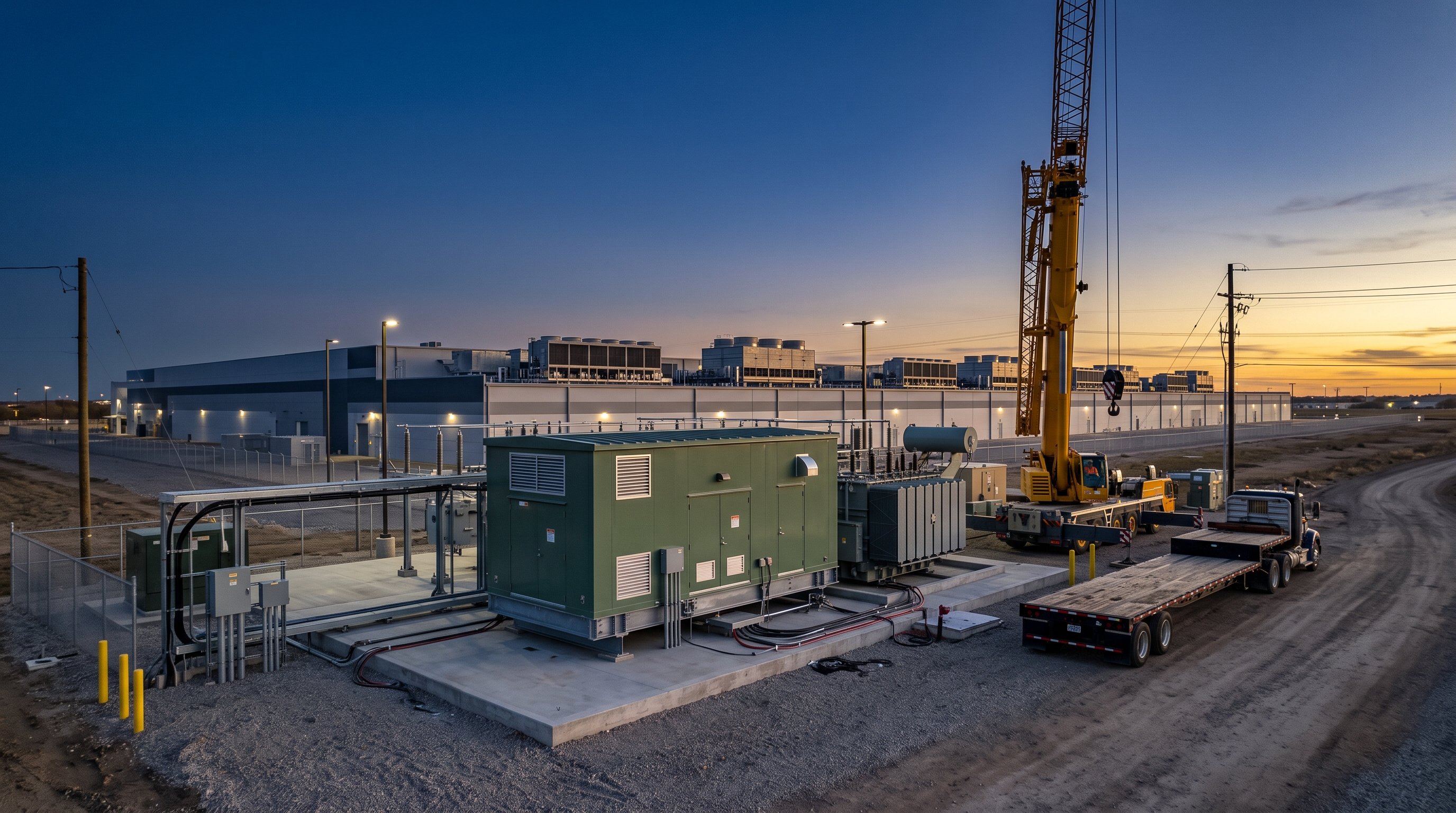
Start with what the thing is. A modular substation is a prefabricated, factory-integrated package: the switchgear, the step-down transformer, the protection relays, and the SCADA all assembled and tested inside a plant, then shipped to the pad ready to energize. The high-voltage version is usually called an E-House, a transportable enclosure that can hold gas-insulated switchgear from 35 kV up to 500 kV alongside a power transformer and its controls. A distribution-class version rides on a skid or a trailer. Eaton’s Modular Integrated Transportable Substation runs primary voltages up to 230 kV and ratings up to 50 MVA on a transformer skid, factory-wired and factory-tested before it ever leaves the building. Siemens, ABB, and Hitachi Energy all sell equivalent platforms, and integrators like Beta Engineering and catalog players like Federal Pacific build to the same idea.
What the schedule math actually buys
The reason this category exists is time. Building a substation the conventional way means pouring foundations, then landing equipment, then wiring point to point in the field, then testing it all outdoors on the utility’s schedule. Doing that work in parallel inside a factory, while the site prep happens at the same time, collapses the sequence. The published numbers are consistent across the vendor base. On-site schedules commonly drop 30 to 50 percent versus a stick-built yard, which in practice moves a 24 to 36 month build toward 16 to 20 months. Siemens states that parallel factory design and manufacture plus pre-testing can cut substation lead times up to 50 percent against a comparable civil build. ABB reports installation time down as much as 50 percent, point-to-point wiring cut up to 80 percent, and project cost lower by 10 to 15 percent, mostly on field labor.
That is a large enough swing to matter, and the market has noticed. The factory-built modular substation segment sat around 455 million dollars in 2025 and is tracked toward roughly 921 million by 2032. What pulls it is the same load story reshaping every distribution buy: campuses now land at 500 MW to 3 GW, with one project on the boards near 9 GW. When a single interconnection is the size of a city, the buyer cannot afford to have the substation on the critical path.
The gate the module does not open
Here is the part a skeptical procurement officer will respect. A modular package builds in weeks. The step-down transformer inside it does not. In North America that transformer is still a 52 to 80 week procurement item, and in Europe the wait runs 128 to 210 weeks. Wrapping a fast enclosure around a slow transformer does not make the transformer fast. If you place the equipment order at design freeze, the way one-off substation work has always been ordered, the enclosure will sit finished on a factory floor waiting for its transformer and you will have bought nothing but a nicer place to wait.
What the good integrators do is absorb that gate instead of pretending it is gone. They batch-order long-lead transformers against a forecast and hold pre-integrated inventory, so a buyer taking a standardized skid inherits a queue position that already started months ago rather than opening a custom order cold. The discipline for the buyer follows directly: place the transformer order at contract signing, not at design freeze. That is the same lead-time rule that governs a pad-mount transformer order and the same posture we lay out for evaluating transformer bids under long lead times. The module changes where the transformer sits in your schedule. It does not change how long the transformer takes.
Why the clock is this tight right now
The interconnection window is the reason this is urgent and not merely interesting. MISO’s Expedited Resource Adequacy Study is trying to compress fast-track projects to two or three year online timelines, and its spring 2026 queue already held about 28 GW across 68 projects chasing that pace. Meanwhile the same 2026 OMS-MISO survey has member utilities planning roughly 15 GW per year of new accredited capacity through 2031, with large-load interconnection requests rising faster than any historical norm. The definitional trigger for that data-center process is a 50 MW load at a single site. When the interconnection target is two to three years and the substation transformer alone can run longer than that, the substation is the piece most likely to blow the date. Anything that keeps it off the critical path is worth real money.
Turbine scarcity tightens the same screw from the supply side. With the big-three gas-turbine makers effectively sold out through 2029 and 2030, every large generation project is competing for the identical pool of factory slots, electrical steel, and step-up transformers that distribution buyers depend on. Section 232 metal tariffs sit on top of the whole stack through 2027. The pattern visible in turbines, multi-year backlogs and nonrefundable reservations, is the same pattern already showing up in distribution equipment. Turbine scarcity reads as a leading indicator for the interconnection and equipment crunch that a modular substation is meant to outrun.
The play for a smaller utility
The advantage a modular substation hands a co-op or a muni is standardization, and standardization is a purchasing tactic more than an engineering one. A regional distributor that gets several small utilities onto the same standard R10 transformer rating and a common medium-voltage skid can pool their orders into one batch large enough to reach the lead-time and allocation tiers otherwise reserved for hyperscale buyers. That is the exact move the large data-center developers use, run in reverse for the small-buyer side of the market. It also settles the switchgear question early, since an E-House pulls a gas-insulated package and its own SF6-free compliance path into the order from day one rather than as a later change.
None of this replaces the design decision. A modular package is a delivery-schedule lever, and it works best stacked on top of the footprint, topology, and standardized-block choices that already turn substation design into a procurement decision. The buyers holding firm energization dates are treating the two as one problem: pick the standard package, and place the transformer order the day the contract is signed.
The current edition, by equipment category
Modular substations solve the interconnection schedule, but the transformer inside one is still a 52 to 80 week order, and that is the number a co-op or muni buyer has to plan a purchase order against. The Monthly Market Tracker pulls the lead times, supplier capacity, and federal program activity for one equipment category into a single report, rebuilt every month from public data and checked before it ships. It runs $79 and downloads the moment you check out.
See the current Monthly Market Tracker
Related Reading
- Data Center Substation Design Is a Procurement Decision
- Pad-Mount Transformer Procurement: Why 2026 Budgets Are Already Broken
- How to Evaluate Transformer Bids When Lead Times Run Past Two Years
Know what changed before your next quote
Free Member tier. Pick your topics. Get a weekly digest filtered to what you actually buy.