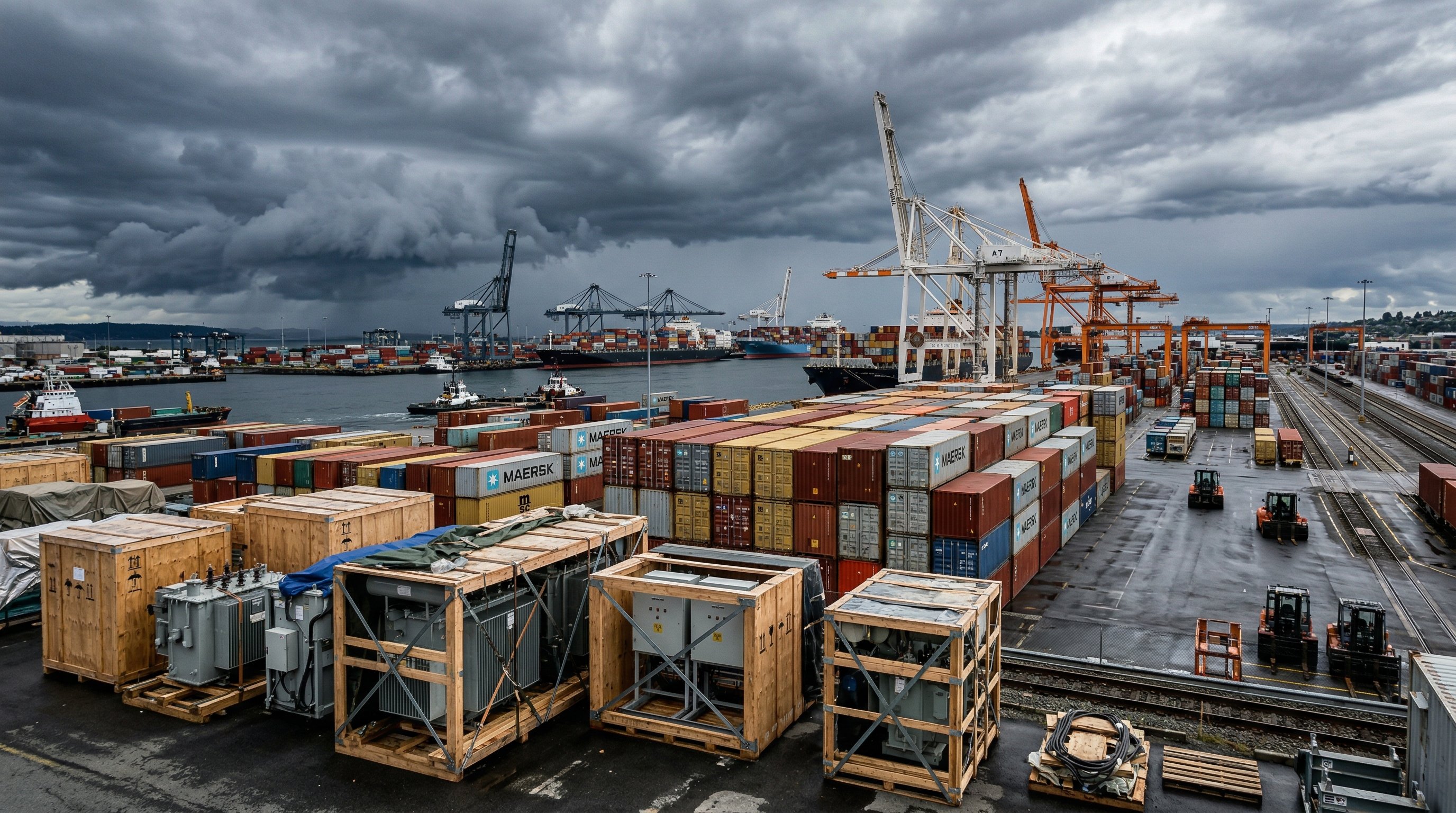
Section 232 Grid Equipment Tariffs: Who Actually Gets 15%
The reduced Section 232 rate reported as covering grid equipment reaches two transformer classifications and no switchgear. Distribution transformers and switchgear are at 25% on full customs value. The annex-by-annex read and the corrected cost math.
Corrected 2026-09-06. As first published on 2026-04-05 this post treated the reduced Annex III rate as covering grid equipment broadly, including distribution transformers and switchgear. That followed the trade coverage and it was wrong. The body below has been rewritten against the proclamation text and the annex code lists. What changed: Annex III is a reduction list reaching two whole-transformer classifications and no switchgear, the cost table has been recomputed at each product’s actual rate, and the buying advice that told readers to order switchgear inside a 15% window has been removed. Sources: Proclamation 11021 (Federal Register, April 9, 2026), Annex III, June 2026 and Annexes I-A through IV, April 2026.
On April 2, 2026, President Trump signed Proclamation 11021, replacing the flat 50% Section 232 metals tariff with a tiered structure effective 12:01 a.m. Eastern on April 6. Trade coverage led with a temporary 15% rate for “electrical grid equipment,” and that framing has been repeated in supplier quotes and board packets ever since.
It does not survive a read of the annexes. The reduced rate lives on a list called Annex III, and Annex III reaches two whole-transformer classifications. It contains no switchgear classification at all. A pad-mount distribution transformer, a low-voltage switchgear lineup and a reel of insulated power cable are all in Annex I-B at 25%, on the full customs value of the unit.
That is a ten-point difference on the invoice for the equipment classes utilities buy in volume, and it runs the opposite direction from what most buyers were told. It also inverts the planning advice: there is no closing window to beat on distribution gear, because there was never a reduced rate on it to lose.
Here is the annex-by-annex read, the corrected cost math by product, and what actually changes for a procurement plan.
The Four-Tier Structure: What Goes Where
The April 2 proclamation replaces the prior flat rate with four distinct annexes, each carrying its own tariff rate and product scope.
Annex I-A (50%): Primary metals. Articles made entirely or almost entirely of aluminum, steel, or copper. Think raw coils, sheet, plate, and bar stock. This is where grain-oriented electrical steel (GOES) sits, and it is the highest rate in the structure.
Annex I-B (25%): Metal-heavy derivatives. Products substantially composed of steel, aluminum, or copper but with other materials and manufacturing value added. Bus duct, cable tray, conduit fittings, and many electrical enclosures fall here.
Annex III (reduced, through December 31, 2027): a temporary reduction list, not a grid equipment tier. This is the tier the trade coverage got wrong, and it is worth being precise about both its scope and its rate.
On scope: the June 2026 re-issue of Annex III carries exactly two whole-transformer classifications, 8504.23.00 (liquid dielectric above 10,000 kVA) and 8504.34.00 (electrical transformers other than liquid dielectric, above 500 kVA). Its remaining 8504 entries are parts under 8504.90. It carries no 8535, 8536 or 8537 classification, which is to say no switchgear. The bulk of the list is heavy industrial machinery: dies, molds, rolling mills, machining centers. Qualifying goods enter under HTS headings 9903.82.07 through 9903.82.12 (GHY International, April 2026).
On rate: the annex itself never states 15%. Clause (5) of the proclamation sets the rate for listed products by reference to the product’s Column 1 duty rate. Where Column 1 is below 15%, the Column 1 duty and the Section 232 duty together come to 15%. Where Column 1 is already at or above 15%, the additional Section 232 duty is zero. The reduction runs to December 31, 2027, and clause (7) reverts those products to Annex I-B treatment on January 1, 2028.
Annex II: products removed from the duty. Clause (4) provides that articles on Annex II are no longer subject to the additional Section 232 duty at all. This is an exclusion list, not a rate tier, and it is a common point of confusion because a separate 10% rate exists elsewhere in the proclamation.
The 10% content rate. Under clauses (2)(c), (3)(c) and (5)(b), an article whose aluminum content was smelted and cast, or whose steel content was melted and poured, in the United States pays 10% rather than the tier rate. This is a property of the metal’s origin, not an annex assignment, and it is the clearest cost incentive for domestic sourcing anywhere in the structure.
Out of scope entirely. Under clause (9), goods listed in Annex I-B or Annex III that are not classifiable in HTS Chapters 72, 73, 74 and 76 and that do not contain sufficient covered metal content, as set out in Annex IV, are not subject to these duties. Protection relays, meters and electronic controls are the usual candidates, and the test is on metal content, not on product category.
The prior quarterly process for adding derivative products to Section 232 coverage is terminated. Commerce and USTR now jointly determine additions when imports threaten to undermine the tariff regime (National Law Review, April 2026).
The Full Customs Value Shift, Priced at the Right Rate
Two things changed at once, and reading only the first one is what produced the market narrative.
Under the old structure, the Section 232 duty on a derivative product applied to the declared metal content value inside it. A $1.4 million imported large power transformer carrying roughly $700,000 in metal paid 50% on that $700,000, or $350,000. Under clause (1), the duty now applies to the full customs value of the article regardless of metal content (CustomsIntel, April 2026).
That transformer is one of the two classifications on the reduction list, so it pays a combined 15% on $1.4 million, or $210,000. The duty fell 40%. It is also the only line in a typical utility order that behaves that way.
Everything below the kVA thresholds is assessed at 25% on the whole unit, and against a 50% rate on the metal fraction the break-even is 50% metal content by value. Below that line the new structure costs more than the old one:
| Product | Annex | Rate | Value | Metal Content | Old Duty (50% on metal) | New Duty (rate on full value) | Change |
|---|---|---|---|---|---|---|---|
| Large power transformer, liquid, above 10,000 kVA (8504.23.00) | III | 15% combined | $1,400,000 | ~50% | $350,000 | $210,000 | -40% |
| Dry-type transformer above 500 kVA (8504.34.00) | III | 15% combined | $45,000 | ~45% | $10,125 | $6,750 | -33% |
| Distribution transformer, pad-mount (8504.22.00) | I-B | 25% | $85,000 | ~65% | $27,625 | $21,250 | -23% |
| Low-voltage switchgear assembly (8536.90.8585) | I-B | 25% | $320,000 | ~70% | $112,000 | $80,000 | -29% |
| Dry-type transformer at or below 500 kVA (8504.33.00) | I-B | 25% | $45,000 | ~45% | $10,125 | $11,250 | +11% |
| Control transformer (8504.32.00) | I-B | 25% | $8,000 | ~30% | $1,200 | $2,000 | +67% |
Two rows in that table share a product and a price and differ only by a kVA rating on either side of a threshold in the annex text. That is the whole finding in one comparison, and it is why a rate quoted without an HTS code is not a quote.
Key takeaway: price each line at its own classification. A blanket 15% assumption understates duty on most of a distribution order, and the further a product sits below 50% metal content by value, the worse the error gets.
The 21-Month Window Applies to the Longest-Lead Equipment Only
The reduction is not permanent. It ends December 31, 2027, and clause (7) moves the listed products to Annex I-B at 25% on full customs value on January 1, 2028 (GHY International, April 2026).
That step from a 15% combined rate to 25% is a 67% increase in duty, and it is written into the proclamation rather than left to a future action. Unless a subsequent proclamation extends or modifies the list, the sunset is automatic.
The cruel part is which equipment it lands on. The reduction covers large power transformers and larger dry-type units, which is the equipment class with the longest lead times in the industry. Nothing else on a distribution order is affected by the date at all, because it is already at 25%.
- Large power transformers (100+ MVA): 104 to 130 weeks, per DOE data
- Medium power transformers (10-100 MVA): 52 to 78 weeks
- Distribution transformers (under 10 MVA): 8 to 16 weeks for standard configurations
- Heavy switchgear lineups: 40 to 60 weeks for engineered-to-order configurations
An order for a large power transformer placed in April 2026 on a 24-month lead time delivers in April 2028, four months after the reduction ends. The duty on that unit is 25%, not 15%. At the 104 to 130 week end of the range, an LPT ordered at any point in 2026 is unlikely to clear customs inside the window at all.
Distribution transformers and switchgear are the inverse case. Their lead times fit inside the window comfortably and it does not matter, because they were never on the reduction list. Accelerating those orders to beat December 2027 buys nothing on duty.
The only Section 232 timing lever on the board is for units above 10,000 kVA liquid or 500 kVA non-liquid, and it turns on the customs entry date rather than the order date. Everything else should be scheduled on lead time and need, not on a tariff clock that does not apply to it.
Domestic Sourcing Gets a Structural Advantage
The 10% content rate for articles made entirely with U.S.-smelted and U.S.-cast metal creates the clearest cost incentive for domestic sourcing that the tariff regime has ever offered. It applies across the tiers, on the origin of the metal rather than on the annex the finished product lands in.
For context, only about 20% of U.S. transformer demand is met by domestic suppliers, according to DOE estimates. The domestic manufacturing base includes:
- ERMCO (Mississippi): The largest U.S.-based distribution transformer manufacturer, with meaningful domestic steel sourcing
- Howard Industries (Mississippi): Distribution transformers with U.S. operations
- GE Vernova (multiple U.S. facilities): Doubling production at its Stafford facility by end of 2026 (Smart Grids Canada, 2026)
- Eaton (multiple U.S. facilities): $340 million South Carolina three-phase transformer plant targeting 2027 start
- Hitachi Energy (U.S. expansion): $457 million facility in South Boston, Virginia, set to become the nation’s largest large power transformer plant by 2028
- Siemens Energy (Charlotte, NC): $150 million large power transformer plant, production expected early 2027
For the large units on the reduction list, the gap between 10% and a 15% combined rate is real but narrow. For everything else it is already 10% against 25%, which is where domestic sourcing stops being a preference and becomes a cost structure. The distribution equipment most utilities buy in volume is on the wrong side of that spread today, not in 2028.
The catch: domestic capacity is already constrained. Every manufacturer listed above is at or near capacity. New facilities do not come online until 2027-2028. The demand surge this tariff structure incentivizes will hit a supply base that cannot absorb it.
No Rate Stacking: One Rate, One Product
A transformer contains both steel (core laminations) and copper (windings). Under the restructured rules, goods containing more than one covered metal are subject to the applicable duty rate once. Rates do not stack per metal (GHY International, April 2026).
Clause (9) states it directly: goods listed as articles or derivatives of more than one metal are subject once to the rate established for their tier. A pad-mount distribution transformer with a steel core and copper windings pays 25% on the full customs value, not 25% on the steel share plus 25% on the copper share.
This is a significant clarification. Under previous guidance, there was ambiguity about how multi-metal articles would be assessed. The proclamation resolves that question clearly.
USMCA and Trade Agreement Provisions
Manufacturing drawback under 19 U.S.C. 1313(a)-(b) is available for Annex I-B and Annex III articles that meet two conditions: (1) the article is a product of a Trade Agreement Partner (currently the UK, EU, Japan, South Korea, Mexico, and Canada), and (2) the metal content was smelted or cast in a Trade Agreement Partner country (GHY International, April 2026).
This matters for the transformer and switchgear market because Mexico and Canada are significant manufacturing and component suppliers under USMCA. Transformers assembled in Mexico using Canadian-smelted steel may qualify for drawback, reducing the effective tariff burden.
UK-origin goods receive preferential treatment: 25% for Annex I-A articles (vs. 50% for other origins) and 15% for Annex I-B articles (vs. 25%). This is a diplomatic carve-out, but its practical impact on the North American electrical equipment market is limited since UK-origin transformer and switchgear volume is small.
For procurement teams working with USMCA-origin suppliers, the drawback provision is worth investigating with your customs broker. It will not eliminate the tariff, but it can reduce the effective rate on qualifying products.
NEMA Opposed This. Here Is Why That Matters.
The National Electrical Manufacturers Association led a coalition of manufacturers, contractors, builders, and utilities in opposing Section 232 tariff application to transformers and grid components. NEMA’s core argument: these tariffs would “hinder infrastructure projects, increase energy costs, and jeopardize expansion of semiconductor plants, data centers, and greenfield manufacturing” (tED Magazine, April 2026).
NEMA’s opposition is worth tracking for two reasons:
First, it signals that manufacturers themselves expect cost pass-throughs. When the trade association representing Siemens Energy, Eaton, Hitachi Energy, and ABB warns about cost increases, expect those costs to show up in your quotes within 60-90 days.
Second, NEMA has historically been effective at securing modifications to tariff policy through Commerce Department engagement, and the annex lists are amendable: the June 2026 proclamation modified all of them and added a new Annex I-C. Further changes are possible in either direction, though procurement teams should plan on the structure as published and re-check the code lists rather than the coverage of them.
The GOES Bottleneck Does Not Go Away
The 50% rate on Annex I-A articles, which includes grain-oriented electrical steel, means the most critical transformer input material carries the highest tariff rate in the new structure.
Cleveland-Cliffs operates the only domestic GOES production facility and covers an estimated 12-20% of U.S. demand (DOE data; DistroForge Research). The remaining 80%+ is imported, primarily from Japan, South Korea, and Germany.
The 50% tariff on imported GOES feeds directly into transformer manufacturing costs regardless of which Annex the finished transformer falls under. A domestic manufacturer building a transformer in the U.S. with imported GOES pays 50% on the steel before the first winding is wrapped.
This creates a compounding cost problem:
- Imported GOES arrives at 50% tariff (Annex I-A)
- That cost flows into the manufactured transformer
- If the transformer is then exported and reimported (or manufactured abroad), additional tariffs apply
Domestic manufacturers with access to Cleveland-Cliffs GOES have a structural cost advantage, but Cleveland-Cliffs cannot supply the entire market. The GOES bottleneck is the single biggest reason transformer prices will not fall meaningfully on the strength of any annex assignment.
Five Actions for Procurement Teams
Based on the restructured tariff math and the 21-month window, here is what your procurement team should be evaluating immediately.
1. Re-price any quote that assumed 15%. Ask each supplier which HTS classification and which annex it used. A distribution transformer, switchgear lineup or cable reel quoted at 15% is quoted at the wrong rate, and the correction arrives as a duty invoice rather than a revised quote. This is the single highest-value hour of work on this list.
2. Confirm classification before you plan around any rate. The tier follows the HTS code, and for transformers it follows a kVA threshold inside the code description. Engage a licensed customs broker to review your product classifications against the annex code lists rather than against trade summaries of them, and get the classification in writing on the quote.
3. Audit open POs for large-unit exposure only. For the two classifications on the reduction list, every PO whose expected customs entry date falls after December 31, 2027 pays 25% rather than a 15% combined rate. Confirm entry dates with freight forwarders, not delivery dates. For the rest of the order book, the date is not a risk, because the rate does not change.
4. Evaluate USMCA drawback eligibility. If you source from Mexican or Canadian manufacturers, or from any Trade Agreement Partner, determine whether your products qualify for manufacturing drawback. This requires documentation of metal origin and smelting location.
5. Build domestic supplier relationships before everyone else does. The 10% content rate creates a structural advantage that persists well beyond the 2027 sunset, and against a 25% tier rate on most distribution gear it is already the widest spread in the structure. Domestic capacity is expanding, with major facilities from Hitachi Energy, Siemens Energy, and Eaton coming online in 2027-2028. Distributors who establish relationships and frame agreements now will have priority access when that capacity arrives.
The Bottom Line
The Section 232 restructuring is not a tariff cut for the utility distribution market. It is a reorganization that gives a narrow reduction to the largest transformers, moves everything else to 25% on full customs value, and rewards metal origin over product category.
The most expensive thing in this file is not a rate. It is the gap between what the annexes say and what the coverage of them said, because quotes, budgets and board packets were built on the coverage. A buyer who priced a switchgear lineup at 15% is short ten points of full customs value on a line item that runs into six figures, and will find out at entry.
Classification is the whole game. Ask for the HTS code, check it against the code list rather than a summary, and price each line at the tier it actually lands in. The ten questions that put this to a supplier directly, including the product-by-product rate table, are in the questions to ask your suppliers, and the way Section 232 stacks with BABA, FEOC and the inverter rules on one purchase order is in the domestic content and trade policy guide.
The monthly read on where this is heading
Annex assignments get amended without much notice, and the trade summaries of them are not reliable enough to quote from, as the correction at the top of this post shows. The Feeder is our free monthly digest of the procurement signals that move utility and distribution equipment buyers: lead-time shifts, supplier capacity, federal funding, and the RFP language that follows. One email a month, no filler.
DistroForge Research tracks tariff, trade, and procurement policy affecting the electrical distribution market. Analysis is based on publicly available sources including federal proclamations, trade publications, and manufacturer disclosures. This article does not constitute legal or customs advice.
Frequently Asked Questions
What is the Section 232 tariff rate for transformers and switchgear?
Most of them are at 25% under Annex I-B, on full customs value. The reduced Annex III rate that trade coverage described as covering grid equipment reaches exactly two whole-transformer classifications: 8504.23.00, liquid dielectric above 10,000 kVA, and 8504.34.00, non-liquid above 500 kVA. Annex III contains no switchgear classification at all. Distribution transformers (8504.21.00 and 8504.22.00), smaller dry-type units (8504.32.00 and 8504.33.00) and low-voltage switchgear (8536.90.8585) are all in Annex I-B at 25%.
How does the full customs value change affect transformer procurement costs?
Previously, Section 232 tariffs applied only to the declared metal content value within a product. Since April 6, 2026 the duty applies to the full customs value of the imported article regardless of metal content. At the 25% Annex I-B rate, the break-even against the old regime is 50% metal content by value: anything below that pays more duty than it did before, even though the headline rate fell from 50%.
Do tariffs stack if a transformer contains both steel and copper?
No. Under clause (9) of Proclamation 11021, goods listed as articles or derivatives of more than one metal are subject once to the applicable duty rate, not stacked per metal.
Are USMCA-origin transformers exempt from Section 232 tariffs?
Not exempt, but they qualify for manufacturing drawback under 19 U.S.C. 1313(a)-(b) if the metal content was smelted or cast in a Trade Agreement Partner country (including Mexico and Canada) and the article is not subject to antidumping or countervailing duty orders.
What happens after December 2027?
Under clause (7) of Proclamation 11021, products on the Annex III reduction list revert to Annex I-B treatment at 25% on January 1, 2028. That affects only the two whole-transformer classifications actually on the list. Everything else in the utility stack is already at 25% and nothing changes for it on that date.
Know what changed before your next quote
Free Member tier. Pick your topics. Get a weekly digest filtered to what you actually buy.