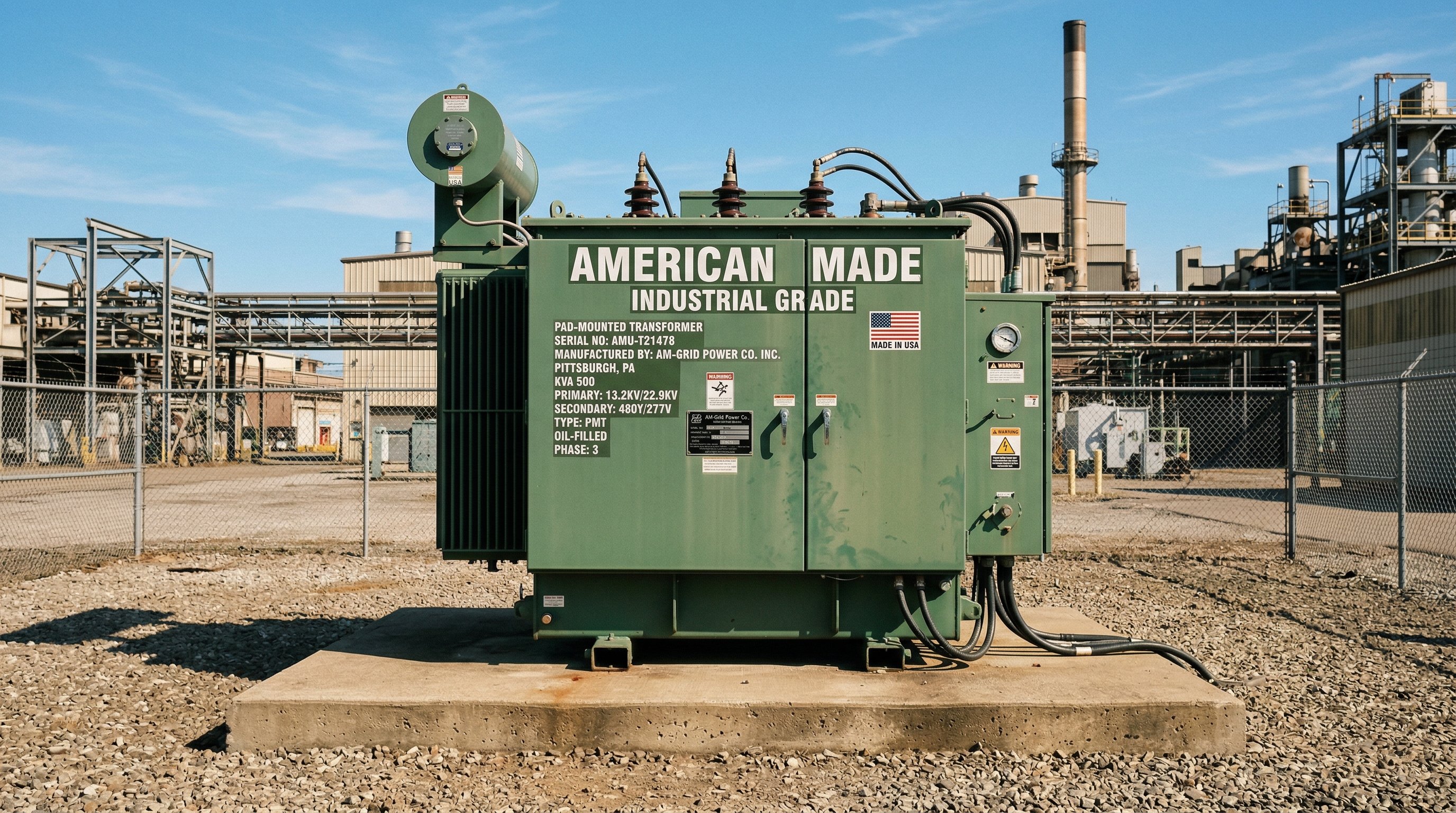
BABA Compliance for Transformer Procurement: Which Manufacturers Are Certified?
No centralized list of BABA-compliant transformer manufacturers exists. Here is what procurement teams need to know about domestic content rules, manufacturer certification, and the waiver process.
Every dollar of federal infrastructure funding now comes with a string attached: the Build America, Buy America Act. If your utility or cooperative received SPARK, GRIP, or IRA-backed grant money, the transformers you buy must meet BABA’s domestic content requirements. No exceptions unless you secure a waiver, and waivers are neither fast nor guaranteed.
The problem? No centralized, public list of BABA-compliant transformer manufacturers exists. The DOE does not publish one. APPA does not maintain one. You are on your own to verify compliance for every unit on every federally funded project.
This guide covers what the rules actually require, which manufacturers have publicly confirmed BABA compliance, and what to do when your preferred supplier cannot certify.
What BABA Actually Requires for Transformers
BABA became law on November 15, 2021, under the Infrastructure Investment and Jobs Act (IIJA). The rule applies to all federally funded infrastructure projects, including utility grid work funded through DOE, USDA Rural Utilities Service, and EPA programs.
For transformers, the requirements break into two parts (DOE BABA guidance):
1. Final assembly must happen in the United States. The finished transformer must be manufactured on U.S. soil. A unit assembled in Mexico from U.S.-made components does not qualify.
2. Domestic components must exceed 55% of total component cost. The cost of components mined, produced, or manufactured in the United States must be greater than 55% of the total cost of all components in the finished product.
That 55% threshold is the number that trips up most procurement teams. It is not about the weight of domestic steel in the core. It is about the cost of all components, from the grain-oriented electrical steel to the bushings, tap changers, and cooling systems. A transformer with a U.S.-wound core but imported bushings and an imported tap changer might still fail the test.
The October 2026 Deadline That Changes Everything
Here is the timeline that matters for procurement teams placing orders right now.
For FHWA-funded projects obligated on or after October 1, 2025, all manufactured products must be manufactured in the United States. That requirement is already active. But the component cost test was not yet enforced during this first phase (Venable LLP analysis, September 2025).
For projects obligated on or after October 1, 2026, both requirements apply: U.S. final assembly and the 55% domestic component cost threshold. That is six months away. If you are issuing RFPs for federally funded projects with delivery dates in late 2026 or 2027, your specifications need to include BABA compliance language now.
DOE-funded projects (SPARK, GRIP, IRA programs) already enforce both the assembly and the 55% cost test. The October 2026 date primarily affects FHWA-funded transportation and infrastructure projects that had operated under a long-standing manufactured products waiver. That waiver is being rescinded in phases (Federal Register, January 2025).
Which Manufacturers Have Confirmed BABA Compliance?
This is the section everyone is looking for, and it is the hardest to write accurately. BABA compliance is not a permanent certification that a manufacturer earns once and carries forever. It is project-specific and product-specific. A manufacturer might produce one transformer line that meets the 55% threshold and another that does not.
That said, several manufacturers have publicly stated their ability to produce BABA-compliant units. Here is what we can verify from public sources as of March 2026.
Manufacturers With Public BABA Compliance Claims
Maddox Industrial Transformer. Maddox explicitly markets BABA-compliant transformers on their website and offers certification letters with qualifying orders. They manufacture and remanufacture transformers at U.S. facilities and stock BABA-compliant units at yards across the country. They note that $27.3 billion in transformers were imported in 2023, and only 18% of large power transformers over 100 MVA were built domestically in 2019 (Maddox BABA guide). Maddox is one of the few manufacturers that has built an explicit public-facing BABA compliance page.
MGM Transformer Company. MGM states compliance with Buy America, BAA (Buy American Act), ARRA, and SPPA statutes. They operate a 120,000-square-foot manufacturing plant in the U.S. and confirm the ability to source raw materials solely from American companies when required. MGM has facilities in California and Texas, with over 1.5 million square feet of total production capacity. They note that customers should specify Buy America requirements at the time of order, since each statute has different standards (MGM Transformers, made-in-U.S. compliance page).
VanTran Industries. Based in Waco, Texas, VanTran maintains a dedicated Buy America compliance resource page. They confirm that all materials are bought from American distributors and that their products meet ANSI, NEMA, and IEEE standards. VanTran specifically addresses domestic content thresholds for distribution transformers (VanTran Buy America compliance).
Read the two entries above as one supplier, not two. MGM Transformer and VanTran were bought separately by the sponsor Neos Partners in 2023 and 2024 and both now sit inside Forgent Power Solutions, Inc. (NYSE: FPS), which listed in February 2026. The brands, plants and compliance pages are still distinct; the corporate parent, order book and allocation priority are not. A bid sheet carrying both as independent alternates is carrying one. The parent also states it can shift production between its US and Mexico campuses to manage tariffs, duties and domestic-content requirements, so the per-order, per-plant certification this article recommends everywhere else applies here with particular force. See the Transformer Procurement Guide for the full supplier-parent picture. (Added 2026-08-21)
Virginia Transformer Corporation (VTC). VTC is the largest U.S.-owned power transformer manufacturer, producing custom-engineered units up to 1,400 MVA and 500 kV. As a domestically owned manufacturer with U.S.-based production, VTC is positioned to meet BABA requirements, though procurement teams should request project-specific certification letters confirming the 55% component cost threshold for each order.
Manufacturers With Major U.S. Production Facilities
These companies manufacture transformers in the United States and are positioned to offer BABA-compliant products, but procurement teams should verify compliance on a per-order basis.
Hitachi Energy. Hitachi has committed over $1 billion in North American transformer manufacturing investment. Their South Boston, Virginia facility is set to become the nation’s largest large power transformer plant by 2028. They also expanded in Jefferson City, Missouri ($80 million) and Alamo, Tennessee ($106 million). The goal: double North American output by 2027 (Industrial Info Resources; Manufacturing Dive, 2024).
Eaton Corporation. Eaton is investing $340 million in a new three-phase transformer facility in Jonesville, South Carolina, with production expected to begin in 2027. They also operate existing transformer manufacturing in the U.S. through their Cooper Power Systems division (New Equipment Digest).
Siemens Energy. Siemens is building its first U.S. large power transformer plant in Charlotte, North Carolina, a $150 million investment with production expected in early 2027 (POWER Magazine, 2026).
Howard Industries. Based in Laurel, Mississippi, Howard operates one of the most modern transformer manufacturing plants in the country. They produce distribution and power transformers for utility and industrial applications with significant domestic production capacity.
ERMCO. Headquartered in Dyersburg, Tennessee, ERMCO is a leading U.S. manufacturer of distribution transformers with multiple domestic production facilities. Their focus on the utility distribution market makes them a natural candidate for BABA-compliant procurement.
Prolec GE (now GE Vernova). One of the largest U.S. manufacturers of power transformers (5 to 1,200 MVA). GE Vernova’s pending acquisition of the remaining Prolec GE joint venture stake signals tighter control over domestic production footprint. However, Prolec GE also has significant manufacturing operations in Mexico, so BABA compliance depends on which facility produces the specific unit.
What This List Does Not Tell You
Having a U.S. factory does not automatically mean every product from that factory is BABA-compliant. The 55% component cost test depends on the supply chain for each specific transformer model. A manufacturer might use imported bushings from Europe, tap changers from Asia, or specialty steel from Brazil. The domestic content percentage changes with every bill of materials.
This is why manufacturer self-certification letters are required on a per-project basis. Do not assume. Request the letter.
How Manufacturer Self-Certification Works
BABA compliance is verified through manufacturer self-certification letters, not through a government approval process. There is no BABA “seal of approval” or federal registry of certified products.
According to USDA guidance that applies across federal agencies (USDA BABA FAQs for Manufacturers), a manufacturer self-certification letter should include:
- Project identification: the project name, location, and project number
- Product identification: specific products being supplied to the project
- Compliance statement: attestation that the products meet BABA requirements for the applicable category (manufactured products, in the case of transformers)
- Manufacturing location: city and state where the product was manufactured
- Company letterhead and authorized signature: from a qualified manufacturer representative
The letter must be product-specific and project-specific. A generic “we are BABA compliant” statement from a manufacturer is not sufficient. You need a letter that names your project and your specific transformer order.
Keep these letters in your project files. If the federal agency audits your project, you will need to produce them.
When Your Supplier Cannot Certify: The BABA Waiver Process
Sometimes the transformer you need simply is not available from a BABA-compliant source. Large power transformers are the most common problem. Only 18% of large power transformers over 100 MVA were manufactured domestically as of 2019 (Maddox, citing industry data). That number is improving as domestic capacity expands, but it has not caught up with demand.
DOE allows three types of waivers (DOE waiver request guidance):
1. Non-Availability Waiver. The product is not produced in the United States in sufficient and reasonably available quantities, or of satisfactory quality. This is the most common waiver type for transformers. If no domestic manufacturer can deliver the specific unit you need within a reasonable timeframe, this is your path.
2. Unreasonable Cost Waiver. Using domestic products would increase overall project cost by more than 25%. If the price difference between a BABA-compliant unit and an imported alternative exceeds that threshold, you can apply for this waiver. You will need documented quotes from domestic and foreign suppliers to support the claim.
3. Public Interest Waiver. Applying the requirement would be inconsistent with the public interest. This is the broadest and least predictable category. DOE has used it for small grants and de minimis component waivers.
What a Waiver Request Requires
Your waiver request must include:
- The specific waiver type you are requesting
- A list of items being waived, with cost and country of origin
- Detailed justification explaining why domestic products are not viable
- Evidence of good-faith efforts to find domestic suppliers (documented quotes, RFP responses, or manufacturer correspondence)
General Applicability waivers go through a public comment period of at least 15 days. Project-specific waivers also require 15 days of public comment. Plan for the waiver process to add weeks to months to your procurement timeline.
DOE has granted waivers for battery energy storage systems and solar modules in recent months, which shows the process works. But no broad transformer waiver exists as of March 2026. Each request is evaluated individually.
Practical Steps for Procurement Teams
Here is what to do if you are managing federally funded transformer procurement right now.
Start with the RFP. Include BABA compliance as a mandatory requirement in your transformer specifications. State the 55% domestic component cost threshold explicitly. Require manufacturers to provide a self-certification letter with their bid response. Do not make compliance an afterthought that gets discovered during delivery.
Ask the right question early. When you send an RFQ to a manufacturer, do not ask “Are you BABA compliant?” That question is too broad. Ask: “For [specific transformer model/specs], can you provide a self-certification letter confirming that the finished unit will be manufactured in the United States and that domestic components will exceed 55% of total component cost?” The specificity matters.
Build your approved supplier list now. Contact manufacturers with U.S. production facilities and ask about BABA compliance for the transformer types you buy most often. Document the responses. Some manufacturers may be compliant for their standard catalog units but not for custom-engineered products that require specialty imported components.
Plan for longer lead times. BABA-compliant transformers may have longer lead times than non-compliant alternatives, especially for large power units where domestic production capacity is limited. Factor this into your project schedules. If you wait until the project kicks off to discover your preferred supplier cannot certify, you have lost months.
Know when to file a waiver. If your project requires a transformer that no domestic manufacturer can produce to spec and on schedule, start the waiver process immediately. Gather quotes from domestic suppliers showing unavailability or unreasonable cost. The 15-day comment period plus DOE review time means waivers are not a last-minute fix.
Track the capacity expansions. Nearly $2 billion in new domestic transformer manufacturing capacity is under construction. Hitachi, Eaton, and Siemens all have major U.S. plants opening in 2027 (POWER Magazine, 2026; NPC Electric, 2026 Outlook). The BABA-compliant supply picture will look different in 18 months than it does today. But you cannot wait for 2027 capacity to solve your 2026 procurement problem.
The Bigger Picture
BABA is not going away. Federal infrastructure spending through the IIJA, IRA, and related programs will continue flowing for years. The 55% domestic content requirement for manufactured products is tightening, not loosening. Utilities and cooperatives that build BABA compliance into their standard procurement process now will spend less time scrambling on individual projects later.
The manufacturers investing billions in U.S. production capacity are betting on this same trajectory. Domestic transformer supply is expanding. But demand is expanding faster, driven by data center construction, grid modernization, and the 160-280% increase in distribution transformer demand projected through 2050 (NREL study, referenced in Utility Dive, 2024).
For procurement teams at municipal utilities and cooperatives, the takeaway is straightforward: verify BABA compliance before you issue the PO, not after. Build your qualified supplier list. Keep your certification letters organized. And if you need a waiver, file early.
The rules are clear. The hard part is finding the suppliers who can meet them. Start that work now.
DistroForge tracks BABA compliance status, manufacturer capacity expansions, and federal funding requirements as part of our ongoing intelligence coverage. Subscribe to The Feeder for the free monthly read on which manufacturers can certify and which projects require waivers.
Free RFQ templates. Weekly digest. Yours.
Free Member tier. Pick your topics. Get a weekly digest filtered to what you actually buy.