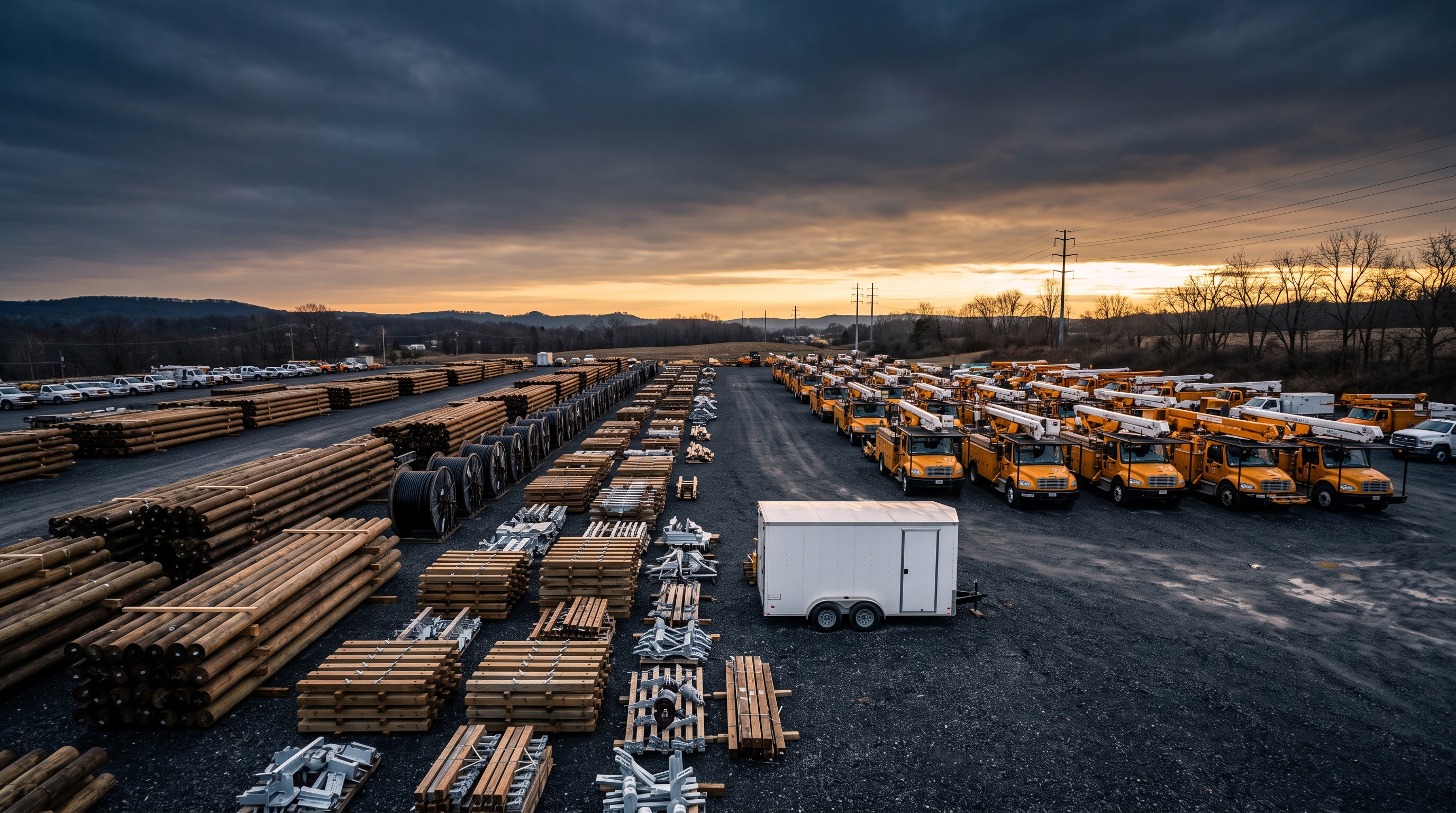
Storm Restoration Equipment: The Readiness Shift
Storm restoration equipment is moving from post-storm scramble to pre-staged readiness. What co-ops and munis stock before the next major storm hits.
For most of the last two decades, storm restoration equipment was something a utility ordered after the wind stopped. The distribution supervisor called the rep, the rep called the factory, and everyone waited in the same post-storm queue as forty other utilities in the same footprint. That model is breaking, and the reason is arithmetic. Utilities have spent roughly $12 billion rebuilding after Category 4 and 5 hurricanes since 2020, Winter Storm Fern added billions more across 34 states, and the lead times on the core rebuild items now run past two years. When the replacement part takes 128 weeks to arrive, ordering it after the outage is not a plan.
The industry response is a shift from reactive buying to what suppliers now call readiness procurement: pre-staging the poles, crossarms, transformers, and mobile equipment a service territory will need before the event, and treating that stock as a standing inventory line rather than an emergency purchase order. For co-ops and municipal utilities that cannot outbid a national IOU in a post-storm scramble, this shift is not optional. It is the only way the equipment shows up in time.
From Reactive Scramble to Readiness Procurement
Suppliers have started organizing this around a “4 R’s” model: Readiness, Response, Recovery, and Restoration. Only one of those four phases happens before the storm, and it is the one that decides how the other three go. Readiness is the pre-event work of stocking, staging, and standardizing the materials a territory burns through in a major restoration. Get it right and Response is a warehouse pull. Get it wrong and Response is a phone call into a sold-out market.
The equipment cost picture is what forces the issue. POWER Magazine reports distribution and power transformer lead times stretching to 128 weeks for power units and past 140 weeks for generator step-up transformers, with standard substation transformers running 12 to 14 months. More than 40 million distribution transformers in the US fleet are already beyond their service life, and a majority of the installed base is more than three decades old. Every one of those is a candidate for storm failure, and every replacement competes for the same constrained factory slots as new load growth from data centers. Storm restoration equipment is no longer a separate market from the demand surge. It is the same market, drawn down twice.
What Goes Into a Storm Restoration Kit
The phrase “storm restoration kit” used to mean a pallet of connectors and a few spare crossarms. It now describes a much broader standing inventory, and a handful of manufacturers have built their positioning around it.
Hughes Brothers, a century-old Seward, Nebraska manufacturer, supplies the structural backbone: wood and steel crossarms, poles, and hardware pre-cut and pre-kitted for rapid field assembly. Their “century tested, storm proven” framing is aimed squarely at the pre-staged-stock buyer. Trystar builds the power side of the kit, mobile substations, portable generators, cable carts, load banks, and power distribution panels, on a quick-ship warehouse model designed to move within days rather than months. McWane Poles offers ductile iron poles as a wood alternative for utilities that want the replacement to outlast the next storm, not just survive the current one.
Underneath the branded product categories, the working restoration inventory for a distribution territory is fairly consistent: poles and crossarms, padmount and pole-mount distribution transformers, reclosers and sectionalizers, connectors and hardware, primary and secondary cable, and increasingly a mobile substation or portable generation capability for the substations that go down entirely. The mix a specific utility should hold depends on its failure history, its circuit design, and its mutual-aid position, which is exactly the analysis that separates a readiness program from a stockpile.
The Spare-Transformer Problem
Transformers are where readiness procurement gets hard, because they are the single item you most need after a storm and the single item you can least easily hold in inventory. A padmount or substation transformer is expensive to carry, slow to source, and specific enough that a generic spare may not fit the failed unit’s voltage, impedance, or bushing configuration. Utilities that treat the spare transformer as a line item they will “get to later” are the ones that end up on a two-year replacement clock after a bad season.
The readiness answer is a deliberate spares strategy tied to a bid process that already accounts for long lead times, not a reactive order placed under duress. Our guide to evaluating transformer bids against long lead times covers the mechanics of building lead time into the award instead of discovering it after the storm. On the structural side, the same logic is pushing utilities toward the condition-driven pole replacement approach we covered in distribution pole asset management, where ductile iron and composite alternatives graduate from pilot to standard spec in the hardest service territories.
Pre-Staged Inventory Changes the Buyer Relationship
Pre-positioning is now standard practice at Entergy, Duke Energy, and FPL, the utilities that take the most direct hurricane exposure and have the most restoration reps to learn from. When a utility commits to holding storm stock through the year rather than buying it in a panic, the supplier relationship changes shape. It becomes a recurring inventory-management arrangement built on quick-ship warehousing and regional coverage, not a single transaction placed the week after landfall.
That change is where distributors with real inventory depth and regional warehouse networks separate from brokers. The readiness buyer is not shopping for the lowest unit price on a one-time order. That buyer is shopping for the supplier who can guarantee the part is on a shelf within a day’s drive when the territory is dark. This is the same resilience investment logic that follows every major event; we traced the sensor and monitoring side of it in grid resilience monitoring investment after Storm Fern.
What This Means for Co-op and Muni Buyers
Municipal utilities and cooperatives feel this more sharply than anyone, because they are the buyers least able to win a post-storm bidding war against a national IOU with a bigger checkbook and a standing factory relationship. Readiness procurement is the equalizer. A co-op that has pre-staged its restoration inventory and locked in a quick-ship supplier does not have to compete in the scramble at all, because its stock is already on the ground.
The practical starting point is not a purchase order. It is an inventory audit against failure history: what fails first in your territory, how many of each item a bad season consumes, what your mutual-aid partners can and cannot cover, and where the two-year-lead items sit in that picture. That analysis, run before the season rather than during the outage, is what turns storm restoration equipment from a source of risk into a standing capability. The same discipline shows up on the proactive side in our co-op grid hardening playbook, which sequences the hardening equipment a resilience-minded cooperative buys as it takes on more of its own system.
Storm restoration equipment is becoming a standing product category because the math no longer supports treating it as an emergency. The utilities that internalize that first will be the ones with the lights back on while everyone else is still on hold with the factory.
The monthly read on where this is heading
Lead times, supplier capacity, and the restoration inventory decisions that follow every major storm move faster than any single procurement cycle. The Feeder is our free monthly digest of the signals that move utility and distribution equipment buyers: lead-time shifts, supplier capacity, federal funding, and the RFP language that follows. One email a month, no filler.
Related Reading
- Grid Resilience Monitoring Investment After Storm Fern
- Distribution Pole Asset Management
- The Co-op Grid Hardening Playbook
The item-by-item restoration inventory model by territory type, supplier quick-ship coverage by region, and the spares-strategy framework that holds up when the factory queue is two years deep live in the full DistroForge report. Request a sample.
Know what changed before your next quote
Free Member tier. Pick your topics. Get a weekly digest filtered to what you actually buy.