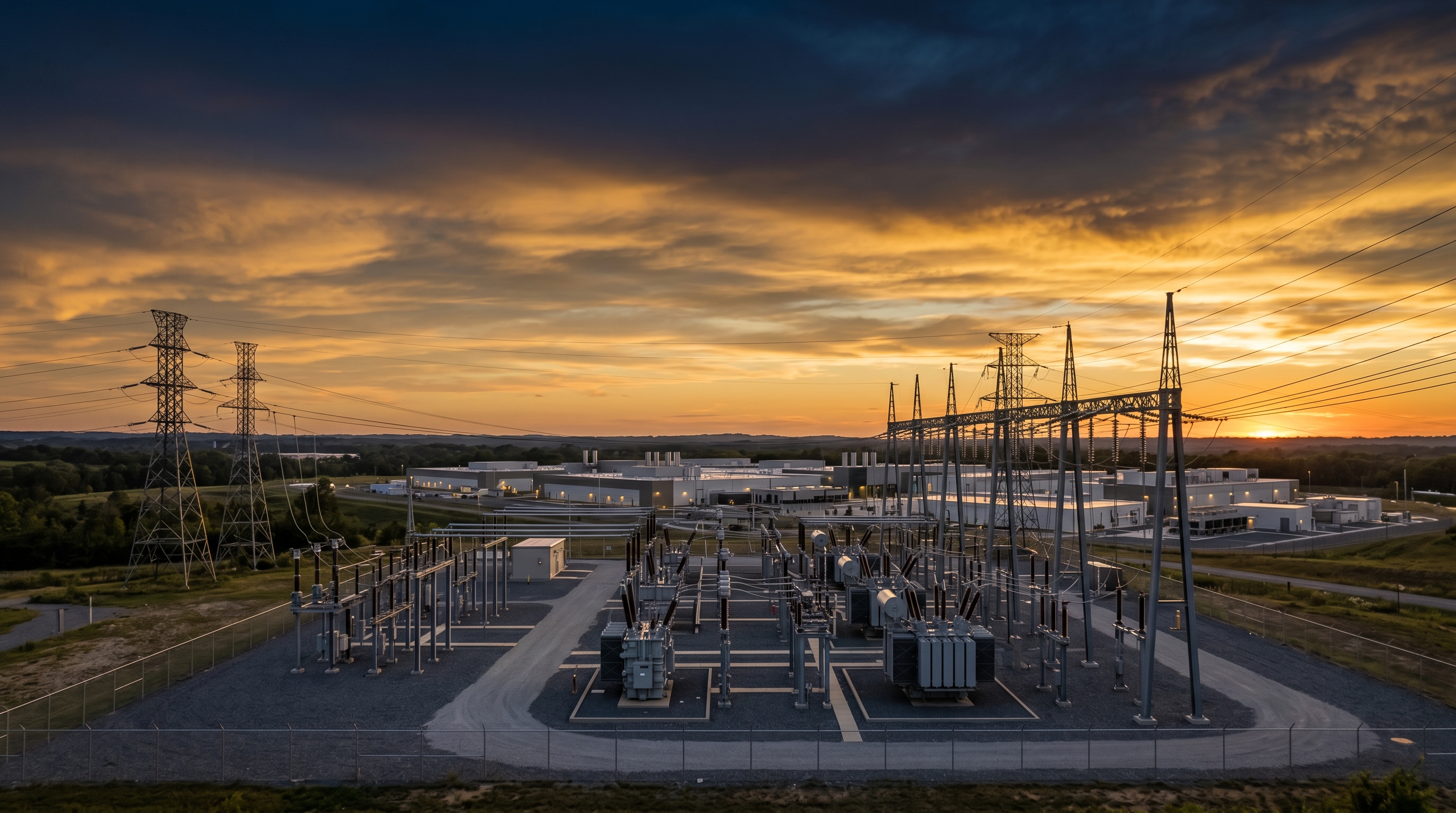
Data Center Grid Infrastructure Costs: The $10B Fight Over Who Pays
Data center grid infrastructure costs are triggering a political battle across 13 states. Who pays for $3.5B in upgrades that were overdue anyway?
PJM just told the market it needs 14.9 GW of new generation by 2031. We Energies filed a rate case with $1.88 billion in data center grid infrastructure costs. Thirteen state governors formed a coalition to fight cost socialization. And the American Society of Civil Engineers downgraded the nation’s energy infrastructure to a D+.
The question at the center of all of this: who pays?
Not just for the data centers themselves, but for the decades of deferred maintenance they are now exposing. The bill is coming due, and the fight over how it gets split will reshape equipment procurement for the next decade.
PJM’s 14.9 GW Backstop: Capacity Procurement at an Extreme Scale
On April 10, 2026, PJM proposed a two-phase “Reliability Backstop Procurement” targeting 14.9 GW of new generation resources (Utility Dive, April 2026). This is a first. PJM has never before failed to clear enough capacity in its auction to meet reserve margins.
The December 2025 auction cleared at $329.17 per MW-day. Two years earlier, that number was $28.92. A tenfold increase.
The first phase runs from September 2026 through March 2027: bilateral matchmaking between new generation sellers and large load buyers, with Charles River Associates serving as confidential intermediary. Whatever shortfall remains goes to Phase 2, a central procurement auction scheduled for March 2027.
Every winning resource must be operational by June 1, 2031. That is a hard deadline. For context, the typical build cycle for a new generation resource with associated network upgrades runs 8 to 12 years. PJM is compressing that into five.
The cost math is staggering. Average interconnection costs have jumped 728%, from $29/kW to $240/kW, driven by network upgrades where transformers and substation equipment are the primary cost drivers (Utility Dive, April 2026). At $240/kW across 14.9 GW, the implied spend on network upgrade infrastructure alone approaches $3.5 billion, before a single generating unit is built.
For procurement teams watching the 50 GW data center demand wave, this is where that demand translates into purchase orders. Step-up transformers, switchgear, protection systems, substation steel. All on a compressed timeline that the supply chain was not built to handle.
The We Energies Test Case: $1.88B in Data Center Rate Costs
Wisconsin is becoming the first real-world stress test of who absorbs data center grid infrastructure costs at the state level. We Energies filed docket 5-UR-112 with the Public Service Commission of Wisconsin on April 1, 2026, requesting rate increases of 4.7% for 2027 and 4.5% for 2028 (We Energies press release, April 2026).
The data center tab: $1.88 billion total. That breaks down to $643 million in generation capacity, $562 million in transmission, and $323 million in energy charges (BizTimes, April 2026).
What is driving this? Two hyperscale campuses. Microsoft’s “Fairwater” complex in Mount Pleasant, a $13 billion-plus project spanning 15 data center buildings. And the Vantage/OpenAI/Oracle “Lighthouse” Stargate campus in Port Washington, a $15 billion project drawing roughly 1 GW of demand (WPR, April 2026).
American Transmission Company is building $2.98 billion in new transmission infrastructure to serve these loads: 96 to 123 miles of new lines and up to 9 new substations across southeastern Wisconsin (WisBusiness, April 2026). WEC Energy Group’s five-year capital plan sits at $37.5 billion, with the most recent $1 billion increase driven entirely by Microsoft’s expansion (BizTimes, April 2026).
The combined pipeline could double We Energies’ demand by 2030. That is not a forecast from an advocacy group. It comes from the utility’s own filing.
Governors vs. Data Centers vs. Ratepayers: The PJM Capacity Cost Fight
Thirteen PJM states formed the Governors Collaborative in September 2025 to push back on how capacity costs get allocated (PA Governor’s office, September 2025). Consumer advocates from Maryland, Pennsylvania, and Delaware filed principles opposing the socialization of capacity costs driven by data center load onto residential ratepayers.
Their argument is simple: if Microsoft and Oracle need 1 GW of power in Wisconsin, Microsoft and Oracle should pay for the grid upgrades to deliver it. Residential customers in Pittsburgh should not see higher bills because a hyperscaler built a campus in Racine County.
We Energies’ proposed “Customer Protection Plan” attempts to address this, routing data center costs to the data center customers themselves. But transmission costs are harder to wall off. ATC’s $2.98 billion in new lines serves multiple purposes, and allocation formulas will be contested at the PSCW for months.
Jefferies analysts captured the dynamic well: “States and utilities will not likely be keen to seeing this level of procurement and hence expect clear pushback” (Utility Dive, April 2026).
Governor Shapiro of Pennsylvania secured a $325/MW-day price cap extension through 2030 to limit residential exposure, with estimated savings of $45 billion across PJM. But price caps are a band-aid on a structural problem. The capacity still has to be built, and someone has to pay for it.
The Double Demand Problem: Aging Equipment Meets New Load
Here is the part that gets lost in the data center headlines. The grid was already failing before a single hyperscaler broke ground.
The ASCE 2025 Infrastructure Report Card gave the U.S. energy sector a D+, down from C- in 2021 (ASCE, 2025). Over 70% of high-voltage transmission lines are more than 25 years old. Sixty percent of circuit breakers have passed 30 years. The average age of large power transformers exceeds 40 years, at or beyond their rated design lifetime (EnergyTech, April 2026).
Fifty-five percent of U.S. distribution transformers are over 33 years old, and failure rates will spike sharply after 2030 (Wood Mackenzie, 2025). Annual spending by major utilities increased only 12% in real dollars over the past 20 years.
The investment gap, with current IIJA and IRA funding levels, sits at $578 billion by 2033. Without that funding, the gap balloons to $702 billion (ASCE, 2025).
Data centers did not create this deficit. They exposed it. And they accelerated the timeline for addressing it, because you cannot connect 1 GW of new load to a substation running 40-year-old transformers and expect reliability.
This creates what we call the “double demand” problem for equipment procurement. Utilities must simultaneously replace aging infrastructure and build new capacity for data center loads. Both demand streams hit the same constrained supply chain of transformers, switchgear, and protection equipment. The result is the triple squeeze we documented earlier this year, intensified by a political fight over who funds it.
What This Means for Procurement Teams
If you manage equipment purchasing for a utility in PJM territory, or anywhere data centers are landing, data center grid infrastructure costs will directly affect your planning horizon. Here is why.
Lead times are set by the backstop deadline, not your capital plan. PJM’s June 2031 deadline means transformer procurement for backstop-related projects needs to start in 2026 and 2027. Large power transformer lead times run 128 to 144 weeks standard, and up to four years for generator step-up units (POWER Magazine, 2026). If your utility has exposure to FERC large load interconnection queues, the procurement clock is already running.
Rate case outcomes determine budget availability. Wisconsin’s docket 5-UR-112 will set a precedent for how data center infrastructure costs flow through to utility capital budgets. A PSCW approval of the Customer Protection Plan gives utilities a template. Rejection means procurement budgets face uncertainty until cost allocation is settled.
Equipment competition is about to get worse. AEP has 4 GW of contracted large load growth in PJM. PPL has 10 GW of signed agreements. We Energies needs up to 9 new substations. All of these projects need pad-mount transformers, medium-voltage switchgear, and protection systems from the same manufacturers facing Section 232 tariff pressure and a 30% supply deficit on large power transformers.
The smartest teams are placing orders now, not waiting for regulatory clarity. Equipment that is ordered today delivers in 2028. Equipment ordered in late 2027 delivers in 2030, past PJM’s deadline. That gap is where projects fail.
Related Reading
- 50 GW of Data Centers Are Rewriting Grid Procurement
- The Triple Squeeze Hitting Utility Equipment in 2026
- FERC Large Load Interconnection Rules
- Pad-Mount Transformer Procurement
Our reports go deeper, with manufacturer capacity analysis, lead time tracking, and procurement strategy recommendations by equipment segment. See the report catalog, or subscribe to The Feeder for the free monthly read.
Sources
- Utility Dive: PJM proposes 14.9 GW backstop procurement (April 10, 2026)
- We Energies rate filing announcement (April 1, 2026)
- BizTimes: We Energies data center cost breakdown (April 2026)
- WPR: PSC We Energies proposed data center rates (April 2026)
- WisBusiness: ATC $2B+ transmission plans (April 2026)
- BizTimes: WEC $37.5B capex plan (April 2026)
- PA Governor’s Office: PJM Governors Collaborative (September 2025)
- EnergyTech: The Data Center Scapegoat (April 14, 2026)
- ASCE 2025 Infrastructure Report Card: Energy (2025)
- Wood Mackenzie: Transformer supply deficits (2025)
- POWER Magazine: Transformers in 2026 (2026)
Know what changed before your next quote
Free Member tier. Pick your topics. Get a weekly digest filtered to what you actually buy.