The Distributed Data Center Lands on a Service Transformer
Sunrun's distributed data center pilot puts compute nodes behind residential meters. The company says commercialization is 2027 or 2028. The planning question is nearer.
On August 5, Sunrun told investors its distributed data center pilot might reach commercialization in the second half of 2027. Or in 2028. Chief executive Mary Powell said the company could not yet say which.
That is the single most useful thing anyone has published about this program, and it came from the company running it. Everything else about the pilot is still withheld: how many homes, how many kilowatts per node, and who is buying the compute. A month after launch and one earnings cycle later, the disclosure has not moved.
So the honest headline is that nothing about a distributed data center is landing on anyone’s feeder this planning cycle. The reason to read on is that the thing it would create, if it ever scales, is a load class the distribution business has no process for. That gap is worth understanding before the volume arrives, not after.
What the Sunrun distributed compute pilot actually is
Sunrun announced the program on July 8. It places compute nodes in homes that already have Sunrun solar and battery storage, runs inference workloads on them, pays the homeowner to host, and sells the aggregated capacity to enterprise buyers. Latitude Media reported the nodes carry Nvidia chips. The workload is inference rather than training, which is the half of the market that wants to sit close to the people making requests.
The part that is genuinely new is the dispatch logic. Sunrun says it will schedule each node against that household’s own consumption pattern, rate structure, and grid program enrollment. The node runs when the home’s marginal electricity is cheapest and stands down when the battery is worth more in a grid program. That is compute treated as a controllable load co-located with generation and storage, which is a virtual power plant with the sign flipped. Instead of paying a house to use less, Sunrun monetizes surplus by adding load it can turn off.
What is not public is more instructive. President Paul Dickson said some homes are already enrolled and declined to say how many, or how many the initial test is targeting. No compute offtaker has been named; the company says it is in discussions with enterprise offtakers, homebuilders, and utility partners. No node rating has been given in watts.
The two trade outlets that described the box do not agree on how big it is. Utility Dive put it at about the size of a small desktop computer. Latitude Media called it roughly the size of a mini fridge, and said it uses a lot more power than one. Physical size is the only public proxy anyone has for the draw of these things, and the two published descriptions are a category apart. Treat any wattage figure you see attributed to this pilot as inferred, because none has been disclosed.
Proportion helps here. Sunrun projects $40 million in gross revenue and $10 million to the bottom line from its entire distributed power plant business in 2026. That business sits on 1,205,613 customers and 4.6 gigawatt-hours of networked storage as of June 30. The grid services line is real and it is small. The compute line is a pilot inside it.
Compute keeps walking down the voltage stack
The useful way to file this is as the third step in a pattern rather than a company story.
A hyperscale campus interconnects at 138 to 345 kV and pulls a substation, a transmission tap, and a queue position. The inferencing build that came next steps down to roughly 10 MW sites interconnecting at 12.47 to 34.5 kV, which is pad-mount and substation transformers in the 5 to 30 MVA range, medium-voltage switchgear, and the feeder reclosers and regulators that hold circuit voltage. That is equipment a municipal utility or cooperative already buys on an ordinary cycle.
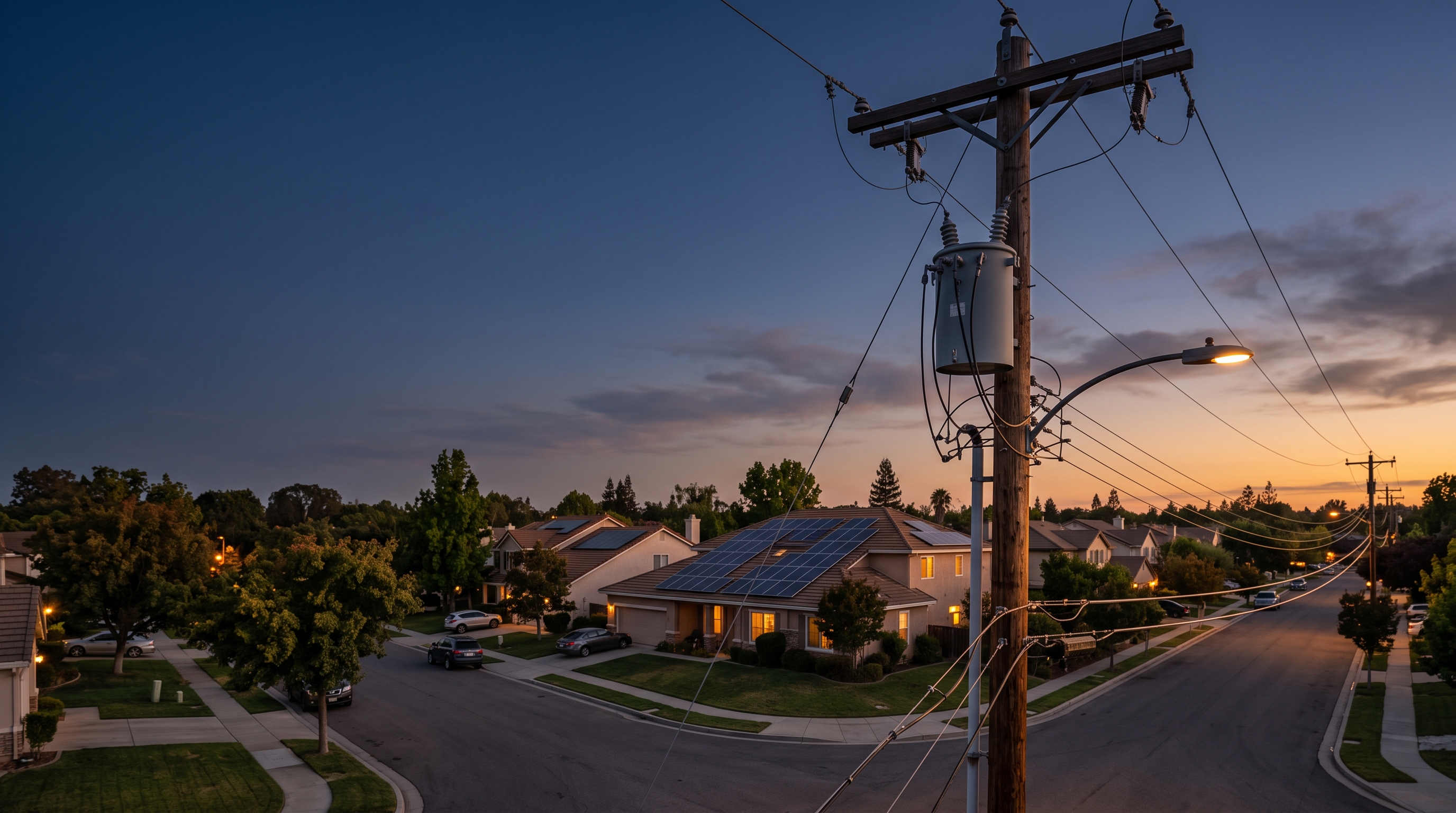
A distributed data center of the kind Sunrun describes steps down again, past the primary system entirely, to a node behind a residential meter on a service transformer that might be 25 or 50 kVA serving a handful of houses. Each step down trades interconnection difficulty for siting difficulty, and each one lands the load on a different desk. The first two land on transmission and substation planners. This one lands on nobody, which is the actual finding.
The distribution-level compute load nobody has a process for
Here is the asymmetry that matters. When a customer adds a battery to that same house, a process fires. The inverter has to meet IEEE 1547, the utility reviews the interconnection, many programs require an advanced meter before the asset can enroll. All of that exists because the battery can push power back onto the system.
A compute node pushes nothing back. It is load. Load added behind a residential meter triggers no interconnection review at all, because interconnection rules were written to govern export, not import. Unless the customer needs a service or panel upgrade, a continuously running kilowatt-class device arrives on the system as nothing more than higher monthly kilowatt-hours on one account.
That collides with how the equipment underneath is sized. A residential service transformer is not sized to the sum of what the houses on it could draw. It is sized against their coincident peak, on the assumption that the dryer, the oven, and the air conditioner do not all run together across every house on the bank. An always-on inference node is the least diverse load anyone could add, because it does not care what time it is.
Two things keep that from being alarmism. The first is that Sunrun’s stated dispatch logic points the other way. If the node really does follow the household’s cheapest hours, on a solar home that means midday, which is exactly when high-penetration feeders are fighting backfeed and voltage rise. Compute could turn out to be a useful daytime sink rather than an evening problem. Nobody has published operating data either way.
The second is the electric vehicle precedent, which is the closest thing to a controlled experiment the industry has run. A 2024 T&D World analysis of high EV adoption found that existing transformer sizing practice held up in more than 81 percent of cases, while also projecting that 2.2 million residential transformers might need replacement at 30 percent adoption and 4.8 million at 60 percent, against the roughly 30 million units serving residential load nationally. Both numbers are true at once. The distribution system absorbs a great deal before it needs anything, and the tail is still enormous because the denominator is enormous.
The difference is that EV charging arrived with a decade of notification programs, load studies, and right-sizing work attached to it. A hosted compute node would arrive with none of that.
What a buyer should do with this
Nothing to procure. There is no order to place against a pilot whose own management will not commit to a commercialization year.
There are two questions worth answering now, and both are free. The first is whether your load research can already tell an always-on kilowatt-class device apart from ordinary growth on a service transformer. If the answer rests on interval data you collect anyway, you are covered. If it rests on a customer volunteering the information, you are not, and that is the same gap that made early EV clusters invisible until a transformer failed.
The second is whether behind-the-meter load additions get any review in your territory at all. Most places the answer is no by design, and that answer was correct when the largest thing a customer could plug in was an oven. It is worth revisiting on your own schedule rather than after somebody else’s pilot scales.
Three things would upgrade this from a watch item. A named compute offtaker. A disclosed megawatt figure. A utility partner willing to say publicly that it is working with Sunrun on siting. Until one of those lands, the correct posture is the one Powell gave on the call: second half of 2027, or 2028.
The wider pattern is the durable part. Compute keeps looking for somewhere to land that is not an interconnection queue, and each attempt lands it lower on the system than the last. Rooftops are the smallest such place anyone has proposed so far. Which planners can see that load, and which cannot, is the question the equipment answer eventually follows. For how the same flexibility bargain is already being written into hardware at utility scale, our analysis of data center load flexibility as an equipment spec covers the switchgear and relay side, and the DERMS orchestration layer is where the visibility problem gets solved when it gets solved at all. The full equipment picture sits in our Grid Modernization Procurement Guide.
Related Reading
- Data Center Load Flexibility Is Now an Equipment Spec
- DERMS Grid Modernization Procurement Goes Mainstream
- What Is the Distribution Grid? A Buyer’s Field Guide
Watch the load classes before they show up on your circuits. The Feeder is our free weekly read on the equipment signals moving distribution buying, from flexible load and DER orchestration to the supply constraints behind them. Subscribe to The Feeder and get the next issue in your inbox.
Track this beat without paying per report
Free Member tier. Pick your topics. Get a weekly digest filtered to what you actually buy.