MISO's Anti-PJM Auction: 141 GW Cleared, Prices Halved, and the Solar Surge That Did It
MISO's 2026-27 Planning Resource Auction cleared at $116-126/MW-day annualized, roughly half last year's $212-217 range. Solar accreditation jumped 59% and 5.6 GW of new accredited capacity entered the market. The signal for distribution equipment buyers in the 15-state footprint is the opposite of PJM.
MISO posted 2026-27 Planning Resource Auction results last week and they read as the headline that defies the prevailing narrative. While PJM’s most recent auction cleared at $329.17 per MW-day and triggered a regional affordability fight that drew governors, FERC, and IOU CEOs into open conflict, MISO cleared at $116-126 per MW-day annualized. Roughly half of the prior year. Summer prices fell from $666.50 per MW-day uniform across the footprint to $424.30 in North/Central, $384.10 in Arkansas/Mississippi, and $412.10 in Louisiana/Texas (Utility Dive, May 2026).
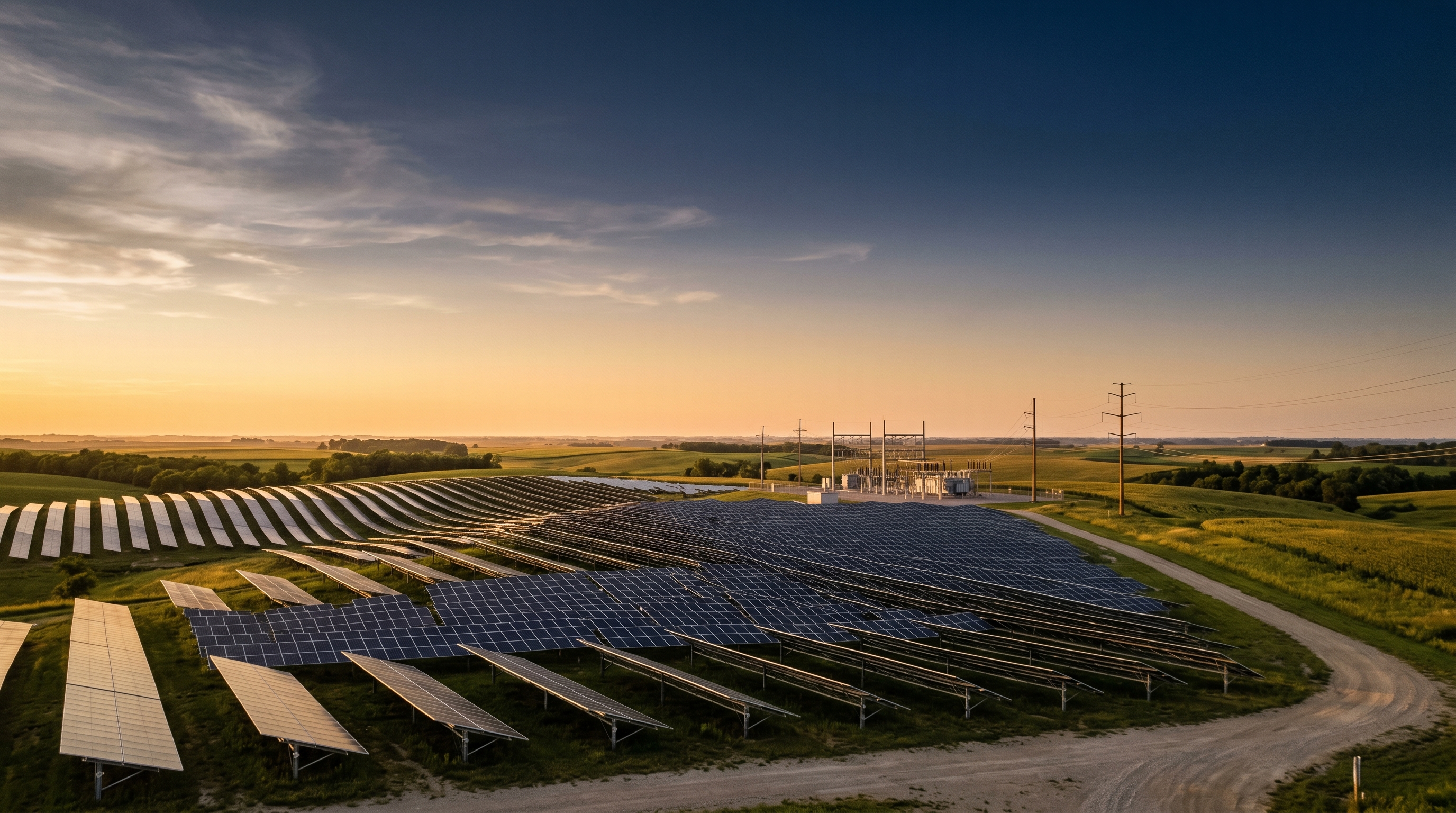
The mechanism is straightforward: 141 GW of capacity offered, up from 136.3 GW the prior year, against demand that had not yet caught up. The driver was solar. Solar accreditation jumped 59 percent year over year to 12.2 GW (from 7.6 GW). New accredited capacity entering the auction totaled 5.6 GW, with the majority solar plus contributions from gas and battery storage.
For distribution equipment buyers operating in the 15-state MISO footprint, this is a directional signal worth reading carefully. It is not the relief it looks like at first glance, and it does not change the multi-year procurement plan. But it does change which projects move first in the next 12-18 months.
What the numbers actually say
The MISO Planning Resource Auction sets capacity prices for the upcoming year by zone. Sellers (generators, demand response providers, accredited DERs) offer capacity in megawatts. Buyers (load-serving entities, including IOUs, cooperative G&Ts, and municipals) buy capacity to meet their planning reserve margin obligations. The clearing price is what every accepted seller earns and every buyer pays.
The 2026-27 results, by zone:
- Annualized price range across all 10 zones: $116-126 per MW-day, versus $212-217 in 2025-26.
- Summer-season North & Central: $424.30 per MW-day.
- Summer-season Arkansas + Mississippi: $384.10 per MW-day.
- Summer-season Louisiana + Texas (MISO South): $412.10 per MW-day.
- Prior-year summer: $666.50 per MW-day uniform across the footprint.
- New accredited capacity: 5.6 GW added.
- Solar accreditation: 12.2 GW (versus 7.6 GW prior year).
The headline read is that MISO solved its near-term reliability margin and did so largely with solar. The 5.6 GW of new accredited capacity outpaced incremental demand growth, and the auction cleared with margin to the planning reserve target.
That margin is meaningful. It is not durable.
Why this is the opposite of PJM
PJM cleared most recently at $329.17 per MW-day, and the resulting rate impact triggered the political fight we covered in PJM at the Inflection: 220 GW Queue, FirstEnergy’s Refusal, and the Hull Street Veto. Both RTOs are facing identical underlying drivers: data-center load growth, electrification, manufacturing reshoring, and the same OEM-side equipment supply constraints. MISO’s central region (Illinois, Indiana, Michigan) is forecasting 2.7 percent annual peak-load growth and is the operational sister to PJM’s western footprint.
The auctions cleared at radically different prices for two reasons.
First, MISO’s solar interconnection pipeline delivered. The 12.2 GW of accredited solar this cycle compares against PJM’s solar queue, which fell to 15 GW in the Cycle 1 reformed queue. PJM’s prior queue purge and the OBBBA tax-credit timeline created a slower 2026-27 supply response in PJM than in MISO. MISO got the new megawatts through accreditation in time for the auction. PJM did not.
Second, MISO’s central planning logic absorbed new supply more efficiently than PJM’s. PJM’s reformed queue is structurally aimed at 2027-2030 in-service. MISO’s auction reflects what was already built or near-built in 2026.
The practical result for procurement teams: the MISO/PJM gap is now $213 per MW-day annualized. That gap will pull marginal load (data-center developers picking sites, manufacturing onshoring decisions) toward MISO when developers can choose. Watch Entergy in MISO South, Cleco, Southern Company in southern Mississippi territory, and Associated Electric Cooperative for incremental data-center inquiries flowing from the price differential.
The relief is temporary
MISO separately disclosed in late April 2026 that its long-term peak load forecast goes from 121 GW (2025) to 163 GW (2035), a 35 percent increase over the decade, with 8-14 GW of new data-center load arriving in 2026-2027 alone. We covered the read in MISO Data Center Power Demand Is Reshaping the Grid.
The 5.6 GW of new accredited capacity that drove the auction price down is roughly half of one year of the 2026-2027 data-center pipeline. The auction caught the bottom of the J-curve. Once the data-center loads arrive, capacity prices likely re-spike. The 2027-28 PRA is the test, and the indicator most worth tracking is the rate of new accreditation versus the rate of new load arriving.
NERC has separately flagged MISO as a high-risk reliability area. The capacity-price drop should not be read as reliability improvement. It is a one-cycle margin built on a solar supply response that may not repeat.
The equipment shopping list, decoded
The 5.6 GW of new accredited capacity is the procurement story for the next 12-18 months in MISO. Approximately 3 GW of that is solar. That cleanly translates into a procurement profile that distribution equipment buyers and their suppliers can plan against:
- Medium-voltage inverters and inverter step-up transformers. Each utility-scale solar farm runs 1.5 MVA to 3 MVA inverter-step-up units. Roughly 1,000 to 2,000 of these across the 3 GW solar fleet, depending on plant size mix.
- 34.5 kV pad-mount switchgear at collector substations. The collector network is where mid-tier distributors compete most directly. Eaton, S&C, ABB, and G&W all hold positions here.
- 34.5 kV to 138 kV step-up transformers at point-of-interconnection (POI) substations. Lead times on these are well within the GE Vernova / Prolec consolidation read: 18-24-plus months on the larger units, with allocation logic that favors hyperscale customers over solar-developer projects.
- 138 kV / 230 kV breakers, disconnects, and protection relays. The interconnect-side equipment for new solar generation. Schweitzer, Siemens, Hitachi, GE Vernova compete here.
- Riser equipment, fiber-optic ground wire (OPGW) for SCADA backhaul, conductor for collector and gen-tie lines. The wire-and-cable supply chain that we covered in the domestic wire and cable capacity analysis.
- Battery storage interconnect equipment. A growing share of new accreditation. Each BESS site needs MV-to-HV step-up transformers and compact medium-voltage switchgear.
The procurement window for this work is now to mid-2027. Solar developers will issue PO runs against this 5.6 GW commitment over the next 12-18 months.
Procurement posture for distribution buyers
For municipal, cooperative, and IOU procurement teams operating inside MISO, the auction result has three practical implications.
Re-bid 2026 frame contracts where buying power allows. The narrative that capacity prices and equipment lead times only travel in one direction took a hit. Procurement teams in MISO with 2026-issued frame contracts that priced in worst-case capacity-driven urgency should test whether the supplier will renegotiate. The window is narrow. It closes when 2027 data-center loads start showing up in IRPs.
Do not slow the multi-year procurement plan. MISO’s 35 percent load-growth disclosure is the leading indicator. Capacity prices are the lagging one. Treat the 2026-27 PRA result as a one-cycle anomaly, not a trend reversal. Substation transformer slots, switchgear lineups, and protection relay packages for 2028-2030 in-service should be reserved on the same timeline that was set 90 days ago.
Watch the cooperative G&T procurement decisions. Cooperative Energy, Associated Electric Cooperative, and Wabash Valley Power in MISO South, plus Basin Electric, Great River Energy, Dairyland Power, and WAPA across the North/Central footprint, are the procurement decision-makers for substation expansions and distribution upgrades that will absorb new solar and battery storage interconnects. Distribution equipment vendors should be in the bid book for these G&T cooperatives now if they are not already.
The MISO/PJM divergence is the procurement story across the central United States for the next 24 months. The two RTOs are working from the same data-center demand, the same transformer lead times, and the same equipment OEMs. They are arriving at very different price signals because they got their solar interconnections through accreditation on different timelines.
That divergence will narrow. It will not disappear, and the underlying load growth will absorb the margin MISO just built. But for the next 12-18 months, the MISO footprint is where the procurement window is wider, the capacity prices are softer, and the 5.6 GW of new accredited capacity is going to be wired into the grid by distribution equipment that has to come from somewhere.
The monthly read on where this is heading
MISO’s auction cleared at half of last year’s price on a solar surge tied to a specific equipment shopping list, and the relief looks temporary once the 2026-2027 data-center pipeline lands. The Feeder is our free monthly digest of the procurement signals that move utility and distribution equipment buyers: lead-time shifts, supplier capacity, federal funding, and the RFP language that follows. One email a month, no filler.
Related Reading
- MISO Data Center Power Demand Is Reshaping the Grid
- PJM at the Inflection: 220 GW Queue, FirstEnergy’s Refusal, Hull Street Veto
- PJM Reopens Its Queue: 220 GW Across 800 Projects
- GE Vernova / Prolec Q1 2026: Transformer Procurement Implications
- The $1.4 Trillion Utility Capex Wave
Track this beat without paying per report
Free Member tier. Pick your topics. Get a weekly digest filtered to what you actually buy.