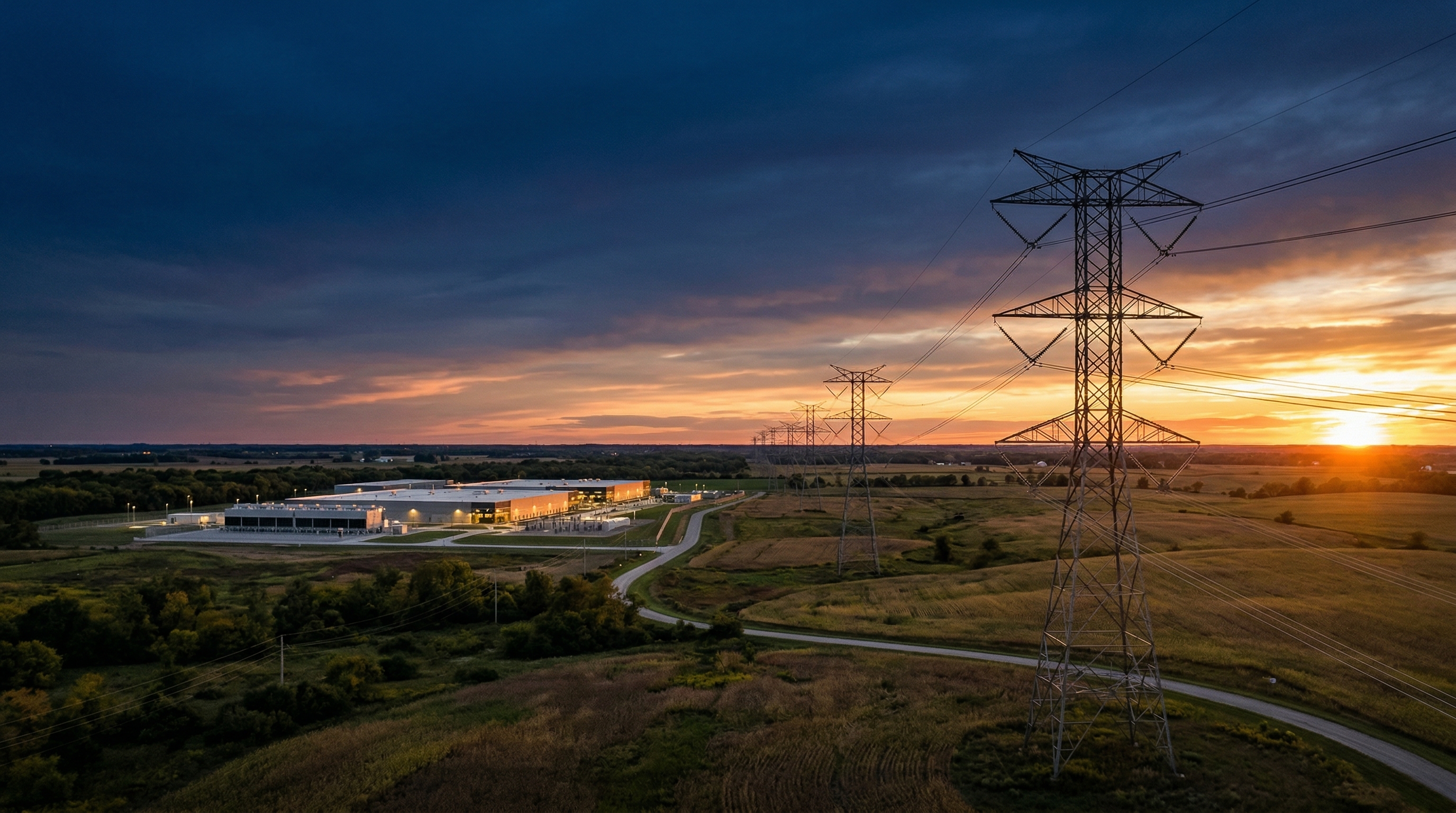
MISO Data Center Power Demand Is Reshaping the Grid
MISO data center power demand is driving $27B in new generation, 1,332 MW of battery storage, and urgent storm replacement.
Three signals dropped in the same week. Michigan approved 1,332 MW of new battery storage tied to a hyperscale data center. Entergy and Meta expanded their Louisiana data center agreement to 5 GW, worth $27 billion. And Winter Storm Fern’s damage report confirmed that MISO territory distribution infrastructure is already failing under existing loads.
Put together, the picture is clear: MISO data center power demand is rewriting the equipment procurement calendar for every utility and distributor operating in the footprint.
Michigan Goes All-In on Battery Storage for Data Centers
On March 27, the Michigan Public Service Commission approved six battery energy storage projects totaling 1,332 MW for DTE Electric (Michigan PSC, March 2026). Three of those projects, at 332 MW combined, exist specifically to support the Oracle-OpenAI Stargate data center in Saline Township: a $16 billion, 1,383 MW facility that will increase DTE’s total load by 25%.
That 25% figure is worth sitting with. One customer. One site. A quarter of the utility’s load.
DTE projects an 8.4 GW data center pipeline behind Stargate. Consumers Energy, the state’s other major utility, projects 2.65 GW of data center demand by 2035 (Yahoo/WLNS, March 2026). Michigan alone is looking at roughly 11 GW of data center load in the pipeline, and the equipment to support it has to come from somewhere.
The DTE Electric battery storage approval is one of the largest single-state BESS procurement events in U.S. history. At 4-hour duration, the 1,332 MW portfolio translates to approximately 5,328 MWh of battery capacity. Each site needs medium-to-high-voltage step-up transformers, inverters, switchgear, protective relaying, and balance-of-plant electrical. The 450 MW Big Mitten Energy Center alone requires 100+ MVA class transformers.
Entergy Meta Data Center Buildout Reaches 5 GW
Farther south in MISO territory, the numbers get bigger. Entergy Louisiana and Meta expanded their Hyperion Data Center agreement in March to a total capacity of 5 GW, roughly seven times the peak power demand of New Orleans (Entergy Press Release, March 2026). The deal includes $27 billion in investment through a joint venture with Blue Owl Capital.
What does 5 GW of data center capacity actually require? Start counting: ten combined-cycle natural gas plants generating 7,700 MW. Two hundred forty miles of new 500 kV transmission lines running from South Louisiana into Arkansas. Eight new substations. Eight new 230 kV transmission lines. Up to 2,500 MW of solar and battery storage.
The first piece, a $1.2 billion, 100-mile 500 kV line between Rayville and Delhi, is targeted for operation by December 2026 (Transformer Magazine, March 2026). That is not a future plan. That is a current procurement event.
Each of the ten gas plants needs generator step-up transformers in the 300-500 MVA class. Each substation needs HV/MV step-down units. Every mile of 500 kV line needs conductor, structures, and protection equipment. This single project could consume a meaningful share of annual U.S. large power transformer production capacity at a time when LPT lead times already sit at 128 weeks (Wood Mackenzie, Q2 2025).
And Entergy is not stopping at Meta. The company has seven data center projects across Louisiana, Mississippi, and Arkansas, serving customers including AWS, Google, Avaio Digital, and Hut 8. CEO Drew Marsh has cited a 5-10 GW total pipeline across the Entergy footprint (Entergy, March 2026).
Storm Fern Exposed Failing Utility Infrastructure as Data Centers Keep Building
The third signal matters because it shows the other side of the equation. While MISO data center power demand is pulling new equipment into the territory, the existing infrastructure is breaking.
Winter Storm Fern in January 2026 hit 34 states, caused 2+ million customer outages, and killed between 153 and 174 people (Electrek, January 2026). The critical finding for procurement planners: distribution infrastructure was the primary failure mode, not generation.
Entergy Louisiana lost 700+ poles, 2,300 wire spans, 170 transformers, and 60 substations (Grist, January 2026). Nashville Electric Service lost 800+ poles and saw 230,000 customers go dark. TVA lost more than two dozen transmission lines. MISO declared an Energy Emergency Alert Level 2 for its North and Central regions, with electricity prices varying 2-15x between northern and southern zones.
NERC CEO Jim Robb testified to Congress calling Fern a “classic near-miss” and warned that nearly two-thirds of the country faces elevated risk of energy shortfalls over the next five years (Energy Central, 2026). Nashville has established a Winter Storm Response Commission with policy recommendations due in 12 months.
All of that destroyed equipment enters a replacement queue in a market already constrained by rising tariffs, extended lead times, and the data center buildout described above.
MISO Grid Modernization Meets Replacement Demand
These three signals point to the same conclusion. MISO territory is becoming the national convergence point for utility infrastructure data center investment and weather-driven replacement demand, happening at the same time, drawing from the same equipment supply pool.
For regional distributors in the MISO footprint: the equipment you stock and the allocation you hold is about to face competition from billion-dollar hyperscale projects and storm recovery programs simultaneously. Lead times that seemed manageable six months ago may not hold.
For municipal utilities and smaller co-ops: when DTE, Entergy, and Consumers Energy are placing multi-year orders for transformers, switchgear, and conductors to serve data centers, the smaller orders get pushed to the back. The same dynamic is playing out in PJM territory with the $33 billion Ohio data center megaproject. As we covered in The State of Transformer Procurement in 2026, power transformer lead times at 128 weeks leave almost no buffer for unexpected demand spikes.
The scale of MISO data center power demand is not a 2028 problem. It is a now problem. The question is whether your procurement timeline reflects that.
DistroForge Intelligence Reports provide detailed equipment availability analysis, supplier lead time tracking, and procurement timing recommendations for specific MISO territory equipment categories. Request a sample report to see what we cover.
Related Reading
- What a $33 Billion Ohio Power Project Means for Regional Equipment Procurement: The parallel megaproject in PJM territory creating the same equipment pressure.
- The State of Transformer Procurement in 2026: Current lead times, pricing trends, and supply constraints across all transformer categories.
- What IEEE PES T&D 2026 Reveals About Grid Procurement: IEEE PES dedicated an entire Data Center Stage to this trend at the 2026 conference.
Transformer Market Outlook — Q2 2026
National supply analysis, lead time data, and pricing benchmarks across the U.S. transformer market. 18 pages of sourced intelligence.
The Grid Brief
Lead times. Pricing shifts. Funding deadlines. Delivered Thursday mornings.