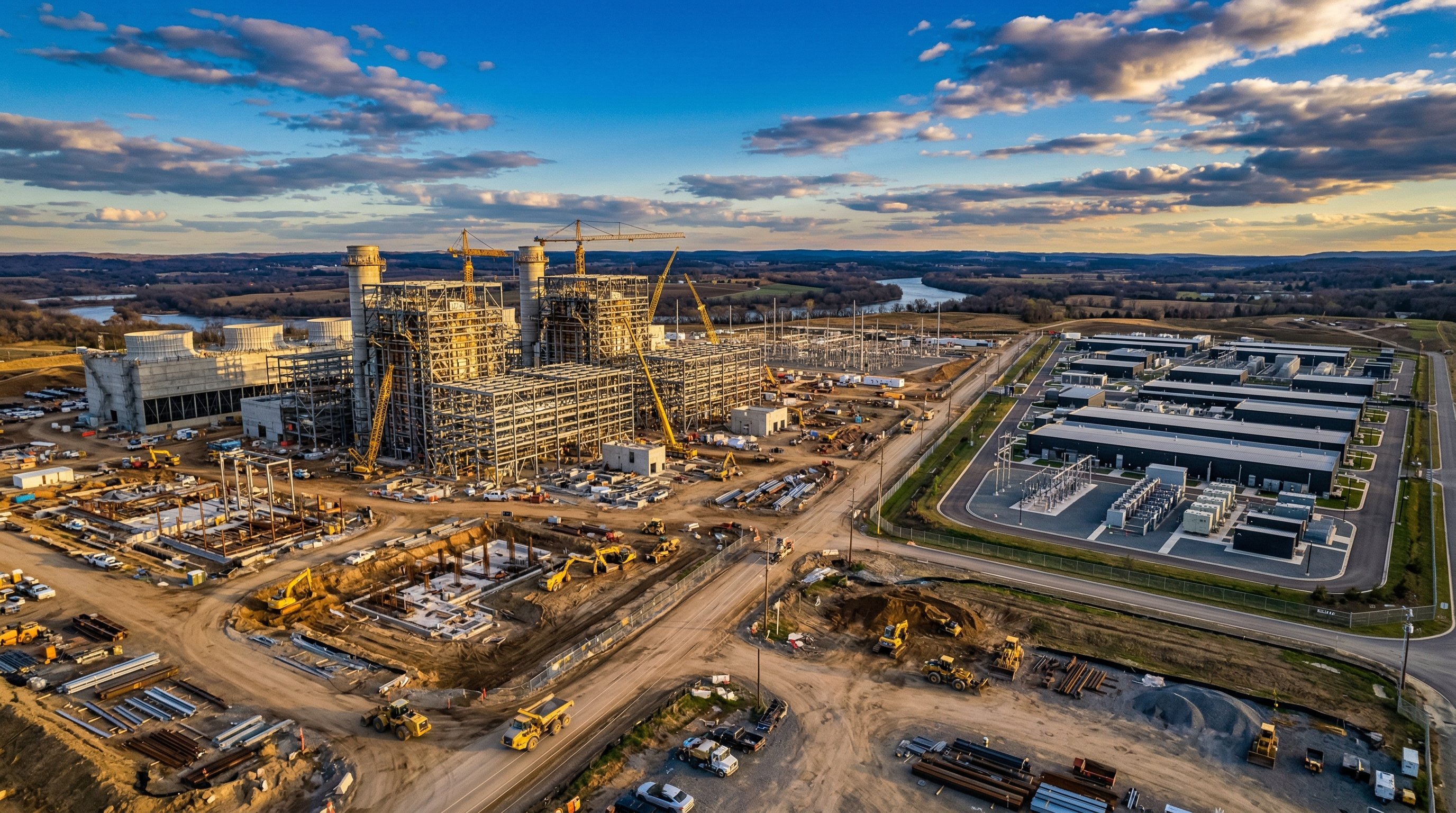
What a $33 Billion Ohio Power Project Means for Regional Equipment Procurement
A $33 billion data center and power generation project in Pike County, Ohio will reshape transformer and switchgear demand across the region. Here is what distributors and utilities need to prepare for.
The largest single energy infrastructure investment in U.S. history just broke ground in Pike County, Ohio. SoftBank, AEP Ohio, and the Department of Energy are building a 10 GW data center campus on the site of the former Portsmouth Gaseous Diffusion Plant in Piketon. The price tag: $33 billion. The procurement implications for every distributor and utility in the Ohio Valley are already showing up.
The Numbers Behind the Project
The project breaks down into two major components. SB Energy, SoftBank’s energy subsidiary, will develop 9.2 GW of new natural gas generation to power the data center campus. AEP Ohio and SB Energy have jointly committed to $4.2 billion in new electrical transmission infrastructure to connect that generation capacity to the grid.
That $4.2 billion in transmission alone translates into thousands of transformers, miles of high-voltage cable, and hundreds of switchgear assemblies. The Portsmouth Consortium, a group of 21 companies from the U.S. and Japan, will deliver the project. Bechtel and Kiewit are leading construction.
This project is part of the U.S.-Japan Strategic Trade and Investment Agreement signed in October, under which Japan committed $550 billion toward American infrastructure. Pike County is the first and largest implementation site. SB Energy has committed to covering transmission costs directly, keeping Ohio ratepayers off the hook.
What This Means for Equipment Demand
A 10 GW power generation complex needs step-up transformers at every generating unit. Substation transformers to step voltage down for distribution. Switchgear for protection and isolation at dozens of interconnection points. All of it on a timeline that starts in late 2026.
The project team has already begun securing long-lead items, including high-voltage electrical equipment. That is a signal worth paying attention to. When a $33 billion project starts locking in transformer and switchgear orders before construction begins, it pulls inventory from the same supply pool that every regional distributor and municipal utility draws from.
Regional distributors in Ohio, Kentucky, and West Virginia should expect tighter allocation on power transformers and medium-voltage switchgear for the next three to five years. This is not a one-time order. It is a sustained, multi-year draw on the regional equipment supply chain.
Context: 50 GW of Data Center Load Already Online
This Ohio project does not exist in isolation. FERC data shows 50 GW of data center capacity was online across the U.S. by the end of 2025, with MISO territory seeing 43% annual growth since 2020. ERCOT, SPP, and the Southeast have also seen rapid expansion.
Each gigawatt of data center load requires roughly 1.2 to 1.5 GW of generation capacity when you account for reliability margins and cooling loads, plus the full complement of T&D infrastructure to move that power. The cumulative effect on transformer and switchgear demand is not theoretical. It is showing up in lead time quotes right now.
Distribution transformers have improved to 26-40 week lead times for standard units. Power transformers still sit at 128 weeks (Wood Mackenzie, Q2 2025). Pad-mount three-phase units are tightening again as utility-scale projects compete with residential and commercial orders. The Pike County project will add significant pressure to all three categories.
Three Things Procurement Teams Should Do Now
1. Reassess your 2027-2028 transformer orders. If you operate in PJM territory or source from manufacturers with Ohio-region plants, your lead time quotes from six months ago may no longer be accurate. The Pike County project is large enough to shift regional allocation priorities at every major manufacturer.
2. Diversify your switchgear sourcing. Medium-voltage switchgear for substations and interconnection points will be in high demand as 10 GW of new generation comes online. If your current supplier serves the data center or industrial market, expect competition for production slots.
3. Watch for secondary demand effects. This project will create thousands of construction jobs and drive housing, commercial, and infrastructure development across southern Ohio. That secondary development generates its own distribution equipment needs, from pad-mount transformers for new subdivisions to switchgear for commercial buildings. The ripple effect extends well beyond the project site.
Who Benefits, Who Gets Squeezed
Large regional distributors with existing manufacturer relationships and volume commitments are best positioned. They have the order history and purchasing power to maintain allocation priority even as demand surges.
Smaller distributors and municipal utilities face a different reality. APPA has documented that public power entities sit lower on the manufacturer priority list compared to large IOUs and national distributors. A $33 billion project backed by SoftBank will command manufacturer attention. Smaller buyers may find themselves pushed further back in the queue.
Cooperatives in the Ohio Valley may benefit from the Rural Utilities Service Electric Loan Program, which Congress increased to $7 billion for FY2026. Access to capital for early transformer orders could offset some of the allocation pressure. And for any federally funded procurement, BABA compliance requirements add another layer of planning that teams should start now.
The Long View
Construction begins in late 2026 and will continue for years. This is not a procurement event. It is a procurement era. The equipment demand from Pike County will overlap with the transformer shortage that has persisted since 2021, the ongoing data center boom across PJM, and new DOE efficiency standards that are pushing manufacturers to retool production lines.
Distributors and utilities that build their procurement plans around current conditions will be caught off guard. The ones that plan for sustained regional demand pressure, starting now, will maintain their ability to serve customers when lead times stretch further.
DistroForge tracks transformer lead times and regional demand signals for utility distribution teams. If you need procurement intelligence on the Ohio market, reach out.
Sources:
- DOE Fact Sheet: Affordable Energy Access in Ohio (March 2026)
- Construction Dive: Bechtel, Kiewit Tapped for $33B Ohio Project (March 2026)
- Utility Dive: DOE Taps SoftBank for 9.2 GW Gas Generation (March 2026)
- Daily Energy Insider: DOE, AEP Ohio, SoftBank Unveil Major Investment (March 2026)
- Wood Mackenzie T&D Supply Chain Survey (Q2 2025)
The monthly read on where this is heading
A single Pike County project is already pulling transformer and switchgear allocation away from smaller Ohio Valley buyers, and that kind of regional squeeze is easy to miss until a lead-time quote comes back longer than expected. The Feeder is our free monthly digest of the procurement signals that move utility and distribution equipment buyers: lead-time shifts, supplier capacity, federal funding, and the RFP language that follows. One email a month, no filler.
Track this beat without paying per report
Free Member tier. Pick your topics. Get a monthly digest filtered to what you actually buy.