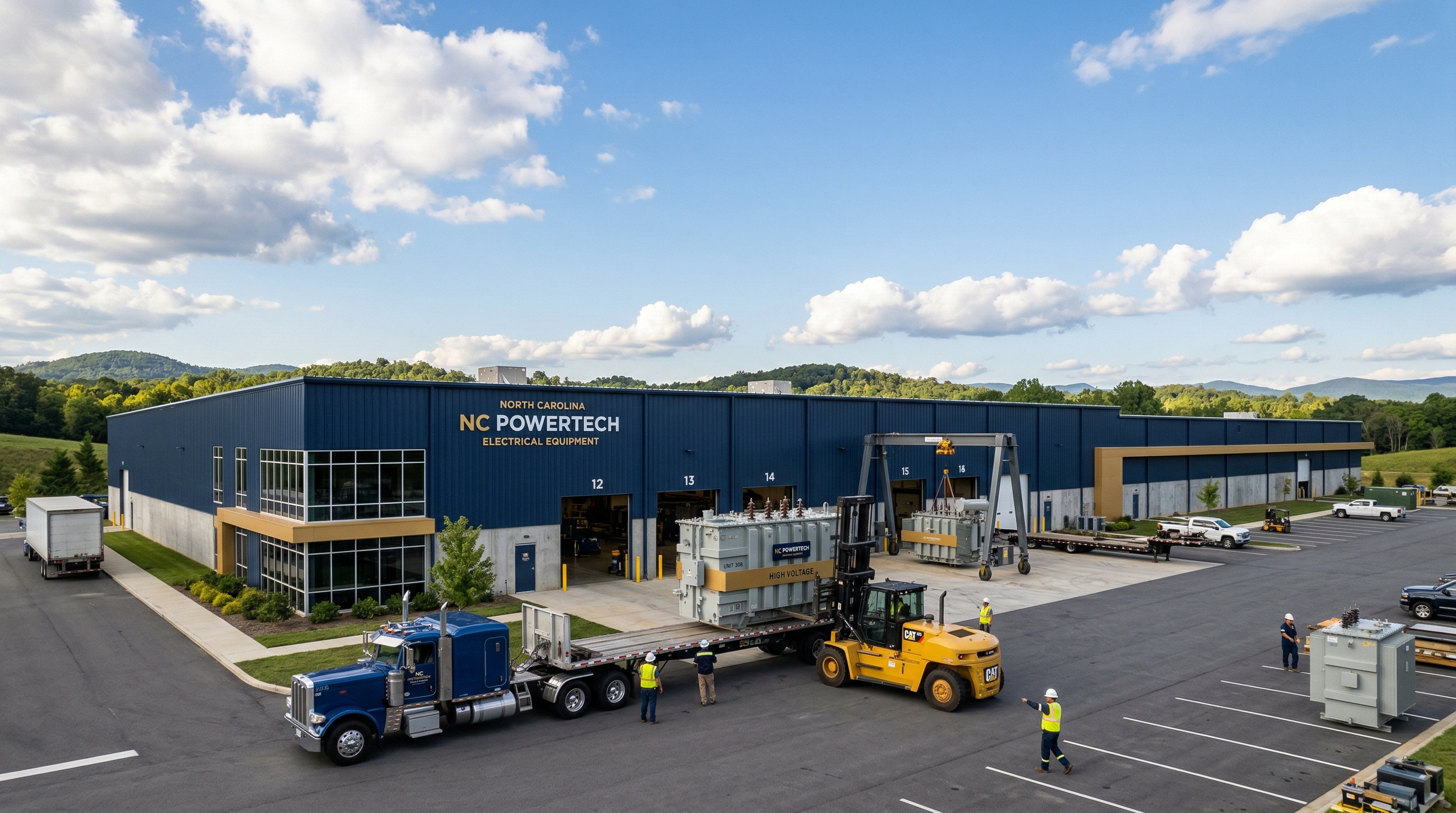
NC Grid Equipment Manufacturing Hub: $185M+ Invested
Three grid equipment manufacturers are building facilities in North Carolina, totaling $185M+ in investment. What this means for procurement lead times.
North Carolina is becoming the Southeast’s grid equipment manufacturing center. Three separate companies announced new or expanded facilities in the state within the past year, representing more than $185 million in combined investment. For procurement teams tracking domestic sourcing options, this concentration of capacity in a single state is worth watching closely.
The three investments: Siemens Energy’s $150 million transformer factory in Charlotte, TSEA Energy’s $25 million voltage regulator plant in Eden, and Hitachi Energy’s $10 million engineering and testing center in Cary. Each serves a different segment of the grid equipment supply chain. Together, they will create more than 900 jobs and add production capacity that the U.S. grid badly needs.
TSEA Energy: Brazilian Voltage Regulator Maker Plants a Flag in Eden
TSEA Energy, a Brazilian manufacturer with products deployed in over 50 countries since 1968, chose Rockingham County for its first U.S. manufacturing facility. The company announced a $25 million investment in a 160,000-square-foot plant in Eden that will produce voltage regulators, large power transformers, and mobile substations (NC Governor’s Office, March 24, 2026).
The numbers tell an interesting story. About 90% of TSEA’s current production already ships to the U.S. market (T&D World, March 2026). Building stateside eliminates tariff exposure on those products and positions the company to certify units under Buy America, Buy America (BABA) domestic content rules. The Eden facility will manufacture voltage regulators rated up to 1,100A nominal current and 36.2 kV nominal voltage, with electronic controls that include modern communication protocols and cybersecurity features.
The 160 jobs carry an average salary of $66,554, well above Rockingham County’s $46,154 average. North Carolina offered a $300,000 performance-based grant from the One North Carolina Fund, contingent on TSEA hitting job creation and investment targets (Business North Carolina, March 2026).
TSEA’s move follows a pattern. WEG, another Brazilian manufacturer, announced a $77 million transformer plant expansion in Washington, Missouri in 2025. Brazilian manufacturers see the same opportunity: Section 232 tariffs on imported grid equipment make domestic production cost-competitive, and the 80-to-210-week lead time crisis for transformers means new entrants can find buyers immediately.
Hitachi Energy: Power Electronics and Cybersecurity Hub in Cary
Hitachi Energy is taking a different approach in North Carolina. Rather than building a production line, the company is investing $10 million in a 32,000-square-foot Power Electronics Center of Competence in Cary, scheduled to open in fall 2026 (Hitachi Energy press release, April 2, 2026).
The facility will house 150 engineers working on STATCOMs, fixed series compensation systems, synchronous condenser systems, and HVDC technologies. It will also serve as Hitachi Energy’s global cybersecurity hub for operational technology environments.
Why does a testing and engineering center matter for procurement? Because it localizes system integration and performance validation in the U.S. Right now, many power electronics projects require overseas engineering support that adds weeks to project timelines. Putting those engineers in Cary means faster turnaround on custom specifications and commissioning support.
This $10 million is a fraction of Hitachi Energy’s broader commitment. The company pledged over $1 billion in North American manufacturing investment in 2025, including a massive transformer plant in South Boston, Virginia, and expansions in Jefferson City, Missouri ($80 million) and Alamo, Tennessee ($106 million) (Industrial Info Resources, 2024). The Cary center adds engineering depth to a supply chain that already has production scale.
Siemens Energy: The $150 Million Anchor in Charlotte
The largest single investment is Siemens Energy’s $150 million transformer manufacturing plant in Charlotte. This is the company’s first U.S. large power transformer factory, with production expected to start in early 2027 (POWER Magazine, 2026).
Charlotte is already home to significant Siemens Energy operations, so this facility expands an existing footprint rather than starting from scratch. The plant will employ approximately 600 workers and is designed to produce large power transformers for transmission-class projects.
Siemens is building this factory into a market where large power transformer lead times average 128 weeks, and generator step-up (GSU) transformers average 144 weeks (Utility Dive, April 2026). Those backlogs exist despite $185 billion in U.S. electrical manufacturing investment since 2018, according to the National Electrical Manufacturers Association. Demand is simply outrunning supply.
For procurement teams evaluating long-lead-time transformer bids, a new domestic factory with 600 workers represents a real addition to bid options within the next 12 months.
Why North Carolina? Three Factors Converging
NC’s appeal comes down to workforce availability, geographic positioning, and state incentive programs. But there is a more specific factor at work.
North Carolina sits at the intersection of PJM and the Southeast reliability region. Utilities in both territories face intense demand growth, driven by data center construction in Virginia and the Carolinas and by federal grid modernization funding flowing through the IIJA and IRA programs.
PTT Inc., another transformer manufacturer, invested $102 to $103 million in Hoke County, NC, adding 217 jobs (Hoke News, February 2025). Count PTT’s investment and North Carolina’s grid equipment manufacturing cluster exceeds $287 million across four facilities.
The geographic concentration matters for logistics. Transformers are heavy and expensive to ship. A manufacturer in Charlotte can serve Duke Energy, Dominion, TVA, and dozens of municipal utilities within a day’s trucking distance. That proximity reduces freight costs and, in some cases, delivery timelines.
What This Means for Procurement Teams
Three practical implications for anyone issuing RFPs for grid equipment in 2026 and 2027.
Your domestic supplier list is growing. TSEA’s voltage regulators, Siemens’ large power transformers, and Hitachi’s power electronics engineering all expand the set of U.S.-sourced options. For projects subject to BABA requirements, that is directly relevant. More domestic production means fewer waiver applications and fewer sole-source justifications.
New capacity does not mean short lead times yet. NEMA projects 2% annual demand growth for electrical equipment through 2050 (Utility Dive, April 2026). That is a 30-year demand signal. The $185 billion already invested since 2018 has not cleared existing backlogs. New facilities in NC will help, but they will not fix the transformer procurement challenge overnight. Plan lead times accordingly.
Watch for regional supply chain risk. North Carolina, South Carolina, Tennessee, Virginia, and Texas now host the majority of new U.S. grid equipment manufacturing capacity. A major hurricane, labor disruption, or logistics bottleneck in the Southeast could affect multiple suppliers simultaneously. Procurement teams should track geographic diversification in their supplier mix, not just price and lead time.
The Bigger Pattern
NC’s grid equipment manufacturing concentration is one piece of a national reshoring wave. Eaton is building a $340 million transformer facility in South Carolina. ERMCO is expanding in Tennessee and Wisconsin. A 430,000-square-foot plant opened in Waco, Texas, last April with projected annual capacity exceeding $1 billion in production (Utility Dive, April 2026). We previously attributed that plant to “MGM/VanTran” on the understanding that MGM had acquired VanTran. It had not. Both were bought separately by the sponsor Neos Partners and now sit inside Forgent Power Solutions (NYSE: FPS), which matters more for a bid sheet than for a plant list: buyers holding MGM and VanTran as two alternate sources hold one. (Corrected 2026-08-21)
The bet these manufacturers are making: tariff protection stays in place, federal funding keeps flowing, and grid demand keeps climbing. All three of those conditions look durable based on current policy and demand projections. Chinese transformer imports are already down 10%, and the companies investing hundreds of millions in domestic plants clearly expect that trend to continue.
For procurement professionals, the question is not whether domestic capacity is expanding. It is. The question is whether it is expanding fast enough to change your sourcing timeline on the projects you are bidding right now. In most cases, the answer is still no. But the pipeline of new capacity is real, and the facilities in North Carolina represent one of the densest concentrations of investment anywhere in the country.
Start building relationships with these manufacturers now. By the time their production lines hit full capacity in 2027 and 2028, early customers will have allocation priority and better pricing.
Our reports go deeper, with manufacturer capacity analysis, lead time tracking, and procurement strategy recommendations. Subscribe to The Feeder for the free monthly read on domestic manufacturing capacity and lead time shifts.
Related Reading
- BABA Compliance for Transformer Procurement. Which manufacturers can certify domestic content.
- Section 232 Tariff Impact on Grid Equipment. How tariffs are driving domestic investment decisions.
- Transformer Procurement in 2026. The full picture on lead times, pricing, and sourcing strategy.
- How to Evaluate Transformer Bids in Long Lead Times. Bid scoring when delivery timelines stretch past two years.
- DOE SPARK Grid Funding 2026. Federal funding driving equipment demand.
Free RFQ templates. Weekly digest. Yours.
Free Member tier. Pick your topics. Get a weekly digest filtered to what you actually buy.