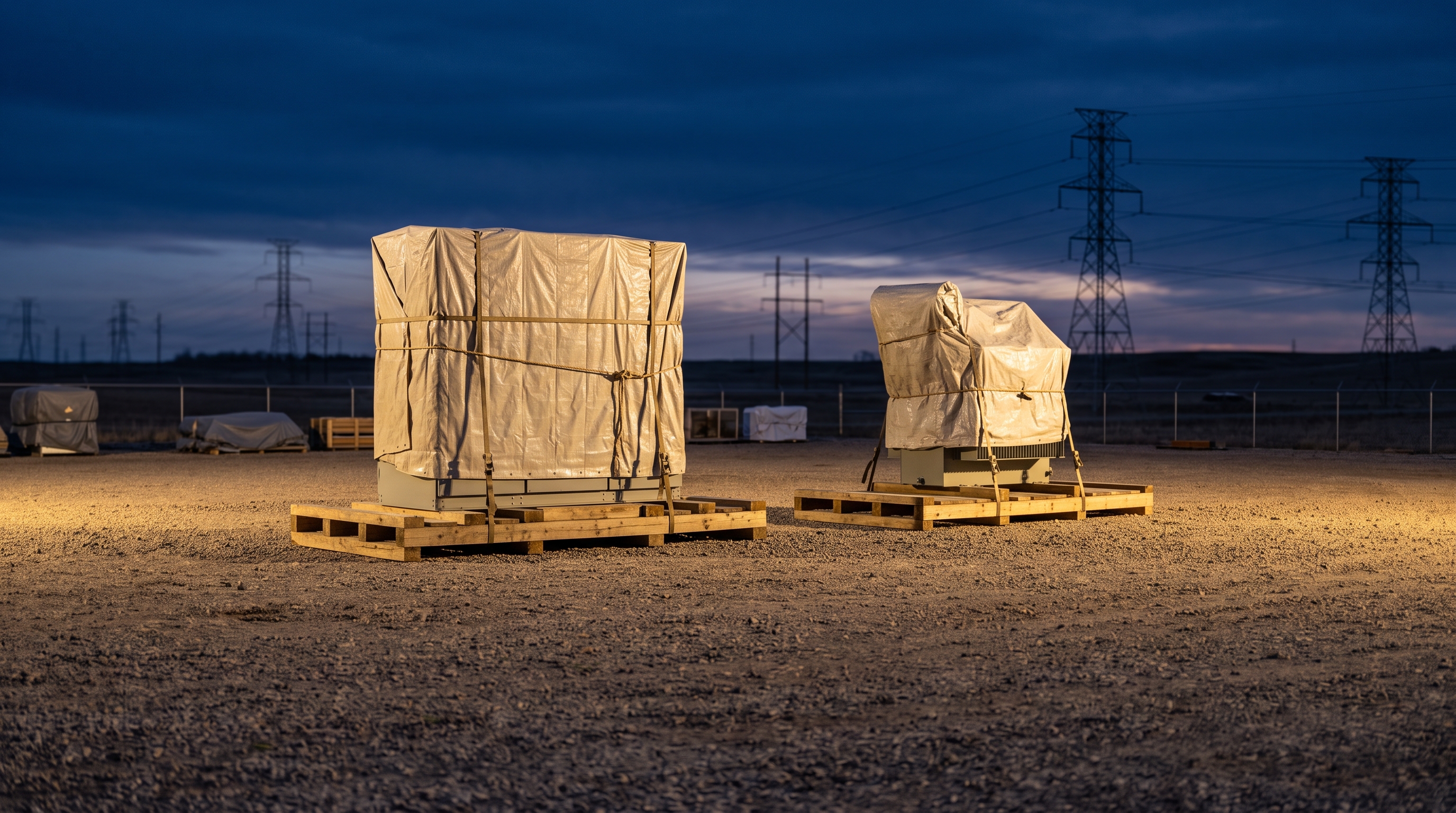
Owner Furnished Equipment Procurement Risk Starts Earlier
Owner furnished equipment procurement risk now lands before the design is finished. What a limited notice to proceed commits, and what it does not.
Mike Kotara has watched a line move. Speaking at the Energy Projects Conference and Expo in Houston in June 2026, the Zachry Group senior vice president and power market executive described how owners used to split a project’s equipment with their contractor. “In the past, they typically would buy the combustion turbines, maybe the steam turbine, typically leave the [heat] recovery steam generators, other equipment, balance of plant equipment for the EPCs.” Then: “Now, what they’re having to do is go out and buy extended scope packages.”
Owner furnished equipment procurement risk is what sits on the other side of that sentence, and it is landing earlier in the schedule than most procurement functions are staffed for. POWER reported the remarks on August 3, 2026. They matter to a municipal utility or a cooperative for a reason that has nothing to do with combustion turbines: the same shift, running down the same supply base, decides who holds the risk on a switchgear line-up or a substation transformer.
The EPC Extended Scope Package Came Back to the Owner
An engineering, procurement and construction contract is supposed to price certainty. The contractor takes the scope, the schedule and a good deal of the supply risk, and the owner pays for that transfer. What Kotara describes is the transfer running backwards on the equipment leg. The EPC extended scope package is no longer something the contractor absorbs and prices. It is something the owner goes out and buys.
Kotara is direct about why, and the reason is not a preference. “The EPC can’t take on that risk.” A contractor asked to guarantee a delivery date it cannot itself obtain from the factory is being asked to underwrite a promise nobody upstream will make. Faced with that, the contractor declines the scope rather than mispricing it, and the scope has to land somewhere. It lands on the owner.
For anyone below the transmission system this is less a change than a confirmation. Municipal utilities and cooperatives have always bought their own transformers and their own switchgear. What the conference remarks establish is that the largest and best resourced owners in the country, on the biggest projects in the country, are now being pushed into the same position, and are absorbing it on equipment they used to hand off. Nobody further up the market has found a way out of this that a smaller buyer could copy.
What a Limited Notice to Proceed Equipment Purchase Actually Commits
The instrument doing the work here is worth naming, because it is the part that converts a market shift into a specific exposure on a specific project. Kotara again: “You’re doing that under maybe a limited notice to proceed that allows you to buy equipment at risk, at the owner’s risk.”
A limited notice to proceed equipment purchase is an authorization to start spending on a defined slice of the job before the full contract exists and before the design is finished. It is a reasonable answer to a real problem. Kyle Harris of Kiewit put the pressure plainly at the same event: “In order to get cost certainty, you have to move your decision-making to the left on the timeline. Every day that you don’t make a decision is really something that is going to drive costs up.”
Read those two remarks together and the trap is visible. Cost certainty pulls the ordering decision earlier. Design maturity pushes it later. A limited notice to proceed is how the industry splits that difference, and the owner keeps the difference. The order is placed against a design that can still change, so the exposure runs past a late delivery. Equipment can arrive on time and correct for a design that no longer exists.
That reframes the question a procurement team should be asking before it signs one. Not “can we afford to commit now,” which is a budget question, but “which attributes of this order survive a design change.” Ratio, impedance, enclosure type, bushing configuration and clearance envelope do not all carry the same risk of being rendered wrong by a downstream revision. Writing the order so the volatile attributes stay open, using the same discipline that goes into or equal specification language, is cheaper than discovering after the fact which ones mattered.
A Filed 10-Q Says the Customer Buys the Materials
A conference panel is one source, and a conference panel about gas plants is an awkward one to hang a distribution procurement argument on. There is a second primary, from an unrelated party, in a document with a very different standard of care behind it.
Centuri Holdings is one of the larger union electrical contractors in the country. Its Form 10-Q for the quarter ended June 28, 2026 states the position without hedging: “Generally, our contracts provide that the customer is responsible for supplying the materials for their projects.” Owner direct purchase long lead equipment arrangements are not an emerging practice this contractor is bracing for. They are the standing default, disclosed to the SEC.
Two unrelated primaries, a spoken remark from a Zachry executive and a filed financial statement from a different company, put the buyer in the same seat. That is what makes this safe to plan against rather than merely interesting.
The Centuri filing carries a second fact that cuts the other way, and the two should be planned separately rather than folded into one worry about a tight contractor market. Centuri completed its acquisition of J.J. White on July 20, 2026, a Philadelphia contractor founded in 1920 with close to 1,000 employees, more than 950 of them union field staff, whose stated focus is power generation, data centers and industrial end markets. Those crews now sit inside Centuri’s Union Electric segment, which the same filing describes as “primarily focused on infrastructure between the substation and end-user meter.” That is distribution, in an SEC filing, in the same reporting segment as capability being aimed at data center work.
So the effects separate cleanly. Contractor consolidation increases competition for union electrical crews, particularly in the Northeast and Midwest. It does not reduce a distribution buyer’s equipment burden at all, because the buyer was always the one supplying the material and is now being asked to supply it sooner. One of those is a labor availability question to confirm market by market. The other is a procurement question that arrives on every project regardless.
The Liquidated Damages Delivery Guarantee Went First
Buying earlier and at your own risk only works if the date you bought is real, and the contractual instrument that used to make it real has been withdrawn. Jeff Gulach of National Grid Ventures, who spent 36 years on the EPC side, told the same conference that original equipment manufacturers and distributors have retreated from delivery guarantees once backed by liquidated damages. Note that distributors are named in that sentence alongside the factories.
His own numbers give the scale of what now rides on an unbacked date: a four-year lead time on his most recent 345 kV breaker purchase, and a complaint he says he hears constantly, “My switches were supposed to be here eight and a half months ago, and they’re not here.”
The mechanism behind that particular failure is a contract term rather than a factory problem, and it is the one most likely to be missing from a buyer’s checklist. Gulach: “You took your eyeball probably off of the production slot, and your [purchase order] allowed the distributor or the OEM to sell your production slot.” The unit was never being built for you in the way the buyer assumed. Our guide to what a quoted date is actually backed by works through the three questions that separate a contractual date from an indicative one, and our read on production slot reservation covers how the OEMs are booking that capacity on the other side of the same transaction.
Stack the two shifts and the compounding is the real finding. Owner furnished equipment procurement risk is not simply that the buyer holds the purchase order. It is that the buyer commits capital earlier, on less design, for equipment whose promised date carries weaker contractual backing than it did three years ago. Neither shift is dramatic alone. Together they move a large amount of schedule risk onto the party with the smallest procurement team.
Standardization Is What Makes an Early Order Survivable
The owners furthest into this have converged on the same answer, which is worth attention because they arrived at it independently and for different stated reasons.
Entergy Louisiana chief executive Phillip May described building the same combined cycle plant repeatedly: “We’re stamping out these things, we’re building the same CCCT over and over again,” framed around giving skilled craft five, seven or ten years of job certainty. QTS builds “the same 3-MW chunk over and over and over again.” NRG’s 5.4 GW partnership with Kiewit is built on a standardized design intended for repeated use. Chevron repeats identical equipment trains across projects against a documented minimum functional case.
Job certainty, capital discipline and speed are three different motives arriving at one behavior. The procurement logic underneath is the part a smaller buyer can use: a repeating design is what makes an early order survivable. If the next substation is the same substation, an order placed under a limited notice to proceed cannot be stranded by a design change, because the design is not going to change. Standardization is usually sold as a cost lever. In this market it is a risk lever, and it is the specific one that offsets buying early.
There is a channel question hiding inside the same theme, and it deserves flagging rather than asserting. QTS fabricates entire electrical rooms off site, which would move switchgear, panelboard and PDU purchasing from a site contractor to a fabrication shop buying identical assemblies on repeat. That is a different buyer with a different order cadence from the same underlying demand. One company doing it is a datapoint and not a trend, and we are treating it as something to watch rather than something to plan around.
What This Changes for a Municipal or Cooperative Buyer
Four things follow, and none of them requires price data or a supplier relationship you do not already have. Owner furnished equipment procurement risk is a scheduling problem before it is a sourcing problem, and it is cheapest to handle in that order.
Treat the ordering decision and the design decision as separately scheduled events, because the market has already separated them. Know which long lead items you would have to commit to before design completion on your next substation or feeder rebuild, and know today which of their attributes a late design change could invalidate.
Ask what the quoted date is backed by before you ask whether it can be improved. A date carrying liquidated damages and a date carrying nothing look identical on a quotation. The remedy on slip, and whether your purchase order permits your production slot to be reassigned, are the two terms that decide which one you are holding. That same reading applies to evaluating bids when lead times run past two years.
Confirm crew availability as a regional question rather than a national one. Consolidation is a reason to check the Northeast and Midwest more carefully on your construction window. It is not evidence that national craft capacity is exhausted, and the utility contractors reporting this year have generally said the opposite.
Discount the demand figures driving all of this, including the ones in your own board packet. ERCOT’s large load queue stood near 474.7 GW as of June 2026, roughly 420.8 GW of it identified as data centers, of which about 7 MW has actually energized. A queue position is not a project, which is why pipeline figures need discounting before contracted ones can be read against them.
Where the Next Contracting Shift Shows Up
Changes like this one surface in conference remarks and quarterly filings months before they reach a specification or a purchase order template. We read the filings and the dockets so the terms show up on your checklist while there is still time to write them into the next order.
The Feeder is our free monthly read on what changed and what it means for the next order. No cost, one email a month.
Related Reading
- Equipment Production Slot Reservation Replaces the Order
- How to Evaluate Transformer Bids When Lead Times Exceed Two Years
- How to Write Or Equal Specification Language
Frequently Asked Questions
What is owner furnished equipment?
Equipment the project owner buys directly from the manufacturer or distributor and supplies to the contractor for installation, rather than having the contractor buy it inside its own scope. On a utility project it typically covers the long lead items: transformers, switchgear, breakers and protection equipment.
What is a limited notice to proceed?
A partial authorization that lets a party start and spend on a defined slice of work before the full contract is executed or the design is complete. Owners are using one specifically to place long lead equipment orders early, which is why the equipment is bought at the owner's risk.
Does hiring an EPC contractor transfer equipment procurement risk?
Not by default, and the direction is moving the other way. Centuri Holdings, a major union electrical contractor, states in its Form 10-Q for the quarter ended June 28, 2026 that generally its contracts provide that the customer is responsible for supplying the materials for their projects.
Are suppliers still backing delivery dates with liquidated damages?
Less than they were. Speaking at the Energy Projects Conference and Expo in June 2026, Jeff Gulach of National Grid Ventures said original equipment manufacturers and distributors have retreated from delivery guarantees once backed by liquidated damages, as reported by POWER on August 3, 2026.
Track this beat without paying per report
Free Member tier. Pick your topics. Get a weekly digest filtered to what you actually buy.