Cooperative Utility Data Center Load Meets a 936 MW Fleet
A cooperative utility data center load of 1.8 GW is landing on a G&T that owns 936 MW. What Kentucky's public dockets show muni and co-op buyers.
Cooperative utility data center load stopped being a hypothetical on July 29, when a coalition led by Brookfield and NextEra Energy announced a $100 billion privately funded data center campus at the Department of Energy’s Paducah Site in western Kentucky. The campus will support up to 1.8 GW of utility capacity and over 1.2 GW of compute capacity, fully constructed by 2032.
The wholesale electric service provider is Big Rivers Electric Power Corporation, a generation and transmission cooperative. Retail service sits with Jackson Purchase Energy Cooperative, a distribution co-op. Paducah Power System, a municipal utility, is named in a supporting community role.
Big Rivers owns and operates 936 MW of generating capacity across three power stations. Its total power capacity, including contracted capacity, is 1,114 MW.
Read those two numbers next to each other. The load arriving on this system is roughly 1.6 times the cooperative’s total capacity position and close to twice the generation it actually owns.
G&T Cooperative Capacity Planning Was Never Built for This
Almost every large-load story in the trade press for the past eighteen months has been an investor-owned utility story. PG&E discounting its own interconnection pipeline, Exelon screening queue entries with collateral-backed agreements, Duke building a new tariff class, NV Energy in litigation with a developer. Those utilities have staffed transmission planning departments, standing supplier panels, and rate cases scheduled years out.
That is not what is happening in western Kentucky. A distribution cooperative and a municipal system are now counterparties to one of the largest single loads in the country, and the procurement cadence at organizations that size was built for feeder rebuilds and storm replacement, not for a campus that will draw more than the G&T’s whole fleet produces.
The generation question, at least, has an answer on paper. NextEra is building up to 4.6 GW of dedicated resources specifically for the project, so the campus is not simply subtracting from Big Rivers’ existing supply. The announcement frames this as meeting the load with new supply rather than passing costs to current residential and small-business ratepayers, and cites the voluntary Ratepayer Protection Pledge as the commitment behind that framing.
A pledge is a promise. What actually binds anyone here is a commission order, and Kentucky is unusual in that the order is already visible.
Kentucky PSC Data Center Dockets Are Already Public
The power service agreement with Big Rivers and Jackson Purchase requires oversight and approval from the Kentucky Public Service Commission. That agreement has not been filed yet, so its terms are not knowable and nobody should pretend otherwise.
But this is not the first time Big Rivers has taken a data center contract to the commission, and the earlier one is on the public record right now.
Case No. 2026-00115 covers a proposed electric service contract among Big Rivers, Kenergy (another member distribution cooperative), and Justified DataPower, a subsidiary of TeraWulf, for a 482 MW facility at the former Century Aluminum site in Hawesville. The commission held a public meeting on it July 28. Its structure is worth reading closely, because it is the closest thing to a template a co-op board is going to find:
- A 15-year term with take-or-pay obligations for the first six years. The load commits to pay for a defined block whether or not it consumes it, which is what converts a speculative campus into a financeable revenue stream.
- Wholesale market pricing through MISO, rather than a negotiated rate carved out of the existing tariff.
- A mandatory curtailment provision that removes the data center from the grid before residential and business customers during a supply shortage.
That third term is the one procurement teams should sit with. A contractual obligation to shed a block that size is not a clause, it is a capital program. It implies metering and telemetry the utility can audit in something close to real time, protective relaying and transfer schemes that can drop the load without destabilizing everything downstream of it, and a communications path back to utility dispatch that works on the worst day of the year. We wrote about load flexibility becoming an equipment specification when the trend was still mostly a talking point. In Kentucky it is contract language filed with a commission.
The Hawesville docket also drew organized opposition. Residents at the July 28 meeting raised higher rates for existing customers, noise near a school about a mile away, environmental impact, and thin local economic benefit.
What the Commission Can and Cannot Decide
The commission was direct about the limits of its own authority in that proceeding: its jurisdiction runs to whether rates and service are fair, just and reasonable. Siting, water use, and noise are not its call.
For a muni or co-op buyer, that boundary is the practical lesson, and it cuts in two directions.
On the good side, the cost-allocation structure gets decided on a public record that any other cooperative can read, copy, and cite. Compare that to states where the same question is being resolved through private arbitration or a lawsuit, where the terms actually agreed to never become visible to the next buyer facing the same negotiation. Kentucky is settling by structure what other states are settling by litigation, and the by-product is a public library of workable contract language.
The limit is that a docket protects the bill and nothing else. A finding that rates are fair, just and reasonable says nothing about whether the equipment to serve the load can be delivered on the schedule the contract assumes. Commission approval is not a manufacturing slot.
The Generation Mix Is a Storage Order, Not a Gas Order
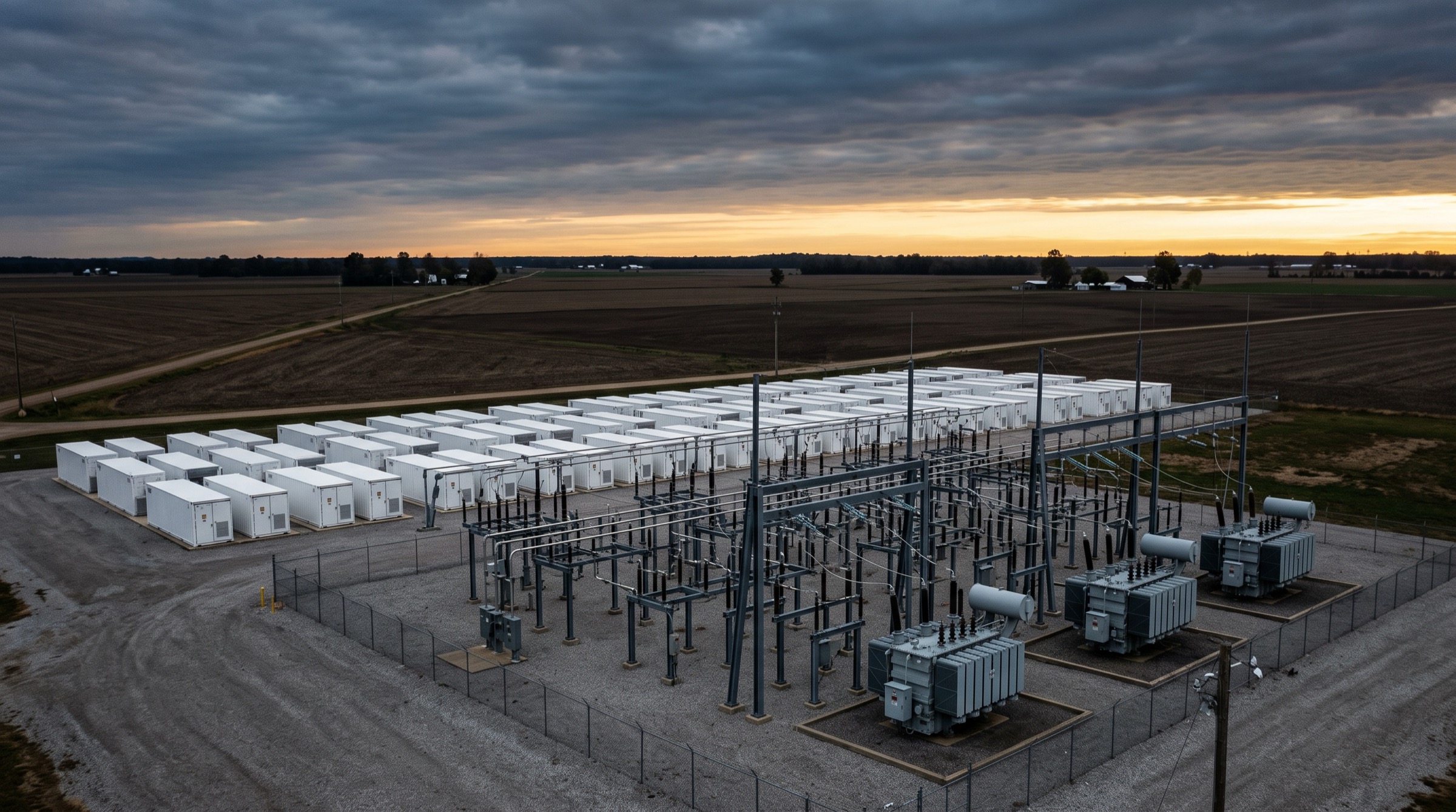
The dedicated generation for Paducah breaks down as up to 2 GW of natural gas and up to 2.6 GW of battery energy storage. Storage is the larger half.
That ratio matters more to equipment buyers than the headline capacity does. A gas build concentrates spend in turbines, generator step-up transformers, and a relatively small number of high-voltage positions. A 2.6 GW storage build spreads it across power conversion systems, medium-voltage collection, a much larger count of medium-voltage transformers, switchgear lineups, and protection. It is a different bill of materials drawing on a different bench of suppliers, and it lands in a segment already reporting heavy forward booking.
Nobody outside the project knows the split between what the generation developer procures and what the utilities procure. But the interconnection, substation, protection, and metering scope on the utility side of that fence is real, it is on a 2032 clock, and the ordering decisions that determine whether 2032 holds are being made now, not in 2030.
What a Municipal Utility Large Load Interconnection Actually Asks of You
If a load larger than your entire system shows up in your service territory, the useful questions are narrower than the headlines suggest. Three of them do most of the work.
Who is the counterparty, and does the agreement go to the commission? A contract reviewed on the record produces terms you can point to later. A contract that does not is a private arrangement your members will eventually ask you about, and you will have nothing to show them.
What does the generation mix imply for your scope? Gas and storage pull different equipment, on different lead times, from different suppliers. The mix tells you which queue you are standing in before the first purchase order is written.
What is your substation, protection, and metering scope against the in-service date? Work backward from it. Every cooperative utility data center load agreement now on file assumes an equipment delivery schedule that nobody in the room controls, and the party holding that risk is usually the utility, not the developer.
None of this requires the scale of an investor-owned utility to get right. It requires reading the dockets that already exist. The co-ops and munis that come out of this decade well will be the ones who treated somebody else’s filed contract as free consulting, and Kentucky is currently handing it out.
Our utility procurement intelligence guide tracks the large-load contract structures and cost-allocation templates shaping the 2026 buying window.
The Feeder is our free monthly read on the regulatory and procurement signals that move equipment demand. We cover what each commission order and interconnection agreement means for buyers before it reaches your lead times. Subscribe to The Feeder and start the next month ahead of the buying cycle.
Related Reading
- IEEE PES T&D 2026: A Muni and Co-op Procurement Field Guide
- H.R. 9340: Ratepayer Protection Act Narrows to Data Centers
- Modular Substations: The Data Center Lead-Time Lever
Know what changed before your next quote
Free Member tier. Pick your topics. Get a weekly digest filtered to what you actually buy.