IEEE PES T&D 2026: A Muni and Co-op Procurement Field Guide
What ComEd, Hubbell, and the IEEE PES T&D 2026 vendor floor are telegraphing about the spec language municipal utilities and cooperatives will see in 2027 and 2028 procurement orders.
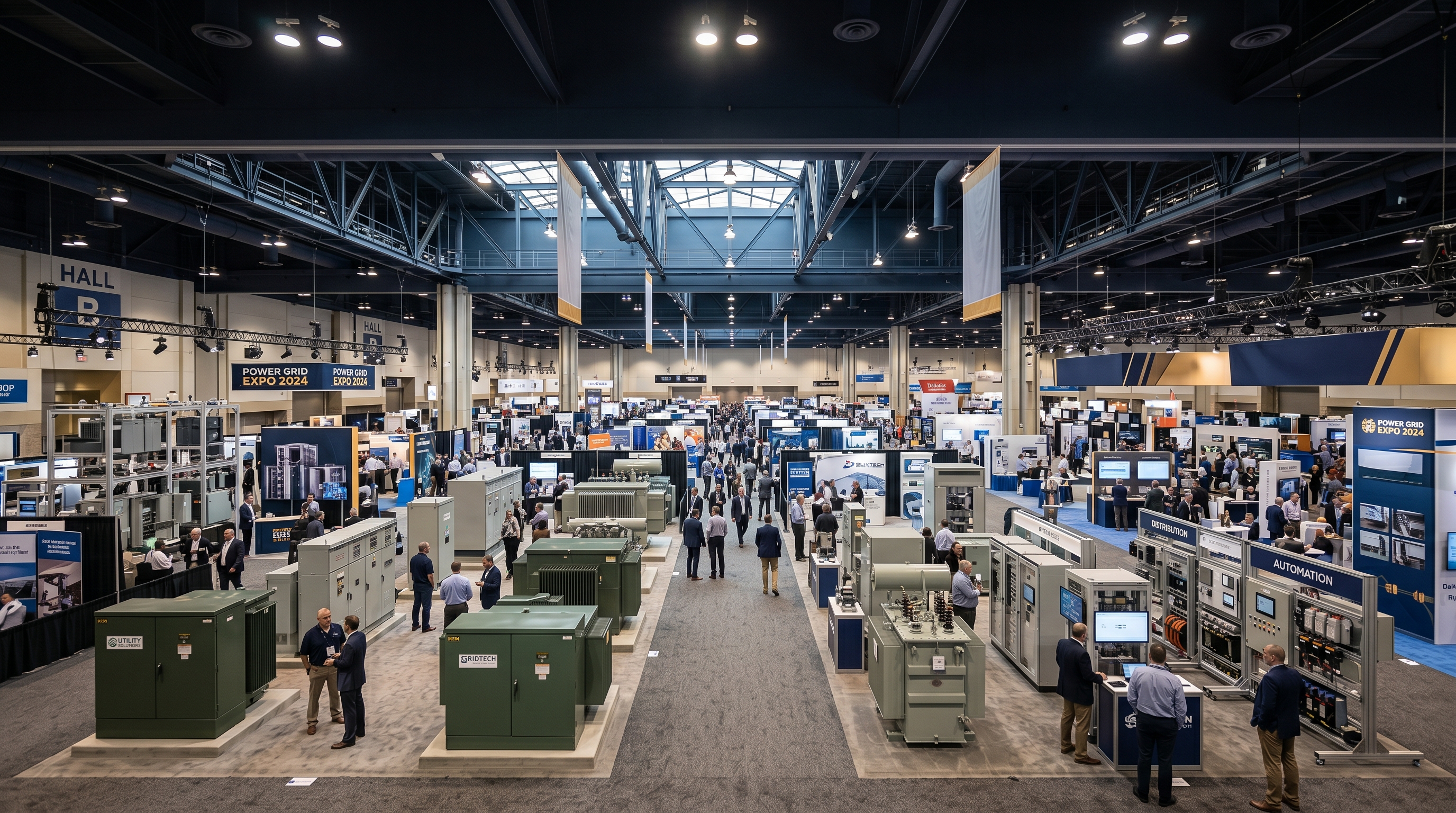
If you run procurement for a municipal utility or a cooperative, the muni co-op procurement IEEE PES T&D 2026 read is not the press releases. It is the spec language that walks back to your desk eighteen months later, embedded in your next state PUC order, your next GRIP grant application, or your next mutual-aid contract. The May 4-7 conference at McCormick Place is the largest IEEE PES T&D event in history at over 15,000 attendees and 800-plus exhibitors. What you should take away from it is a forecast of the technical requirements you will be writing into bid documents in 2027 and 2028.
The lighthouse utility this year is ComEd, the Exelon subsidiary serving roughly four million customers across northern Illinois. The Hubbell product showcase, headlined by the AIS-9 and AIS-10 pad-mount switchgear lines and the LineDefender single-phase recloser, is the equivalent signal on the manufacturer side. Read together, they tell smaller utility procurement teams three things about the next two years.
ComEd’s Modernization Stack Is the 2027 Spec Template
Lighthouse utilities like ComEd do not invent procurement requirements. They demonstrate them at scale, and three to five years later the same language appears in commission orders for the utilities downstream of them.
ComEd’s currently visible stack, drawn from public Illinois Commerce Commission filings and prior coverage of the utility’s flexible interconnection program, includes:
- A distributed energy resource management system (DERMS) managing roughly 8 GW of distributed resources, with 1.4 GW of solar already interconnected and residential DER connections growing 114% annually.
- A flexible interconnection program scaling from 50 MW per year to 100 MW per year, targeting 650 MW by 2031.
- A $1.5 billion grid plan approved by the Illinois Commerce Commission in late 2024 covering 2028-2031.
- An advanced technology budget of $406 million for fiber, DERMS platform expansion, and grid-edge sensors, after the Environmental Law and Policy Center successfully cut the original $909 million ask.
Now look at what the conference programming says about that stack. The “Future of Grid Automation: Securing ADMS, DERMS and Beyond” super session on Thursday morning lists Eversource, DTE, SEL, and S&C Electric on the panel and is moderated by ComEd’s own Dale Player. The “Power Puzzle: Large Load Integration” super session puts PJM’s Aftab Khan, Dominion’s Matt Parker, and Exelon’s Diana Sharpe in the same room. SEL is sponsoring an entire dedicated Data Center Stage on the exhibit floor, which is a first for a T&D event historically organized around heavy iron.
For municipal and cooperative procurement managers, that combination is not background noise. It is a preview of what your state’s PUC staff and your federal grant reviewers will treat as the bare minimum for new feeder, substation, and distribution-automation procurements by 2028. Three concrete implications follow.
Distribution automation hardware needs to be DERMS-ready out of the box. The smart inverter, the pad-mount switchgear, the recloser, and the substation automation controller all need to communicate cleanly with whatever DERMS or ADMS platform the utility (or the state) eventually deploys. “DERMS-ready” should appear in your spec, with named protocol support (DNP3, IEEE 2030.5, IEC 61850) called out explicitly. Equipment without it is buying you a forced replacement in 2030.
Communications backhaul is now part of the equipment spec, not an afterthought. Fiber, private LTE, or hybrid backhaul belongs in the equipment-class specification, not in a separate IT line item. Coops working with the Rural Utilities Service and munis applying for GRIP-funded distribution automation upgrades are already being asked about backhaul architecture in scoring rubrics.
Flexible-interconnection language is migrating from optional to expected. The ComEd model where 650 MW of community solar gets interconnected at lower cost via curtailment-managed feeders is being studied by California, Colorado, and New York. Munis and co-ops in DER-heavy service territories should expect their state commissions to ask about flexible-interconnection capability in the next rate case after the next one. That has direct procurement implications: smart inverters with managed-curtailment hooks, sensors capable of feeder-level state estimation, and SCADA-ready switchgear become the floor.
Hubbell’s Bundled Pad-Mount Is the New Procurement Comparable
The most procurement-relevant manufacturer signal at IEEE PES T&D 2026 is not a single product. It is the way Hubbell has packaged its distribution-equipment portfolio for muni and co-op buyers.
The product set Hubbell is showcasing at booths 631 and 3662:
- AIS-9 air-insulated switchgear: three-phase, two switch ways plus two fuse ways, dead-front pad-mount design.
- AIS-10 air-insulated switchgear: three-phase, four switch ways, dead-front pad-mount design.
- Motor-operated AIS: medium-voltage, SCADA-integrated, designed for remote operation and automated switching on underground networks.
- LineDefender single-phase recloser: stays in the cutout after lockout and can be ground-reset, cutting arc-flash exposure and eliminating the climb to reset.
- Pad Vault foundation systems: two-piece (74 by 114 by 40 inches) and one-piece (72 by 120 by 30 inches), plus PB74764360036 polymer concrete switchgear box pads.
The differentiator is not any single product. It is the integrated foundation-and-switchgear bundle. In the existing pad-mount switchgear market (Eaton’s VFI line, S&C’s Vista and PMH, G&W’s Trident and Lazer, ABB’s SafeRing and SafePlus, Schneider’s RM6 and FBX) the utility or the distributor sources foundations and vaults separately, typically from Oldcastle, Quazite, or Strongwell. Hubbell bundles them. For a municipal utility staring at a lineworker shortage and a fixed engineering services budget, the bundle removes one engineering review cycle and one purchase-order line. Pricing comparisons that look only at the breaker box will miss the labor differential.
The LineDefender positioning is the second tell. Single-phase reclosers compete in a crowded market against G&W’s Viper-ST, S&C’s IntelliRupter, Eaton’s NOVA, Tavrida, and ABB’s Grid-Shield. Hubbell is leading with safety: ground-resettable, stays in the cutout after lockout, no climb required. That language is aimed squarely at cooperative boards, where a single lineworker injury can dominate a board meeting for a year, and at small munis where the same five linemen handle every storm. Expect that safety framing to migrate into bid evaluation criteria. Co-ops in the Southeast and Midwest are already weighting safety features beyond the conventional cost-and-spec scoring.
This matters for one practical reason. When a small utility writes a pad-mount switchgear spec in 2026, the conventional comparable set is Eaton, S&C, G&W. After IEEE PES T&D 2026, Hubbell belongs in the same comparable set, especially when the project also includes a foundation buy and is bundling SCADA-ready instrumentation. Procurement teams that have not refreshed their pre-qualified vendor lists in three years should plan to do that in 2026 ahead of the Q4 specification cycle.
What Spec Sheet Should You Carry to the Show
If you are sending a procurement officer, a planning engineer, or a board member to McCormick Place, the takeaway should not be a stack of glossy brochures. The list of questions worth bringing back is short and specific.
For pad-mount switchgear vendors:
- Does the unit support DNP3 over fiber and IEC 61850 GOOSE messaging without a third-party gateway?
- Is the foundation system sold as part of the same purchase order, or do we still source it separately?
- What is the current factory lead time for AIS-9 and AIS-10 equivalents in your line, and where does that sit relative to your 2025 baseline?
- What is the SF6 status, given that EU F-gas regulations are pulling alternatives into the North American buyer’s evaluation set? (See our SF6-free switchgear procurement analysis for the broader context.)
For recloser vendors:
- Can the unit be ground-reset, and if so, is that a standard configuration or an upgrade?
- What is the SCADA module’s communications stack, and is it certified for IEEE 2030.5 alongside DNP3?
- What is the published mean time between failures, and what is the manufacturer’s position on extended-service-area mutual aid for parts?
For DERMS, ADMS, and distribution-automation platform vendors:
- Which of your installations match a service territory of fewer than 500,000 meters, and what is the typical implementation cost at that scale?
- Which feeder-level sensors and pad-mount switchgear lines are pre-integrated, and which require custom integration work?
- What is the licensing model: per-asset, per-MW, or per-customer, and what is the renewal escalation clause?
A muni or co-op procurement officer who comes back from Chicago with crisp answers to those questions has a real foundation for the 2027 budget. A procurement officer who comes back with twelve thousand pages of spec sheets and four lanyards has spent the trade-show budget on a vacation.
What This Means for the Next Twelve Months
IEEE PES T&D happens every two years. The procurement effects of what gets shown there typically compound over the eighteen months that follow. Three things to plan for between now and Q2 2027:
A spec-language refresh in your next major procurement. Whether the next major buy is feeder reclosers, pad-mount switchgear, a DERMS pilot, or a substation automation refresh, the spec deserves a refresh that incorporates DERMS-ready protocol requirements, communications-backhaul integration, SF6 status, and bundled-foundation pricing. Munis and co-ops that have not refreshed their pre-qualified vendor lists since 2023 should treat that as a pre-2027 priority.
A pre-qualified vendor list expansion. Hubbell joining the conventional muni/co-op pad-mount comparables (Eaton, S&C, G&W, ABB, Schneider) is the most concrete change to come out of this event. Add them. Verify Buy America Build America compliance and domestic content certification at PO time given the broader BABA compliance rules for transformer and switchgear procurement.
A workforce-development conversation. ComEd’s emphasis on workforce and the conference’s focus on AI-enabled grid automation point to the same conclusion: the utilities that get this right are not just buying equipment, they are building the talent pipeline (community college partnerships, apprenticeships, IBEW programs) to operate it. Small utilities that try to bolt smart-grid procurement onto a flat headcount plan will be in front of the PUC explaining a reliability dip three years from now.
The IEEE PES T&D 2026 conference itself is four days. The procurement reverberations are the next thirty-six months. Use the show to calibrate your 2027 spec language, not to decide what to put in your 2026 cart.
Want the Full Procurement Picture?
DistroForge reports cover muni and co-op procurement strategy in depth: vendor-by-vendor capacity tracking, lead-time benchmarks across the major switchgear and recloser lines, and procurement-timing recommendations indexed to your next rate case or grant cycle. Reach out to discuss your 2027 procurement planning.
Want the research behind this?
The vendor questions above work for one trade-show trip; the pre-qualified vendor lists, spec-language templates, and manufacturer dossiers behind membership carry that same checklist into every RFQ you write next year. The Insider library holds the deeper version: topic deep-dives, manufacturer and utility dossiers, the RFQ and spec template set, and the full report archive. Membership runs $9.99 a month and opens all of it.
Related Reading
- IEEE PES T&D 2026: What the Conference Reveals About Grid Procurement. Our broader read on the conference programming.
- SF6-Free Switchgear Procurement: 2026 Utility Buyer’s Guide. The parallel spec-language shift on circuit breakers.
- PG&E Undergrounding Filing: 5,000 Miles Proposed to 2037. Demand-side context for pad-mount switchgear, vault transformers, and cable.
- The Pad-Mount Transformer Procurement Crisis. Companion analysis on the equipment class most exposed to the demand wave.
Free RFQ templates. Weekly digest. Yours.
Free Member tier. Pick your topics. Get a weekly digest filtered to what you actually buy.