Solid-State Transformers: $500 Million and 140 Years of Disruption
Half a billion in venture capital says the conventional transformer's days are numbered. Here's what utility procurement teams need to know right now.
Half a billion dollars is a serious signal. That is roughly what venture capital firms poured into solid-state transformer startups between mid-2024 and early 2026. Five hundred million dollars into a technology competing directly with a product that has not fundamentally changed in 140 years.
Whether the SST displaces the conventional transformer in your service territory in 5 years or 25 years, the capital flows are telling you something: the procurement calculus for grid-connected power electronics is about to get complicated. This is what your planning team needs to know.
What a Solid-State Transformer Actually Is
Start with the physics. A conventional transformer works on Faraday’s law of electromagnetic induction: two coils of copper wire wrapped around a silicon-steel core, magnetically coupled at line frequency (60 Hz). Simple, reliable, and essentially unchanged since the 1880s.
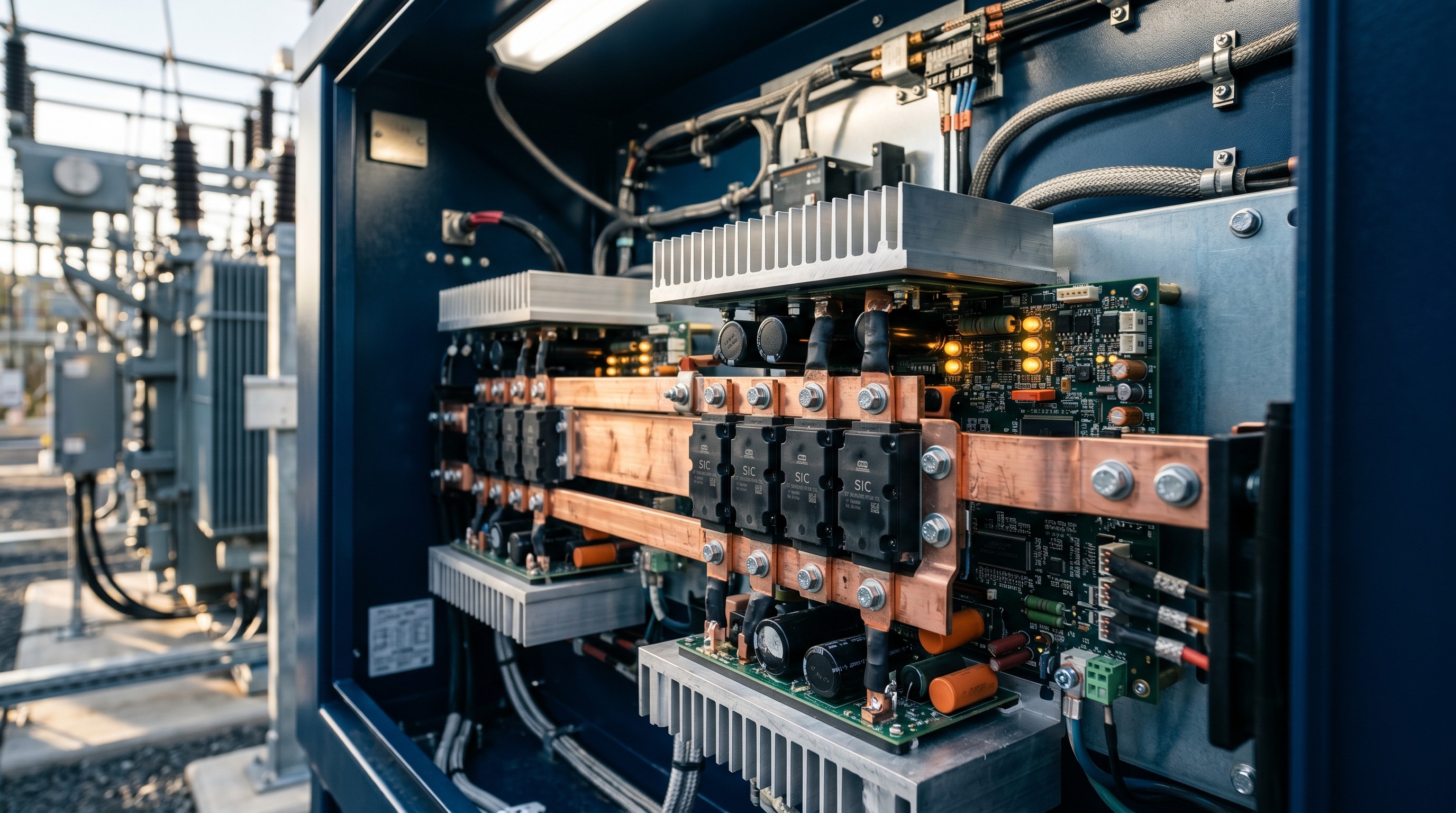
A solid-state transformer does the same job through a different path. It converts the incoming AC to high-frequency AC (10-100 kHz) using power electronics, steps that high-frequency signal up or down through a compact isolation transformer, then converts back to AC at the output. The high-frequency operation is what shrinks the magnetic core. Transformer size scales inversely with frequency, so running at 10,000 Hz instead of 60 Hz cuts core volume by orders of magnitude.
The practical result: 75-90% reduction in weight and volume compared to an equivalent conventional transformer.
That weight reduction is not just an engineering curiosity. A conventional 2.5 MVA distribution transformer weighs roughly 4,000-6,000 lbs. An SST at the same rating could weigh under 500 lbs. For the U.S. Navy, that math translates directly into ship-killing tons of displacement per vessel. For utilities, it means transformer installations in spaces that were previously impossible.
The dominant architecture today is called Type C or three-stage: an AC-DC rectifier stage, an isolated DC-DC converter using the high-frequency transformer, and a DC-AC inverter stage at the output. That intermediate DC bus is more than a design detail. It is what gives SSTs capabilities conventional transformers simply cannot match.
The Capabilities That Are Driving the Money
Active voltage regulation. Bidirectional power flow. Native DC bus access. Grid-forming capability.
These four features are why investors writing nine-figure checks think SSTs are worth the bet.
Active voltage regulation means an SST can hold output voltage at spec regardless of input fluctuations. No separate voltage regulator. No tap-change mechanism. For distribution feeders carrying high solar penetration, where voltage swings 10% in either direction across the day, that matters.
Bidirectional power flow matters for a grid where distributed energy resources (rooftop solar, battery storage, vehicle-to-grid) are pushing electrons in both directions. Conventional transformers pass current both ways in an emergency, but SSTs manage bidirectional flow cleanly, at rated capacity, as a standard operating condition.
The DC bus is the feature that has data center hyperscalers writing purchase orders. NVIDIA’s 800V HVDC architecture, which is becoming the standard for dense AI compute deployments, requires direct medium-voltage to 800VDC conversion. A conventional transformer and rectifier combination handles this in 2-3 discrete stages, each with conversion losses. An SST does it in one, with software-controlled output matching exactly what the server racks need.
Grid-forming capability is the ability to synthesize a stable voltage and frequency reference from stored energy. That is the technology that makes microgrids and islanded operation manageable. For utilities building resilience into distribution networks, this is significant.
Who Is Building This Technology (and Who Is Writing the Checks)
The money is concentrated in a small number of well-capitalized startups. The incumbents, with one exception, are watching from a distance.
Heron Power is the headline. The company raised $178 million total through early 2026, with founders who came out of Tesla’s energy operations. Their claimed order book is 50+ GW, and they are building a manufacturing facility targeting 40 GW per year of production capacity. For context, the entire U.S. distributed transformer market runs roughly 30-40 GW equivalent per year. If those numbers hold, Heron Power alone is planning to be a category-defining manufacturer within a few years.
Amperesand, backed by $92.5 million from investors including Temasek and Breakthrough Energy Ventures, has the most credible proof point in the field: a 1.5 MW grid-connected SST that has been operating in Singapore since 2022. Not a lab demo. Not a pilot. Four years of continuous operation. They are deploying 30 MW of additional capacity in 2026.
DG Matrix raised $80 million and claims to offer the first commercially available multi-port SST. The company grew out of North Carolina State University’s FREEDM Systems Center, which has been doing foundational SST research since 2008. When NC State FREEDM researchers spin out a company, the underlying power electronics engineering tends to be serious.
Eaton is the outlier among incumbents. In August 2025, Eaton acquired Resilient Power for terms that included a significant upfront payment plus performance-based earn-outs. Resilient Power had been developing SST technology specifically for data center and grid-edge applications. That acquisition signals that at least one major switchgear and transformer manufacturer sees the technology as real enough to buy it rather than develop it internally.
The investors funding the rest of the field include a16z, Chevron Technology Ventures, and several sovereign wealth funds. The Goldman Sachs projection for the SST data center market alone exceeds $50 billion annually after 2030. Grand View Research valued the overall SST market at $169 million in 2024, with a trajectory toward $936 million by 2030.
Most of the other major transformer manufacturers (Siemens, Schneider, Howard, WEG, Hyundai) are not chasing SST development. They are expanding conventional transformer capacity, because that is what customers are buying right now and that is what generates revenue. That is a rational business decision, not a strategic error. But it does mean the next generation of the technology will not come from the companies most utilities currently rely on.
The Data Center Pull Is Real and Already Happening
The immediate commercial market for SSTs is not utility distribution. It is data centers.
Rack power densities that were 10-15 kW per rack two years ago are moving toward 100-300 kW for GPU-intensive AI workloads, with some projections putting hyperscale AI racks at 600 kW to 1 MW per rack by 2027. At those densities, the inefficiency of cascaded conversion stages (medium voltage AC to 480V AC to 480V DC to 48V DC to chip-level power) adds up to meaningful wasted electricity and, more importantly, wasted floor space in facilities where every square foot costs real money.
Delta Electronics deployed SSTs at Chindata’s hyperscale campus in China in February 2026. That deployment is the reference architecture that every major colocation and cloud provider is now watching.
NVIDIA’s 800V HVDC specification is not a science experiment. It is the direction the company’s compute architecture is moving, and suppliers to NVIDIA-dependent facilities are being told to get ready for it. Direct medium-voltage to 800VDC conversion, which SSTs handle natively, eliminates the intermediate 480V AC stage entirely.
The signal for utility procurement teams: the first large-scale SST deployments at your largest commercial accounts will probably happen in your service territory before you deploy any SSTs yourself. That changes the interconnection picture. It changes the protection coordination picture. It changes what your metering infrastructure needs to handle.
The Enabling Technology: Silicon Carbide Hits an Inflection Point
None of this works without the right semiconductor. Conventional silicon power transistors can’t switch fast enough or handle the voltages required for medium-voltage SST applications. Silicon carbide (SiC) devices can.
Wolfspeed launched the first commercial 10kV SiC MOSFET in March 2026, directly from a multiyear DARPA and U.S. Navy research program that developed the technology for shipboard power systems. The Navy’s Solid State Power Substation runs 2.75 MVA at 13.8 kV and saves 170 tons per vessel. That program, now roughly a decade ahead of commercial grid applications, is transferring its knowledge base to the civilian power electronics industry.
The cost trajectory for SiC wafers is the most important number to watch. SiC wafer prices collapsed approximately 67-73% over two years, from around $1,500 per wafer to $400-500. That cost reduction is structural, not cyclical. It is being driven by manufacturing scale-up in the U.S., Europe, and Asia. Wolfspeed’s Mohawk Valley fab in Marcy, New York is the primary domestic SiC source for defense and grid applications with Buy America requirements.
China controls roughly 40% of global SiC wafer capacity. For any SST project using federal funding, that supply chain exposure is a Build America Buy America eligibility question that needs to be answered before procurement, not during project review.
Where the Technology Stands Today: Honest Assessment
The enthusiasm from investors and engineers is real. So are the barriers. Both deserve attention.
The cost problem is large but shrinking. SSTs currently run $500-1,000 per kVA. Conventional transformers, even after the 77-95% price increases since 2020, still cost $60-120 per kVA. That is a 5-15x premium, and it is the single largest barrier to broad deployment. The price gap is closing from both sides. Conventional transformer prices are elevated and SiC costs are falling. But at current trajectories, SST cost parity for distribution applications is years away, not months.
Reliability data is thin. Conventional distribution transformers carry mean time between failure figures of 30-40 years. SSTs have demonstrated 4-5 years of continuous operation in field conditions, mostly in non-utility applications. The IEEE P3105 working group, which is developing the first SST performance standard, does not yet have a published draft. There is no DOE efficiency standard that covers SSTs. Utilities and their regulators are not equipped to evaluate SST reliability claims using existing frameworks.
Protection coordination breaks. This is the technical issue most discussions understate. Conventional transformers pass through fault current at 18x rated capacity or more during a grid fault, which is what allows overcurrent protection devices (fuses, reclosers, breakers) downstream to detect and clear faults. SSTs limit fault current to 1.1-2x rated capacity. Every protection scheme designed around conventional transformer fault current behavior needs to be rethought. That is not a minor modification to existing practice.
No utility has deployed SSTs for standard distribution service. Not one. GE Vernova has DOE funding for a 1 MVA substation SST demonstration. ERMCO/GridBridge has the TIGER Pad, a hybrid conventional/solid-state design at the pad-mount level. These are pilots and demonstrations. They are not deployments at the scale of a distribution upgrade program.
The military is roughly 5-10 years ahead of commercial practice on medium-voltage DC distribution. That gap does not translate cleanly to utility timelines. The Navy can accept higher unit costs, tighter maintenance windows, and more engineering hours per installation than a utility distribution operation can.
Who Is Building SSTs and Who Is Sitting It Out
There is a pattern in how the incumbent transformer manufacturers are responding to SST development that is worth reading carefully.
The major OEMs are not ignoring SSTs. They are watching them. Siemens, Schneider, Howard, WEG, and Hyundai are all investing in conventional transformer capacity expansion, because their order books are full and their customers need conventional transformers right now. That is where the revenue is.
Eaton’s Resilient Power acquisition is the outlier, and it tells you something about how Eaton reads the medium-term market. Resilient Power’s SST technology was specifically targeted at data center and grid-edge applications. That is exactly the market generating commercial SST deployments today. Eaton paid a significant premium to own that technology rather than license it or develop it from scratch.
The DOE is putting money across multiple bets. The FITT program put $20 million across nine SST development projects. ARPA-E’s CIRCUITS program committed roughly $30 million to 21 wide-bandgap converter projects. The DOE has earmarked $3.5 billion for distribution upgrades that explicitly prioritize solid-state platforms.
Federal funding creates a procurement question that most utilities have not yet worked through: when DOE grant conditions specify solid-state platforms, and the SiC components in those platforms largely come from Asian manufacturers, what does BABA compliance actually require? Wolfspeed’s Mohawk Valley fab is the answer for domestic SiC sourcing, but the supply chain analysis needs to happen at project inception, not during closeout audits.
A Realistic Timeline for Procurement Planning
Here is where the technology sits on a timeline, stripped of the hype that surrounds both the optimistic and the skeptical camps.
Now: SSTs are commercially deployed in data center power conversion and EV charging infrastructure. Amperesand’s Singapore installation has four years of operation. Delta’s Chindata deployment is the current hyperscale reference. These are real installations, not labs.
1-3 years out: Solid-state on-load tap changer replacements will be ready for utility pilot programs. The solid-state OLTC is a partial implementation. It uses power electronics for voltage regulation while keeping the conventional magnetic core, and it is the most near-term application that meaningfully changes distribution voltage management.
3-5 years out: Hybrid transformer designs combining a conventional magnetic core with solid-state electronics for voltage regulation and reactive power control will move from pilot to early commercial deployment. This is the path most likely to reach utility procurement teams before full SST replacement is viable.
10-15 years out: Full SST replacement for distribution-class transformers becomes realistic as a mainstream procurement option, assuming the cost and reliability trajectories continue. This is a planning horizon scenario, not a near-term procurement decision.
Not in any planning horizon: Substation-class SSTs at 69 kV and above. The physics and economics of high-voltage SST applications do not currently support a credible development path for bulk transmission-level replacement.
What Procurement Teams Should Do Right Now
The question utility engineers and procurement managers ask most about SST technology is usually framed wrong. It is not “should we buy SSTs?” It is “what do we need to understand now so we are not caught flat-footed when the market shifts?”
Track SiC wafer pricing quarterly. SiC wafer cost is the leading indicator of when SST price parity becomes realistic for distribution applications. When wafer prices approach $200, the cost curve for SSTs changes substantially. That number is publicly tracked through manufacturer earnings calls and industry reports.
Follow IEEE P3105. The first published draft of the SST performance standard will tell you more about near-term utility deployability than any vendor pitch deck. Standard publication signals that regulators, utilities, and manufacturers have agreed on performance baselines. Without it, procurement teams have no objective framework for evaluating SST reliability claims.
Audit your protection coordination assumptions. Any distribution feeder where you are evaluating modernization investments over a 15-year horizon should be documented for current protection coordination philosophy. When solid-state devices with limited fault current contribution enter your system (from customer-owned SST installations at data centers, if nothing else) you will need that baseline to understand what changes.
Ask BABA questions early on any federally funded project. If you are pursuing DOE distribution upgrade grants that specify solid-state platforms, verify the SiC sourcing chain before you submit the application. The domestic supply picture is manageable through Wolfspeed’s Mohawk Valley fab, but it requires deliberate planning.
Watch what the hyperscalers are installing. The data centers in your service territory are going to be your first exposure to SST interconnection questions. Delta’s Chindata deployment model is spreading. When a major colocation facility requests interconnection for an 800V HVDC architecture, your engineering team should already understand what that means for metering, protection, and power quality on the feeder.
For conventional transformer procurement decisions in the next 2-3 years: plan on conventional equipment. Lead times are still running 2.5 years for large units, prices remain elevated, and SSTs are not a near-term substitute for distribution-class transformers in utility service.
For capital planning horizons of 5-10 years, build SST scenarios into your analysis. Not as primary cases. As risk scenarios that inform where you maintain flexibility versus where you lock in long-term commitments to conventional infrastructure.
The $500 million flowing into this space is not going to convert to utility distribution orders next year. But the engineers who understand the technology today are the ones who will be positioned to make good decisions when it does.
DistroForge tracks equipment technology developments, cost trajectories, and manufacturer capacity as part of its ongoing intelligence work for utility distribution procurement teams. Source data and methodology available on request.
Want the research behind this?
This piece tracks the SST funding and technology timeline at the surface; the manufacturer-by-manufacturer capability comparisons and the SiC supply chain detail go further than we can put in a public post. The Insider library holds the deeper version: topic deep-dives, manufacturer and utility dossiers, the RFQ and spec template set, and the full report archive. Membership runs $9.99 a month and opens all of it.
Frequently Asked Questions
What is a solid-state transformer and how does it differ from a conventional transformer?
A solid-state transformer replaces the copper windings and silicon-steel core of a conventional transformer with power electronics and a high-frequency transformer. The result is a device that can regulate voltage actively, support bidirectional power flow, and provide direct DC bus access, all at 75-90% less weight and volume than its copper-and-iron equivalent.
Are solid-state transformers ready for utility distribution service?
Not yet for standard distribution. SSTs are commercially deployed in data centers and EV charging applications today. Utility-grade pilots are 1-3 years out. Full distribution-class SSTs capable of replacing conventional pad-mounts at scale are a 10-15 year horizon, contingent on cost reductions, reliability improvements, and updated protection coordination standards.
How do solid-state transformer costs compare to conventional transformers?
SSTs currently run $500-1,000 per kVA versus $60-120 per kVA for conventional transformers, a 5-15x premium. However, conventional transformer prices are up 77-95% since 2020, and silicon carbide wafer costs have dropped 67-73% in two years, so the gap is narrowing at both ends.
Which manufacturers are leading solid-state transformer development?
The field is led by well-funded startups: Heron Power ($178M raised, 40 GW/year factory under construction), Amperesand ($92.5M, first grid-connected SST operating since 2022), and DG Matrix ($80M, first commercially available multi-port SST). Among incumbents, only Eaton has made a decisive move with its acquisition of Resilient Power in August 2025.
What should procurement teams do right now regarding solid-state transformers?
Track the technology without committing capital to it. Follow SiC wafer pricing as the leading cost indicator, watch IEEE P3105 for the first draft standard, and note which pilots your peer utilities are running. For any project in the next 2-3 years, plan on conventional transformers. For longer planning horizons, build SST technology scenarios into your capital planning.
Free RFQ templates. Weekly digest. Yours.
Free Member tier. Pick your topics. Get a weekly digest filtered to what you actually buy.