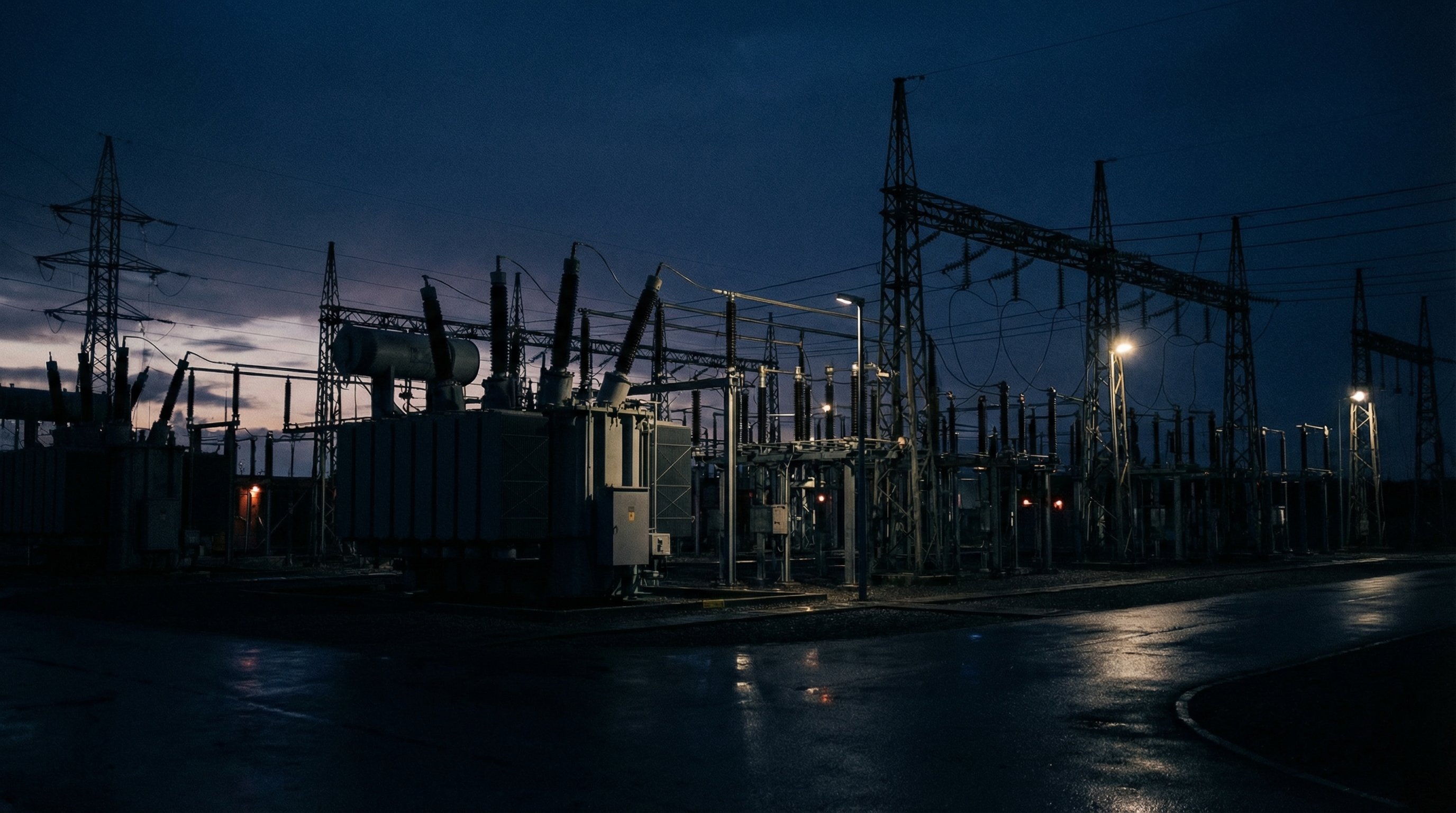
The Triple Squeeze Hitting Utility Equipment in 2026
Record demand, Section 232 tariffs, and $4B in storm damage are hitting the same constrained equipment supply chain at once.
Three forces are bearing down on utility equipment procurement right now. Each one, on its own, would strain supply chains for years. All three are hitting at the same time.
The utility equipment supply crisis of 2026 is not a single problem. It is three problems sharing the same constrained pool of transformers, switchgear, poles, and conductors. Procurement teams that treat these forces as separate issues will get blindsided by the compounding math.
Here is what is converging, and why the utility equipment supply crisis in 2026 demands a different procurement playbook.
Record Electricity Demand Is Pulling Equipment Forward
The EIA’s March 2026 Short-Term Energy Outlook projects U.S. electricity consumption will set records in three consecutive years: 4,195 billion kWh in 2025, 4,244 billion kWh in 2026, and 4,381 billion kWh in 2027 (EIA STEO, March 2026). That 2027 figure represents roughly 3% year-over-year growth, the strongest single-year jump in decades.
The driver is not a mystery. The EIA revised its commercial sector growth forecast from 2% to 5% annual growth, citing data center load explicitly. If you serve a territory anywhere near a data center corridor, this is already showing up in your interconnection queue.
What makes this a procurement problem: every megawatt of new load needs equipment to deliver it. Substations, transformers, switchgear, conductors. Power transformer demand has risen 119% since 2019; distribution transformer demand is up 34% over the same period (POWER Magazine, January 2026). That demand is landing on a supply base already running a 30% shortfall for power transformers and 10% for distribution units, according to Wood Mackenzie’s 2025 supply deficit analysis.
And the fleet waiting to be replaced keeps growing older. Roughly 55% of the 80 million distribution transformers in service across the U.S. are over 33 years old (POWER Magazine, January 2026). Replacement demand would be rising even if load was flat. Load is not flat.
The result: lead times for large power transformers sit at 128 weeks. Generator step-up units take 144 weeks. Some orders stretch past 210 weeks, or four years (POWER Magazine, January 2026).
Section 232 Tariffs Are Inflating Costs on the Equipment You Can Find
Finding the equipment is hard. Paying for it is getting harder.
The April 2026 Section 232 tariff restructuring sounds like simplification. Lower headline rates. Four tiers instead of one. But the math tells a different story.
The old 50% tariff applied only to the declared metal content within a product. The new structure applies the rate to the full customs value of the finished product, including labor, engineering, and fabrication. For many product categories, the actual duty paid goes up even though the headline rate goes down.
Cato Institute analyst Clark Packard published a worked example in April 2026: a $1,000 product with $200 in steel previously paid $100 in duty (50% of the metal value). Under the new structure at the 25% derivative rate, that same product pays $250 in duty (25% of the full $1,000 value). That is a 150% increase in the actual cash leaving the buyer’s account.
The reduced Annex III rate that trade coverage attached to “grid equipment” through December 2027 is far narrower than reported. Read against the proclamation annexes it reaches two whole-transformer classifications and no switchgear at all, so distribution transformers and low-voltage switchgear sit in Annex I-B at 25%. For an assembled switchgear panel with roughly 25% metal content by value, that is a 100% increase in duty paid against the old regime, not the modest bump the 15% framing implies. At 25% on full customs value the breakeven against the old metal-content rate is 50% metal content, and almost nothing in an assembled panel gets there.
Layer on the 50% tariff on semi-finished copper (effective August 2025) and the picture gets worse. Copper and grain-oriented electrical steel (GOES) together account for more than 50% of a large power transformer’s material cost (Morningstar DBRS, March 2026). Copper prices have risen over 70% since 2020. GOES prices have doubled. The U.S. has a single domestic GOES producer, Cleveland-Cliffs, covering only 12-20% of national demand (POWER Magazine, January 2026).
A large power transformer that cost $900,000 in 2020 now runs $1.4 million or more for an equivalent unit (Morningstar DBRS via Utility Dive, March 2026). The tariff structure makes it almost impossible for that price to come back down while import dependency sits at 80% for power transformers and 50% for distribution.
$4 Billion in Storm Damage Just Jumped the Line
Winter Storm Fern hit 34 states in late January 2026. The numbers are staggering: 174 deaths, over 2 million customer outages, 470-plus miles of damaged transmission, and $4 billion or more in total damage (PowerOutage.us, DOE, February 2026).
Nashville Electric Service lost 67 poles and had 217,000 customers in the dark. A northeast Louisiana cooperative saw 130 poles destroyed in a single parish, requiring a complete rebuild of two main feeder lines (APPA, February 2026). MISO pricing spiked to $1,800 per MWh.
The procurement impact is immediate. Emergency orders for poles, conductors, crossarms, insulators, and hardware are competing with planned capital programs for the same constrained supply. When a co-op needs 130 poles next week, they are buying from the same inventory pool that a utility planned to draw from over the next 18 months.
This is not the first time. Utilities have spent $12 billion rebuilding after Category 4-5 hurricanes since 2020 alone (Trystar, March 2026). Storm damage is no longer a one-off shock. It is a recurring procurement competitor.
The restoration speed gap tells the story of what comes next. Utilities that had pre-staged inventory restored power in 4-5 days. Those without it took 9-10 days (APPA, February 2026). That differential will drive regulatory pressure for utilities to maintain storm stock, which means more equipment sitting in reserve, pulling volume from an already tight market.
Transformer prices are 4-6 times higher than 2022 levels. Circuit breakers are up 47% since 2021. Medium-voltage switchgear is up 50% (T&D World, Hughes Brothers, March 2026).
Where All Three Forces Collide
Look at these three forces in isolation, and each one is manageable on a long enough timeline. Manufacturing capacity is expanding. Manufacturers have committed nearly $2 billion in new transformer facilities since 2023, including Hitachi Energy ($1 billion-plus in South Boston, Virginia), Eaton ($340 million in South Carolina), and Siemens Energy ($150 million in Charlotte) (POWER Magazine, January 2026).
But these plants are not online yet. Most will not reach full production until 2028 or later. Between now and then, these three forces are drawing from the same finite pool of equipment, and the math does not work.
The supply gap in transformers alone: Wood Mackenzie modeled a 30% shortfall in power transformers and 10% in distribution units for 2025, with the pad-mounted segment specifically worsening in 2026 due to data center and EV charging load. Power transformer demand grew 21% year over year in 2025 alone. That growth rate, compounding against a 30% deficit, means the gap widens in absolute units every year even as manufacturers expand.
Now add $4 billion in emergency procurement from Fern. Add the tariff-driven cost escalation that makes every purchase order more expensive. Add the regulatory push for pre-staged storm stock that ties up inventory before storms even arrive.
This compounding effect is what turns a tight market into a full utility equipment supply crisis, and most procurement teams are underestimating it.
The Fourth Pressure: Generation Equipment Is Constrained Too
The squeeze extends beyond distribution equipment. Wood Mackenzie projects gas turbine prices will reach $600 per kW by end of 2027 (Wood Mackenzie, April 2026). That is a 195% increase from the 2019 baseline of roughly $204 per kW.
GE Vernova carries an 80 GW backlog stretching into 2029. Siemens Energy holds a record backlog of $148 billion. Large gas turbines ordered today face 5-6 year lead times, with a single-crystal blade production bottleneck limiting how fast manufacturers can ramp (EPRI’s Bobby Noble, April 2026).
This matters for distribution procurement because every delayed generation project pushes utilities toward grid-side alternatives, distributed generation, and demand-side capacity that still requires distribution equipment to connect to the grid. Generation constraints amplify distribution equipment demand.
The Strait of Hormuz crisis (ongoing since late February 2026) is compounding both problems simultaneously. Diesel prices peaked above $5.80 per gallon in April, raising installation and transport costs. Polyethylene supply dropped, spiking cable insulation prices 50-80%. And turbine component forging, already constrained, faces shipping delays through the strait that handles 20% of global petroleum and LNG trade (EIA, April 2026).
What Procurement Teams Should Do Now
The utility equipment supply crisis of 2026-2028 is the tightest this industry has faced in at least a decade. Relief from new manufacturing capacity is 18-24 months away at the earliest.
Three priorities for procurement managers watching this convergence:
Classify before you plan around a rate. Only large power transformers above 10,000 kVA and non-liquid units above 500 kVA are on the Annex III reduction list that expires in December 2027. If those are on your 2028-2029 plan, an order that clears customs before the expiry is a real cost save. Everything else, distribution transformers and switchgear included, is already at 25% on full customs value, so there is no window to beat on those lines and a supplier quoting them at 15% has the classification wrong.
Build storm stock before the next event. Fern proved that pre-staged inventory cuts restoration time in half and avoids competing for emergency supply at peak demand and peak pricing. The affordability math on pre-positioned inventory favors buying now at today’s prices over scrambling later at emergency premiums.
Extend your planning horizon to match lead times. A two-year capital plan is no longer sufficient when power transformers take 128 weeks and some units take over 200 weeks. Procurement strategy needs to look out 3-4 years minimum, accounting for the policy shifts that could accelerate or delay projects.
What Comes Next
New manufacturing capacity will bring some relief. But not before 2028, and not enough to close a 30% supply deficit in a single cycle. The convergence of record demand, tariff-driven cost escalation, and recurring storm damage is structural, not cyclical. It will define equipment procurement strategy for the rest of this decade.
Our reports go deeper, with manufacturer capacity analysis, lead time tracking by equipment class, and procurement strategy recommendations for the equipment categories under the most pressure. See the report catalog, or subscribe to The Feeder for the free monthly read.
Know what changed before your next quote
Free Member tier. Pick your topics. Get a weekly digest filtered to what you actually buy.