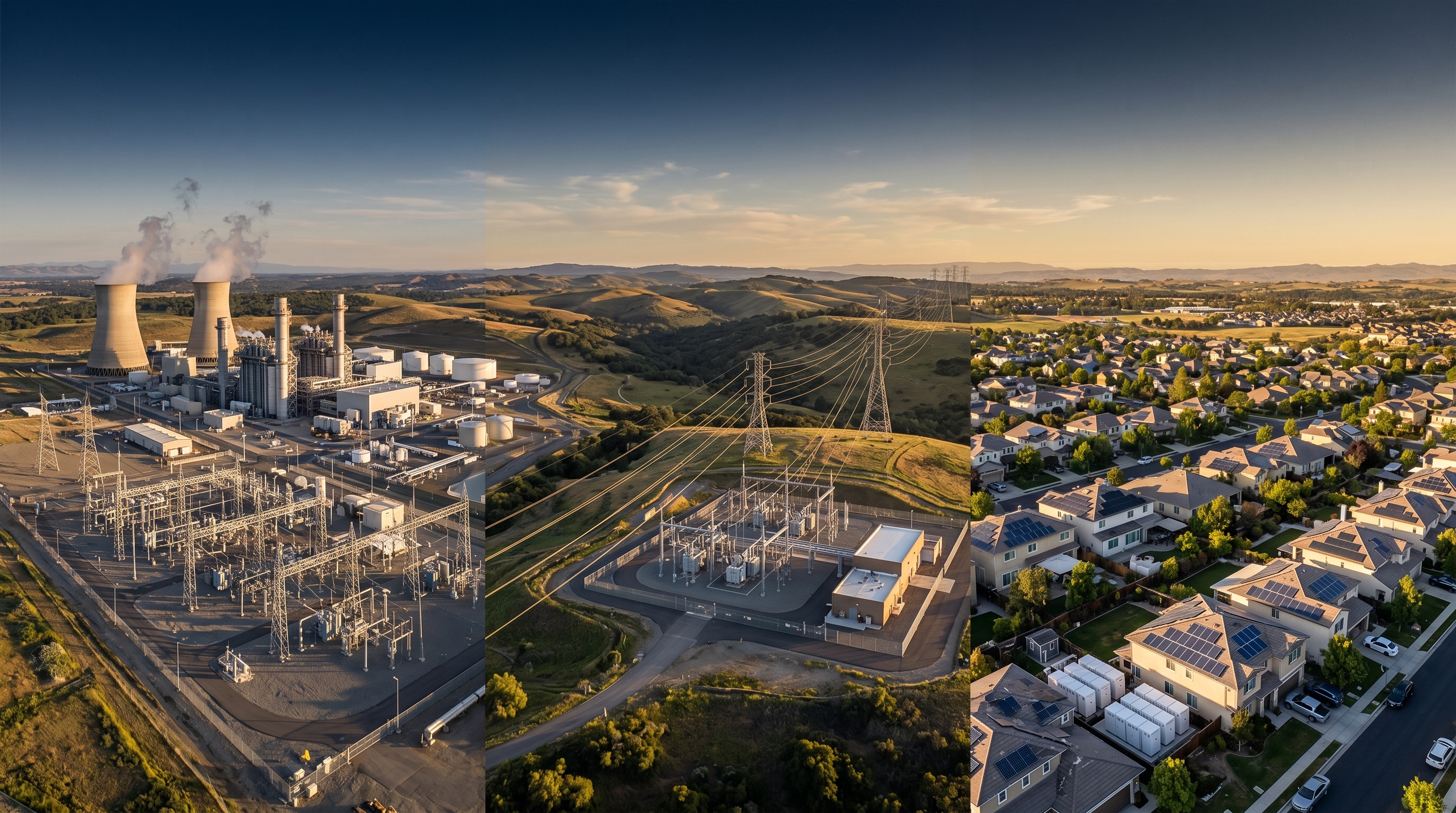
Utility Data Center Strategies: Embrace, Resist, Distribute
First week of May 2026 produced three different utility answers to the same data center load question. Eversource refused, Dominion announced 3 GW of gas, Sunrun hit 4.3 GWh of distributed storage. What each strategy means for distribution equipment procurement.
Eversource CEO Joe Nolan told a Q1 2026 earnings call on May 7 that his company is “resisting data centers” because they “will only drive up the price of energy” and provide “no value to our residential customer, actually any customer.” That single statement is the first time a major U.S. investor-owned utility CEO has publicly refused hyperscaler load. It landed inside the same five-day window as four other utility data center strategies disclosures that go in entirely different directions.
Same week, Dominion Energy announced a 3 GW combined-cycle gas plant in Cumberland County, Virginia, sized to serve up to 750,000 home equivalents and explicitly justified by Northern Virginia data center load. Evergy lifted its retail sales growth forecast to 7-8 percent annually through 2030, raised planned Missouri gas-fired generation to 4.7 GW, and cut planned solar by more than 90 percent. Sunrun reported 4.3 GWh of networked behind-the-meter storage, a 50 percent year-over-year increase, and committed to 10 GWh of dispatchable capacity by end of 2028. NRG closed its 13 GW LS Power gas-fleet acquisition while bringing the 415 MW Texas Energy Fund T.H. Wharton plant near commissioning.
Read together, the announcements sort cleanly into three patterns. They are not three views of the same strategy. They are three different utility data center strategies, each with its own equipment-procurement consequence. Distribution buyers should know which one their service territory is going to follow before the next RFQ cycle starts.
The five-day cross-section
| Date | Utility / Actor | Action | Strategy |
|---|---|---|---|
| May 7 | Eversource | CEO publicly refuses data centers; relies on 1.5 GW offshore wind | Resist |
| May 7 | Dominion Energy | 3 GW Cumberland Energy Center announced for 2033-2034 commissioning | Embrace via gas |
| May 7 | NRG Energy | 415 MW TEF plant near completion; 13 GW LS Power acquisition closed | Embrace via gas |
| May 7 | ERCOT | Gas overtakes wind in interconnection queue, first time since 2016 | Embrace via gas |
| May 7 | Exelon | $1.1B distribution capex pulled, $1.5B added to transmission; PECO rate case withdrawn | Resist |
| May 7 | PJM | Three capacity-market reform options floated; Mills confirmed permanent CEO May 8 | Market-design pivot |
| May 7 | TVA | $6.6B revenue, 82B kWh sales for H1 FY2026; 3,770 MW under construction | Embrace via gas |
| May 8 | Evergy | Lifts gas plan to 4.7 GW, cuts wind 2.4 GW, cuts solar 90 percent plus | Embrace via gas |
| May 8 | Sunrun | 4.3 GWh networked storage; 10 GWh dispatchable target by 2028 | Distribute |
| May 8 | California Energy Commission | $700M Soda Mountain 300 MW solar plus 1,200 MWh BESS approved | Distribute |
Twelve announcements across PJM, SPP, ERCOT, ISO-NE, and CAISO inside five days. The footprint is national, the strategy split is regional, and the procurement consequences differ at every step.
Strategy 1: embrace via gas
Five disclosures fall into the embrace pattern: Evergy, Dominion, NRG, ERCOT queue mix, and TVA. The common thread is dispatchable capacity at gigawatt scale paired with active deprioritization of variable resources.
Evergy is the most aggressive case. The Missouri-based IOU lifted its retail sales growth forecast from 6 percent to 7-8 percent annually through 2030, citing Meta, Google, and a Panasonic EV battery plant. Planned gas generation went from 3.7 GW to 4.7 GW. Planned wind dropped 2.4 GW. Planned solar fell from 2,415 MW to 465 MW. That is more than 90 percent of the prior solar plan cancelled in a single integrated resource plan revision. Large-load energy services agreements jumped to 2.5 GW from 1.9 GW three months prior, with 1.5 GW more in expansion discussions and another 1.5 to 3 GW in advanced post-2030 discussions. Capital plan: $21.6B. Annual rate-base growth: about 12 percent.
Dominion’s Cumberland Energy Center is configured as two sets of two gas turbines paired with a steam turbine, the 2x2x1 combined-cycle layout common at H-class and F-class machines. Three GW. Hydrogen-capable. Online 2033-2034. Local conditional-use permit, Virginia DEQ air permit, and SCC Certificate of Public Convenience and Necessity all required. The site sits 60 miles west of Richmond, just outside the densest part of the Northern Virginia data center cluster.
NRG closed the 13 GW LS Power gas-fleet acquisition while completing the 415 MW Texas Energy Fund T.H. Wharton plant. Cedar Bayou and Greens Bayou are both in TEF Round 2. NRG now has 1.6 GW of state-supported gas in the pipeline this decade, on top of the LS Power inheritance.
ERCOT’s interconnection queue inverted in a way that hasn’t happened since 2016: gas surpassed wind. Approximately 64 GW gas in the queue versus 48 GW wind. The queue inversion is the cleanest signal that ERCOT generators believe Texas data center load growth is now the dominant siting driver, displacing 15 years of wind dominance.
TVA’s H1 FY2026 financials disclosed 3,770 MW under construction with data-processing growth named as a driver. $6.6B in operating revenues on 82B kWh of sales for the six months ending March 31, 2026.
The procurement footprint of this strategy is large primary equipment in long-lead categories. Each new combined-cycle plant pulls two to three large generator step-up transformers in the 600-900 MVA range, multiple 230 or 345 kV circuit breakers, generator circuit breakers in the 30 kV class with current ratings near 10,000 A, GIS or AIS substation switchyards, instrument transformers, iso-phase bus, and balance-of-plant medium-voltage switchgear. Lead times for greater-than-500 MVA GSUs sit in the 36-48 month range as of Q2 2026 across Hitachi Energy, Siemens Energy, GE Prolec, and the consolidated US shop floor. Customer-funded substation work for the data center campuses themselves adds another wave at the 60-100 MVA class. Distribution buyers serving territory adjacent to any of these IOUs should expect frame-contract pressure through 2027.
Strategy 2: resist
Two utilities chose the opposite path inside the same week. Eversource publicly refused. Exelon publicly redirected.
Joe Nolan’s quote breaks new ground in its directness. Until May 7, every major IOU CEO had described the data center question as a cost-allocation problem to be solved with creative tariffs. Nolan reframed it as a yes-or-no problem and answered no. Eversource’s mechanism is the 1.5 GW combined output of Revolution Wind, which is about 95 percent complete with full commercial operation expected H2 2026, and Vineyard Wind, which finished construction in March 2026 and is in a turbine dispute with GE Renewables. Connecticut Light and Power’s wholesale prices rose 13.8 percent year-over-year in Q1 2026, from $99.02/MWh to $112.71/MWh. Nolan is making the argument that adding hyperscale load to that price trajectory is bad for residential ratepayers. The FERC base ROE finding of 9.57 percent versus Eversource’s 11.39 percent appeal sets the financial backdrop: a $60.4M to $932M pre-tax loss range and about $70M after-tax 2026 earnings hit.
Exelon expressed the same affordability framing in capital allocation terms. The Q1 2026 update pulled $1.1B from distribution capex and added $1.5B to transmission, lifting the four-year capex plan to $41.7B. ComEd and PECO each got about $500M added on the transmission side. PECO withdrew $510M of rate case requests at the Pennsylvania PUC on April 16, 2026, with CEO Calvin Butler saying he is “not being tone-deaf” and targeting $350M in 2027 cost cuts. Through 2024-2025, virtually every large IOU layered transmission and distribution capex simultaneously. Exelon is the first to publicly cut distribution capex while raising transmission. The signal is residential affordability stress strong enough to override the rate-base-growth playbook.
The procurement footprint of resistance is different in kind. Distribution-equipment demand from Eversource and Exelon territory holds at maintenance pace rather than accelerating. Distribution transformers, padmount and polemount, single-phase and three-phase, see order pace at replacement levels rather than expansion levels. Reclosers, sectionalizing switchgear, and AMI expansion likely pause in PECO and ComEd unless explicitly tied to outage reduction. The work that does happen tilts toward refurbishment, storm hardening, and wildfire mitigation in the Northeast and California, plus transmission substation equipment, large 138 kV through 500 kV power transformers, transmission breakers, ACSR and HTLS conductor, and switchyard structures in the case of Exelon’s transmission shift.
Strategy 3: distribute
Sunrun’s quarter is the cleanest expression of the third path. 4.3 GWh of networked behind-the-meter storage as of March 31, 2026, a 50 percent year-over-year increase. 251,000 storage and solar systems installed. 107,000-plus customers enrolled across 18 active grid-service programs. 429 MW delivered during dispatches over the past year. Storage attachment rate at a record 73 percent of new installations. Target: more than 10 GWh of dispatchable energy by end of 2028. Sales dropped in Q1 2026 from solar tax credit expiration and tariffs, but margins expanded and 2026 guidance held.
The fleet is bigger than most utility-scale battery projects. Aggregated as a virtual power plant, it competes directly with utility-scale storage in capacity-market and ancillary-services bids. The California Energy Commission also approved Soda Mountain on May 8: $700M, 300 MW solar plus 300 MW / 1,200 MWh BESS, four-hour duration. Different pole on the distributed continuum, same procurement consequence.
The equipment footprint of distribution is the inverse of the gas-pivot. Long poles include distributed energy resource management systems, advanced distribution management system upgrades, communications backhaul (cellular, RF mesh, fiber), advanced metering with bidirectional capability, smart inverters, secondary feeder protection coordination upgrades for reverse power flow, BESS PCS-class transformers, and distribution-feeder switching gear coordinated with VPP dispatch software. Short poles include large transmission equipment and gas-plant primary iron. Distributors serving CAISO territory and growing-VPP states will see equipment categories that don’t appear in a 2018 utility procurement spec. The vendor list shifts in the same direction.
What every strategy shares
All three strategies start from acknowledgment of load growth. Even Eversource is not denying the load is real, only refusing to absorb it inside its own ratemaking envelope. All three face affordability scrutiny. Evergy filed a $140M Missouri rate case the same quarter it raised its IRP. Pennsylvania HB 2233 became law unanimously in the state House on May 5, codifying advanced transmission technology mandates partly on affordability grounds. PA PUC pressure is already inside the Exelon and Sunrun stories. All three carry tax-credit policy risk. Strategy 1 cancellations were partly driven by 45Y/48E sunset uncertainty. Strategy 3 pricing is exposed to the same factor. And all three contend with the public power and electric cooperative buyer-side reality. The 2026 Tantalus utility-future survey found 86 percent of public power and co-op decision-makers identify modernization as a top priority while only 9 percent feel ready to execute it.
That 86/9 gap is the procurement opening for everyone reading this.
What this means for distribution buyers
The same OEMs operate in all three regions. Hitachi Energy, Siemens Energy, GE Prolec, Eaton, ABB, SEL, S&C Electric, Howard Industries, and ERMCO appear in every footprint. Capacity is finite. Strategy 1 territories are absorbing the long-lead primary equipment first, which means refurbishment and storm-hardening work in Strategy 2 territories has lighter competition for skilled labor and shorter-cycle equipment. Distributed and DERMS-grade work in Strategy 3 territories runs through a different vendor set entirely.
Tariff structure determines who specifies the equipment. Embrace-via-gas projects and customer-funded data center substations follow utility spec on the IOU side and hyperscaler spec on the customer side. The Xcel template covered in our prior hyperscaler utility capex 2026 analysis is the cleanest version of customer-pays cost-of-service. Resistance-strategy refurbishment follows aging-asset-replacement spec, which favors incumbents with existing reliability records. Distribute-strategy work follows DERMS interoperability and protection-coordination spec, which is the youngest standard set and still consolidating.
Geography is fate inside this frame. A municipal utility in Kansas City, Missouri sits inside Evergy’s footprint and faces every Strategy 1 procurement consequence. A municipal in Hartford, Connecticut sits inside Eversource’s footprint and faces Strategy 2’s slower equipment cadence. A California co-op in Riverside County sits adjacent to CEC-approved utility-scale BESS, distributed VPP fleets, and an ADMS upgrade cycle that runs at a different pace from the rest of the country. Map your territory to the strategy first, then map your RFQ cycle to the procurement consequence.
The 86/9 Tantalus gap is the buyer-side reality every distribution executive should price into capital planning right now. The next 18 months will favor procurement teams that name their strategy explicitly and source against it, rather than treating data center load as a single national phenomenon with one OEM playbook.
The full breakdown of OEM short lists by strategy region, lead-time risk by equipment class, and the procurement playbook for each of the three patterns sits in our Q2 2026 utility data center strategies procurement intelligence brief. If your service territory crosses strategy lines, that is the document to read before the next frame contract decision.
The monthly read on where this is heading
Eversource refused, Dominion embraced gas, and Sunrun scaled distributed storage, all inside the same five-day window, and each strategy points at a different equipment order book. The Feeder is our free monthly digest of the procurement signals that move utility and distribution equipment buyers: lead-time shifts, supplier capacity, federal funding, and the RFP language that follows. One email a month, no filler.
Related reading
- Hyperscaler Utility Capex Q1 2026: Three Buyer Strategies
- Data Center Demand: 50 GW of New Grid Infrastructure Procurement
- Data Center Moratorium Movement: Where Equipment Demand Goes When States Say No
- Data Center Grid Infrastructure Costs and the Fight Over Who Pays
- VPP Procurement Wave: State Mandates Meet Battery Prices
- Grid Modernization Procurement Guide
Track this beat without paying per report
Free Member tier. Pick your topics. Get a weekly digest filtered to what you actually buy.