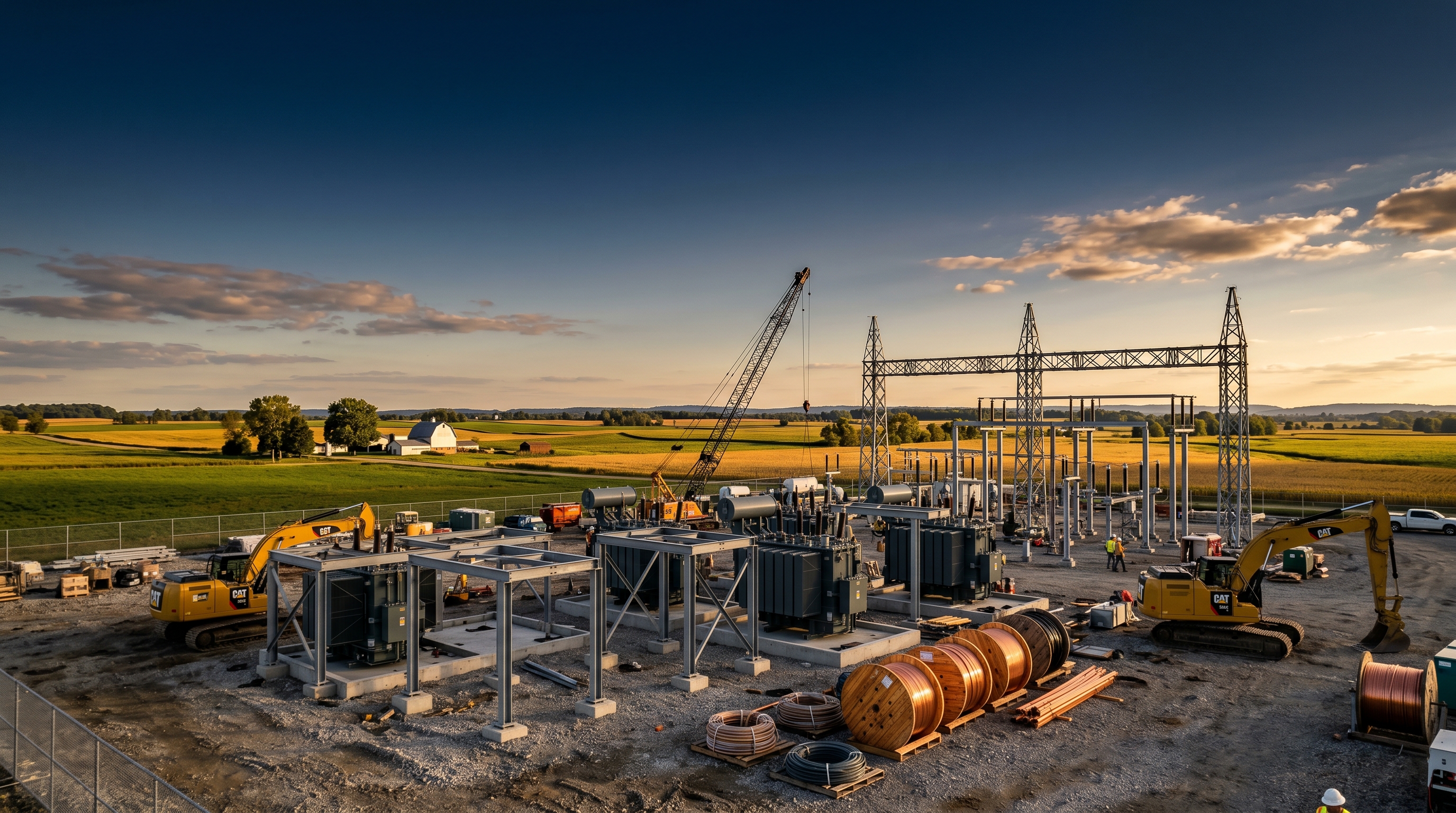
Data Center Moratoriums Relocate Equipment Demand, They Don't Erase It
Maine became the first state to enact a data center moratorium. Twelve more are filing bills. Here is where the equipment demand actually goes.
On April 9, 2026, Maine’s legislature passed HB 307. The bill prohibits any data center load above 20 MW from receiving siting approval until November 2027. It is the first state-level data center moratorium in the United States. It will not be the last.
Twelve more states have filed comparable bills in 2026. Sixty-three local jurisdictions have introduced moratorium actions, and roughly fifty-four of those have already passed, according to a Stateline tracker maintained by the Pew Charitable Trusts. Virginia’s proposal would freeze new applications until July 2028 or until the interconnection backlog clears. New York is weighing a three-year halt. Georgia wants a one-year pause starting July 1.
The procurement question this raises is not whether data center load growth slows. It does not. The question is where the equipment demand resurfaces.
The demand does not disappear
The hyperscalers have committed capacity, signed power purchase agreements, and locked in compute roadmaps. When New York or Maine forecloses a site, the project does not die. It moves.
The Energy Information Administration’s April 2026 Short-Term Energy Outlook revised commercial-sector electricity growth from 2 percent to 5 percent for 2026, citing data centers explicitly. EIA now projects record US electricity consumption in 2025, 2026, and 2027, the first four-year run of demand growth since 2007. Total consumption climbs from 4,195 billion kWh in 2025 to 4,381 billion kWh in 2027.
Underneath that headline number is a relocation map. The World Resources Institute pegs current US data center power demand at roughly 41 GW, comparable to all US nuclear capacity. WRI projects a climb from 183 TWh in 2024 to 426 TWh by 2030. None of that goes to Maine. It goes to the states without moratoriums.
Where the equipment buyers actually are
Three states are absorbing the displaced load.
Ohio has no moratorium activity, large grid headroom, and an established hyperscale corridor running through Hilliard, Dublin, and New Albany. AEP Ohio and Duke Energy Ohio are already absorbing site applications redirected from Virginia. Substation expansion, medium-voltage switchgear, padmount transformers, and protection relay procurement is accelerating.
Texas sits inside ERCOT, which has its own interconnection process and a regulatory environment friendly to large-load siting. The Permian Basin and the I-35 corridor are pulling load that would otherwise have gone to constrained eastern markets.
Indiana is quietly building share. AES Indiana and Duke Energy Indiana have approved multiple hyperscale tariffs in the last twelve months, and the state has not seen meaningful moratorium legislation reach committee.
The procurement implication is concrete. Distributors serving these three states should expect substation transformer, recloser, and feeder cable demand to outpace national averages by a meaningful margin through 2027. Grid access has now overtaken land as the binding constraint on data center buildout, per ENR’s reporting on developer site selection. That means utilities in the destination states will spend ahead of load to maintain interconnection throughput.
The buyer profile is changing
Maine’s bill, and most of the others, is paired with a cost-allocation principle: the data center developer pays for its own grid interconnection. PJM ratepayers are already on the hook for $4.3 billion in upgrades attributable to data center connections inside its footprint. State legislatures watching that number are writing developer-pays language into both moratorium bills and the rules that come after the moratoriums lift.
This is reshaping who actually procures the equipment. When a hyperscaler underwrites a substation, it sometimes funds direct procurement rather than running it through the host utility. That introduces a new buyer class for distribution-grade equipment: the data center developer’s owner’s-engineer, working through an EPC, sourcing transformers and switchgear on a project schedule rather than a utility capital plan.
Distributors who can quote into both the utility procurement channel and the developer-direct channel will see better allocation through 2027 than those positioned only into traditional utility RFPs.
The cancellation signal does not change the equipment math
Baird analyst Justin Hauke reported on April 24 that US data center project cancellations climbed to 25 in 2025, up from 6 in 2024. Public opposition and lack of available power capacity led the cancellation reasons. That is a real signal, and it deserves to be read accurately.
Cancellations at this scale do not relieve the substation transformer or medium-voltage switchgear shortage. The cancelled projects were typically blocked at interconnection. The equipment that would have served them was already on order, already allocated, and is now being redirected to the surviving projects in permissive states. The 4x cancellation growth points to interconnection bottleneck, not to load demand collapse. New York’s interconnection queue still climbed from 6,800 MW in September 2025 to 12,000 MW by January 2026.
What procurement teams should do this quarter
Three actions follow from the moratorium-displacement pattern.
First, if you serve utilities in Ohio, Texas, or Indiana, raise your safety stock targets on padmount transformers, distribution switchgear, and 15 to 35 kV cable. The displaced demand is arriving on a faster timeline than your normal forecast horizon.
Second, if you serve utilities in Maine, Virginia, or New York, do not assume your transformer and switchgear allocation is freed up. Manufacturers are reallocating to the destination states, not releasing the capacity back to the original buyers.
Third, build a quoting pathway for data center developer EPCs and owner’s engineers. The developer-pays trend is creating a procurement channel that did not exist three years ago. The buyers are sophisticated, the timelines are tight, and the volumes per project are large.
Related Reading
- 50 GW of Data Centers Are Rewriting Grid Procurement
- Data Center Grid Infrastructure Costs: The $10B Fight Over Who Pays
- FERC Large Load Interconnection: What Utility Procurement Teams Need to Know
Our Intelligence Reports go deeper, with state-level demand redirection forecasts, manufacturer allocation analysis, and procurement timing recommendations for substation and distribution equipment in the displacement-target states. Talk to us about a custom report.
Transformer Market Outlook — Q2 2026
National supply analysis, lead time data, and pricing benchmarks across the U.S. transformer market. 18 pages of sourced intelligence.
The Grid Brief
Lead times. Pricing shifts. Funding deadlines. Delivered Thursday mornings.