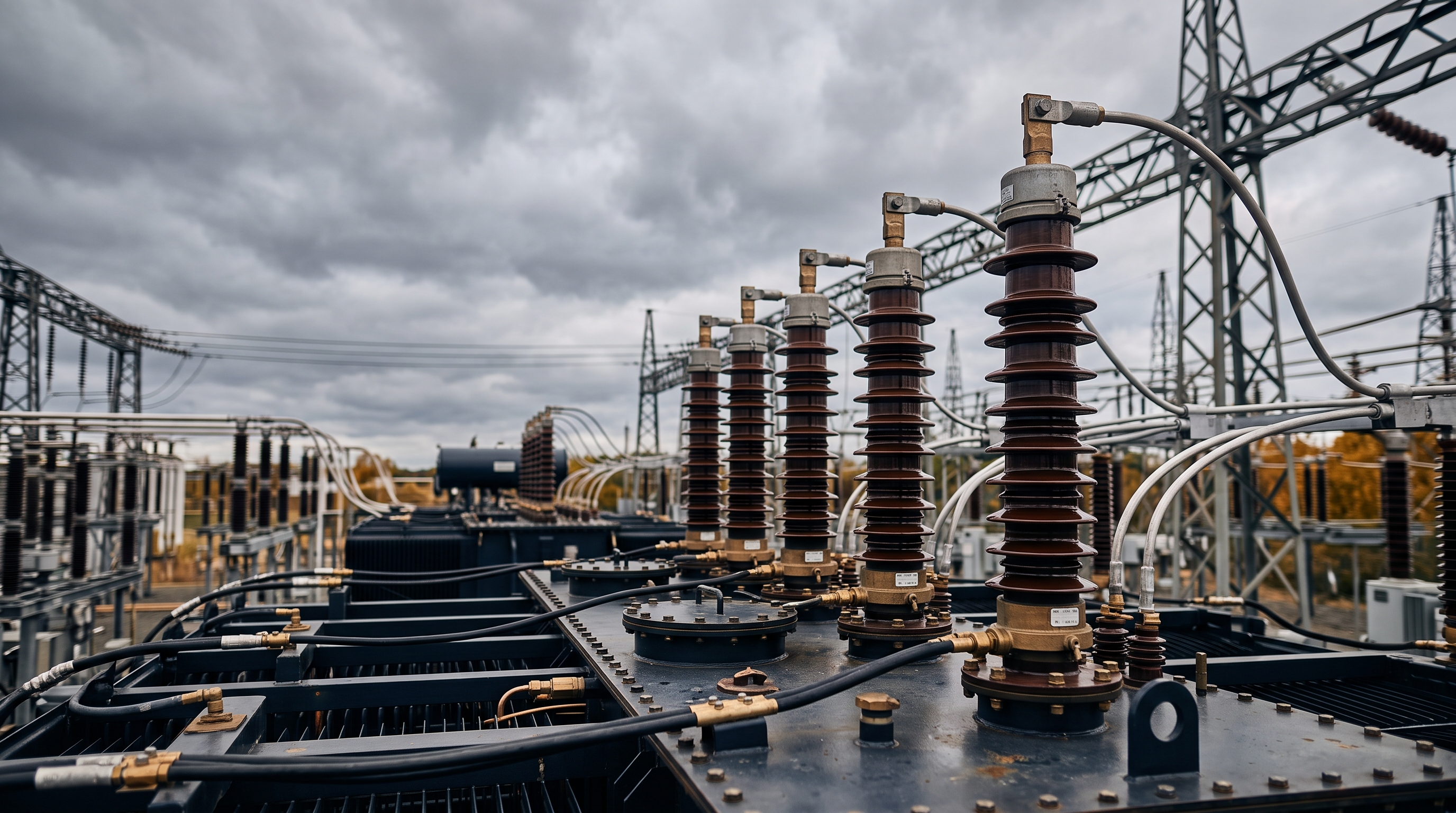
Transformer Bushing Lead Times Now Exceed the Transformer
A DOE-funded federal lab report puts transformer bushing lead times at up to 130 weeks, longer than the tank they bolt into. The spec clause that shortens them.
The number everyone quotes about transformers is the wrong number.
Order-to-receipt for a large power transformer has gone from 12 to 18 months before the pandemic to 30 to 36 months now, and extra-high-voltage units run as long as five years. Those figures are real and they are bad enough. But a supply chain gap analysis published in May 2026 by a DOE-funded national laboratory, report TP-5700-96742, contains a finding that reframes the whole conversation: transformer bushing lead times reach up to 130 weeks. That is roughly two and a half years for a component that bolts onto the top of the tank.
The bushing is longer-lead than the transformer.
Trade coverage of the report treated it as a hydropower story, because the funding came through DOE’s hydropower office and the framing is about rehabilitating aging plants. That undersells it badly. Almost none of the supply chain analysis is hydro-specific. It is a teardown of the entire United States large power transformer market, and it is the most granular public dataset on that market we have seen.
What the component numbers actually say
Three components carry the delay, and none of them is the transformer itself.
Bushings run up to 130 weeks. Before 2020, a 230 kV bushing took somewhere between 40 weeks and a year. Above 345 kV there is now no domestic option at any lead time. Specialty insulator constructions, the resin-impregnated and oil-impregnated synthetic types, stretch further still, and the report is blunt about what buyers do in that case: the only option is to rely on whatever inventory exists.
On-load tap changers run 80 to 90 weeks, with a single United States producer. Everything else comes from Germany and Switzerland. One domestic factory stands between the American grid and a fully imported tap changer supply.
Pressboard has one domestic manufacturer. The report describes sourcing it as a global challenge. Some regional suppliers of continuously transposed cable have left the market entirely, which concentrates the remaining orders onto fewer lines.
Put those together and the picture inverts. A procurement officer pushing an original-equipment manufacturer hard on the transformer delivery date is negotiating over the wrong item. The factory can often build the tank. What it cannot do is conjure a 345 kV bushing that no one in the country makes.
The clause that changes the date
Here is the finding that turns this from a market observation into something a buyer can act on this week.
The report describes how domestic manufacturers cope with component scarcity. They pre-order inventory against forecast demand, and they ask customers to accept alternate makes or specifications.
Read that second half again, because it is the whole point. The manufacturer is not asking for a favor. It is telling you that the delivery date is partly yours to set. A specification that permits equivalent bushing and tap changer makes lets the factory pull from what is already on the floor or already inbound. A specification that names one bushing manufacturer and one type puts your unit at the back of that manufacturer’s queue, and that queue is 130 weeks long.
A buyer who single-sources a bushing type in the RFQ has written a two and a half year delivery into their own document, and will spend the next two years believing the market did it to them.
Rigid component specs are self-inflicted lead time.
This is not an argument for accepting whatever shows up. Standardization exists for good reasons. A utility that has stocked one bushing type for 20 years has spare parts, trained crews, and known failure behavior, and throwing that away to save eight months is a bad trade. The argument is narrower and it is about where the flexibility sits. Name the performance requirement, the creepage distance, the BIL, the cantilever rating, the test standard, and let the make float. Ask for equivalents to be priced and dated as alternates rather than excluded at the door. Then decide with the schedule in front of you instead of discovering it after award.
The same logic runs through how bids should be scored once they come back. We laid out that framework in How to Evaluate Transformer Bids When Lead Times Exceed Two Years, and component-level dating is the piece most scoring sheets still leave out. If your bid form asks for one delivery date, you are buying a number the vendor built out of assumptions you never saw. Ask for the date by line item: tank, core and coil, bushings, tap changer. The spread between them tells you where the risk sits and which bidder actually has a slot.
Why the domestic answer is not a fast answer
The obvious response to a component shortage is to buy American, and federal policy is pushing hard in that direction. The report is unusually direct about why that does not resolve quickly.
United States manufacturers met only about 30 percent of domestic demand as of 2023. Between the report’s comparison years, domestic demand rose 28 percent while domestic manufacturing capacity rose 11 percent. Capacity is not catching up. It is falling behind by roughly 17 points. Something close to 80 percent of United States large power transformer consumption is imported, and for high-grade grain-oriented electrical steel the import share is around 90 percent.
The steel finding is the sharpest one in the document. The highest grade of grain-oriented electrical steel is produced by a single company in Japan and is not available from any American supplier. The one domestic producer makes intermediate grades that the report describes as more expensive than the imported high-grade material while offering no efficiency advantage. The domestic option exists, and it is economically dominated.
That sets a trap for anyone chasing a domestic content bonus on a federally funded project. Thresholds step from 40 percent to 55 percent by 2027 while the largest single material input has no competitive domestic source. Electrical steel and continuously transposed cable each account for roughly a quarter of production cost, so this is not a rounding error on the bill of materials. The retrofit accounting compounds it, because reused components count as zero toward domestic content, which penalizes exactly the refurbishment projects that make the most sense on an aging fleet. We walked through how the certification side of this works in BABA Compliance for Transformer Procurement, and the gap between the policy and the plant floor in Federal Transformer Procurement: Policy vs. Reality.
One practical note that gets missed: the federal waiver library already holds 2,293 proposed or approved waivers. Waivers are the normal path, not a sign the project failed. Buyers should plan the waiver into the schedule from the start rather than treating it as a recovery step after a bid comes back non-compliant.
The demand nobody was counting
The report’s hydro framing turns out to matter for a reason that has nothing to do with hydro.
A large power transformer has a design life of roughly 40 to 45 years. The American hydro fleet routinely operates past that. Every generator step-up unit in that fleet is a replacement order that has not been placed yet, and when one fails unexpectedly it becomes an unplanned outage measured in years, competing for the same factory slots as everything else.
For a municipal utility or a cooperative, that is the part worth internalizing. Most forward-buy planning models load growth: data centers, electrification, renewable interconnection. This is a category of replacement demand that no load forecast contains, entering the same queue from the side. The 2024 surge in transformer imports to a decade high was driven by backlogged orders plus data center and renewable demand. Add an aging generation fleet reaching end of life and the queue gets longer for reasons that have nothing to do with anyone’s load projection.
One number to stop repeating
A correction worth making, because it circulates constantly and it damages credibility in a rate case or a board meeting.
The widely quoted figure of 10 million dollars per transformer comes from the top of a published federal trade commission range. It applies to the highest power ratings and voltage classes, not to a typical unit. Quoting it as a normal price overstates a typical large power transformer by a wide margin. If you need a defensible figure, cite the commission’s published range and state the rating you are talking about.
What is defensible as a trend is the federal price index. Bureau of Labor Statistics data for power transformers shows 2025 running roughly 80 percent above the essentially flat level that held from 2014 through 2021. That is an index, not a quote, and it is the honest way to describe the direction of this market without inventing a number for a specific unit.
What to do before your next RFQ goes out
Four things, in order of how much time they save.
Ask for delivery dates by component, not one date for the assembly. Permit equivalent bushing and tap changer makes against a performance specification instead of naming a single manufacturer. Confirm whether your voltage class can be built domestically at all before you write a domestic content requirement into the solicitation, because above 345 kV the American field narrows to a handful of plants. Plan the waiver timeline into the schedule rather than treating it as an exception.
None of that requires budget approval or a new supplier relationship. It requires editing a document you already own, before it goes out rather than after the bids come back.
The deeper version of this analysis is what our transformer edition covers: which plants can build which ratings, where component sourcing sits by supplier, and how lead times are moving month over month. That is the Monthly Market Tracker at $79 for a single equipment category, current edition, delivered as a PDF. If transformers are the category deciding your capital plan this year, start there.
Related reading
- How to Evaluate Transformer Bids When Lead Times Exceed Two Years
- BABA Compliance for Transformer Procurement: Which Manufacturers Are Certified?
- Federal Transformer Procurement: Policy vs. Reality
Frequently Asked Questions
How long are transformer bushing lead times in 2026?
A DOE-funded national laboratory report published in May 2026 puts high-voltage bushing lead times at up to 130 weeks, roughly two and a half years. Before 2020 a 230 kV bushing took 40 weeks to a year. Bushings above 345 kV currently have no domestic source at all.
Why is the bushing the bottleneck instead of the transformer?
The bushing is a separately manufactured component with its own supply chain and its own queue. At up to 130 weeks it can run longer than the tank it bolts into, so the transformer sits finished and undeliverable while the factory waits on a component that ships from a different continent.
How can a utility shorten transformer lead times through its specification?
By permitting equivalent bushing and tap changer makes rather than naming a single manufacturer. The federal lab report notes that manufacturers manage component scarcity partly by asking customers to accept alternate makes. A spec that allows equivalents lets the factory use inventory already on the floor.
Free RFQ templates. Weekly digest. Yours.
Free Member tier. Pick your topics. Get a weekly digest filtered to what you actually buy.