Utility Rate Case Procurement: What $9.2B Misses
Utilities asked for $9.2B in Q2 rate increases, up 26%. Both halves of that headline mislead. How to read rate cases as an equipment demand signal.
Utilities asked state regulators for $9.2 billion in rate increases during the second quarter of 2026, up 26% year over year, affecting more than 56 million customers. That is the number moving through the trade press this week, and it is the wrong number to run a utility rate case procurement forecast on. Not because it is false. Because both halves of it mislead, and the figure that actually tells you what is getting built is sitting two paragraphs deeper in the same report.
Start with the direction of travel. The 26% increase is a second-quarter comparison against a soft second quarter in 2025. Look at the sequence instead and it inverts: Q1 2026 requests totaled $9.4 billion, so Q2 came in marginally lower than the quarter before it. Widen to the half and it inverts harder. First-half 2026 requests total $18.6 billion against roughly $25 billion in the first half of 2025, a decline of about 26%. The same tracker supports a “requests up 26%” headline and a “requests down 26%” headline depending on which window you pick. Several outlets have attached the word “record” to this. It does not belong there.
None of that makes rate cases useless as a demand signal. It makes the quarterly total the worst available way to read them.
Why the filings are still the best leading indicator anyone has
A rate case is the earliest public, dated, dollar-denominated statement of what a utility intends to spend on its wires. The utility files, discloses a test year and a capital plan, and a regulator decides how much of it comes back through rates. The filing lands quarters or years ahead of the purchase orders it implies. For a distributor or a municipal buyer trying to see demand before it arrives at the factory queue, that beats equipment-market commentary for one structural reason: the numbers are attested to under oath in a docket, and the docket is public.
That is the whole case for utility rate case procurement work. Nobody else in the supply chain is obligated to tell you what they are about to buy. A regulated utility is.
What the filings are not is a spend forecast you can lift directly. Three things sit between a request and a dollar of equipment.
The first is the approval haircut. Regulators granted 58% of the increase costs sought across 2023 and 2024. Any request total needs that discount applied before it means anything, and the share is itself a political variable rather than a constant.
The second is methodology. The quarterly tracker comes from PowerLines, an advocacy group that publishes the totals but not the filing-level method behind them. That is not a reason to discard the data, and we use it. It is a reason to treat the aggregates as directional rather than audited, and to check any single line against the docket before building on it. As you will see below, the largest line in the Q2 report does not survive that check cleanly.
The third is timing, and it is the one that trips procurement teams most often. A rate case is a recovery mechanism. It is a utility asking to be paid back for capital it has largely already committed or spent. The equipment in a tracker filing is frequently already in the ground. Reading a rate case as forward demand double-counts equipment you missed the chance to compete for two years ago.
Working the Oncor line
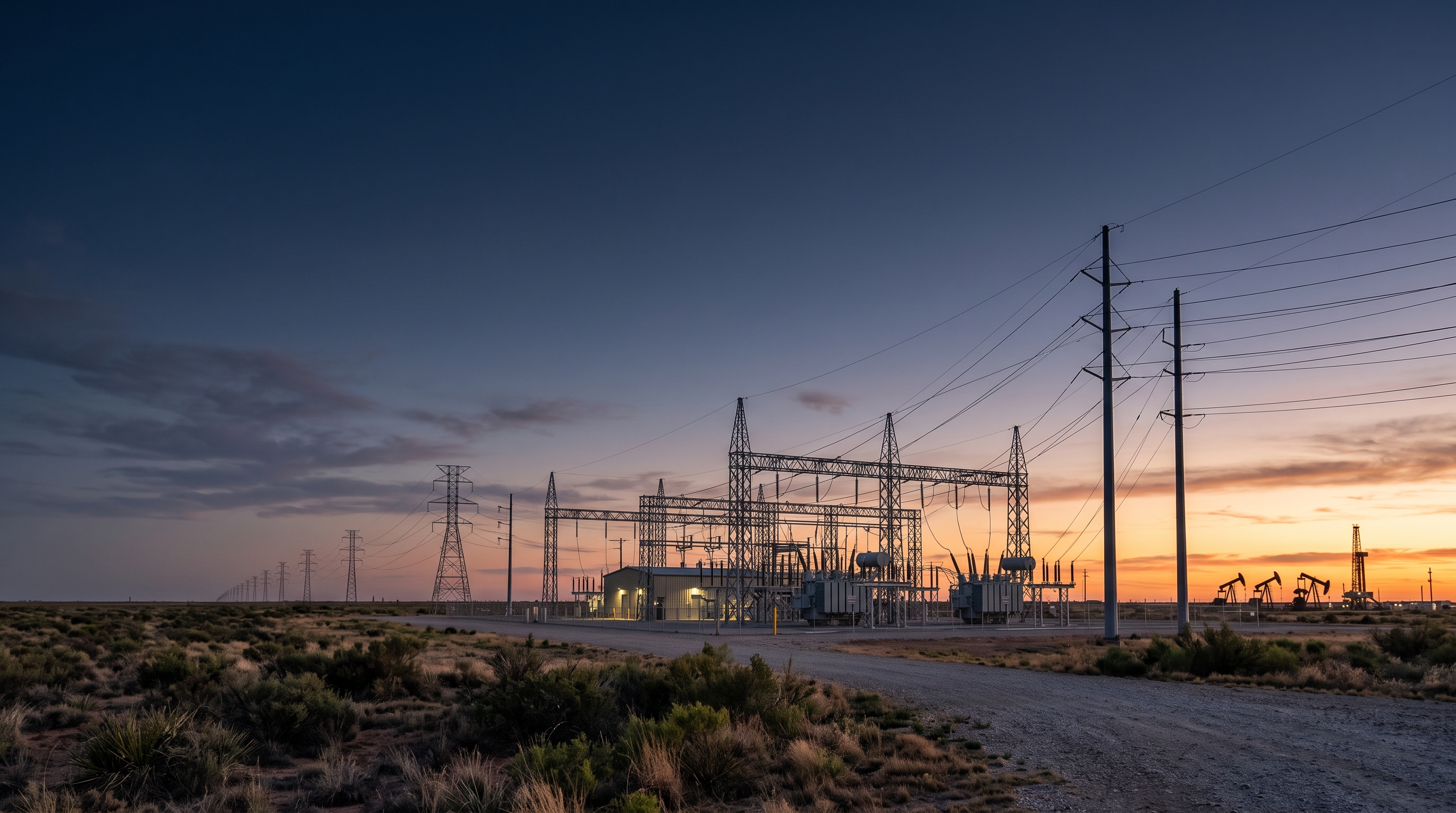
Oncor filed the largest single request of the quarter at $1.2 billion, attributed to transmission and distribution investment serving oil and gas load and data centers in the Permian Basin. That is the most procurement-relevant line in the report: T&D-attributed, dated, and public. It is also the line that shows why you check the docket.
The $1.2 billion does not reconcile to any single proceeding at the Public Utility Commission of Texas. Oncor’s base rate review, Docket 58306, was filed in June 2025 asking roughly $834 million. It settled on April 17, 2026 at about $560 million, an 8.7% increase over the 2024 test year, with a 9.75% return on equity and rates effective June 1, 2026. Separately, on April 22, 2026, Oncor filed distribution and transmission tracker updates under the state’s newer consolidated process, covering roughly $4.4 billion of eligible T&D net capital invested during calendar 2025 and seeking about $550 million in net revenue. Those two second-quarter actions sum to roughly $1.1 billion, which is plausibly how the tracker arrived at $1.2 billion, but the method is unpublished and we are not going to assert it.
Now notice what the reconciliation exposes. Oncor asked for $834 million and settled for $560 million, a live demonstration of the approval haircut on the single largest ask of the quarter. And that $4.4 billion of transmission and distribution capital is 2025 spend. The transformers, breakers, and conductor behind it were bought, delivered, and energized before this filing existed. Anyone reading Oncor’s $1.2 billion as a forward equipment signal is reading a receipt.
The number that actually forecasts demand
The forward signal was never in the rate case. It is in the capital plan.
Oncor’s base capital plan for 2026 through 2030 is $47.5 billion, up from $36.1 billion in the prior 2025-2029 plan. That is an $11.4 billion increase in a single planning revision, with roughly $10 billion in additional incremental opportunities pending regulatory approval on top of it. The rate case is the recovery mechanism. The capital plan is the order book. One looks backward at money already turned into steel; the other tells you what has to be manufactured, and when.
Texas T&D at that run rate pulls substations, distribution transformers, medium-voltage switchgear, reclosers, conductor, and poles at a scale that will keep ERCOT-region lead times tight regardless of what happens nationally. Oncor built 3,100 circuit miles in 2025 and added more than 65,000 new premises. Its large commercial and industrial interconnection queue runs to roughly 255 GW, mostly data centers. Municipal utilities and cooperatives competing for the same manufacturing slots in Texas and the surrounding region should assume no queue relief, and should read the $1.4 trillion national capex wave as the aggregate version of the same story rather than a separate one.
This is the habit worth building. When a utility in your region files, skip past the headline ask and pull two things out of the record: the capital plan behind it, and the test year. The first tells you what is coming. The second tells you what already went.
What a denial actually changes
The affordability counter-pressure is real, and it is the thing that could bend this. Average US residential rates reached 18.8 cents per kilowatt-hour in April 2026, up 7.3% year over year. Advocacy groups track rate cases precisely because bills are rising, and regulators feel it. If political pressure pushes the approval share below 58%, the reflex reading is that equipment demand contracts.
That reading is wrong, and getting it wrong costs money in both directions. Utilities do not stop spending when a regulator trims a request. They defer the discretionary tranche first. Load-growth and reliability-driven work survives, because it is either mandated or it is the reason the utility is filing at all. Oncor’s Permian buildout survives. Eversource’s $503 million Connecticut request tied to distribution system reliability survives. What slips is the elective layer: pole replacement cycles, aesthetic undergrounding, non-mandated modernization programs.
So a rate-case denial is a signal about mix, not volume. It shifts which equipment categories move and when, and it rewards a buyer who knows which side of that line their product sits on. The same logic runs through the distribution grid spend shift we tracked earlier this year, and it is why pole and conductor programs behave so differently from load-growth work when budgets tighten.
Where the pressure concentrates
The regional split in the Q2 data is worth keeping, because it is the part least distorted by the quarterly-total problem. The South leads in absolute terms at $4.5 billion across more than 26 million customers, followed by the Midwest at $2.7 billion across 14 million and the West at $1.5 billion.
Per customer, the ranking reorders. The Midwest is hit hardest at $193, then the South at $172, the Northeast at $135, and the West at $110. Per-customer burden is the better predictor of regulatory friction, because it approximates what a commissioner hears about. Two Michigan utilities in the same quarter, DTE at $474 million and Consumers at $456 million, is the kind of concentration that produces a harder proceeding than either filing would face alone. Dominion is seeking roughly $1.5 billion across three separate Virginia requests, larger in aggregate than Oncor’s ask but split across filings, which is a different regulatory posture and generally a deliberate one. FirstEnergy’s $392 million Ohio request is tied to roughly $2.5 billion of capex over three years, and that ratio, not the request, is the number worth writing down.
The affordability fight and the buildout are the same event viewed from two ends. The rising-bill story and the equipment ROI story are not in tension. Rate increases are being driven by infrastructure investment, which means the procurement pipeline is deepening while it gets politically harder to fund. Both things stay true through the end of the decade.
The takeaway
The binding constraint on equipment demand over the next 24 months is neither money nor need. Both are abundant and documented. It is manufacturing slots and regulatory approval speed, and rate cases only tell you about the second one.
Read them anyway, but read them correctly. Good utility rate case procurement analysis ignores the quarterly aggregate entirely. Pull the capital plan, note the test year, apply the haircut, and ask whether the work in question is load-growth, reliability, or elective, because that is what determines whether it survives a trim. A utility that just settled for two-thirds of its ask is not a utility that stopped buying. It is a utility that just reprioritized, and the reprioritization is the intelligence.
Want the research behind this?
The Oncor read above is the method: pull the capital plan, apply the haircut, sort load-growth from elective spend. Running that same read across every utility in your territory, docket by docket, is what the dossiers behind membership are built for. The Insider library holds the deeper version: topic deep-dives, manufacturer and utility dossiers, the RFQ and spec template set, and the full report archive. Membership runs $9.99 a month and opens all of it.
Related Reading
- The $1.4 Trillion Utility Capex Wave: What It Means for Transformer Procurement
- The Affordability Crisis Is a Distribution Equipment Story
- Transformer Procurement in 2026: Reading Lead Times Before They Bite
Frequently Asked Questions
Why do utility rate cases matter for equipment procurement?
A rate case is the earliest public, dated, dollar-denominated view of a utility's planned transmission and distribution spend. The utility discloses a test year and a capital plan under oath in a docket, and the filing precedes the purchase orders by quarters or years. For anyone forecasting equipment demand, that is a better leading indicator than market commentary, because the numbers are attested to in a regulatory proceeding.
Did utility rate increase requests actually hit a record in 2026?
No. Q2 2026 requests totaled $9.2B, which is up 26% against a soft Q2 2025, but Q1 2026 was $9.4B, so Q2 fell sequentially. First-half 2026 requests total $18.6B against roughly $25B in H1 2025, a decline of about 26%. The quarterly rise and the half-year decline are both true, and the record framing several outlets applied to the number does not hold.
What share of requested rate increases do regulators actually approve?
PowerLines reports that regulators approved 58% of the rate increase costs sought in 2023-2024. That haircut sits between any request total and actual spend, which is one reason a request figure should never be converted directly into an equipment demand forecast.
What is the difference between a rate case and a capital plan?
A rate case is a recovery mechanism for money a utility has largely already spent or committed. A capital plan is the forward order book. Oncor's 2026-04-22 tracker filing, for example, seeks recovery on roughly $4.4B of transmission and distribution capital already invested during calendar 2025. The forward signal is its $47.5B 2026-2030 base capital plan, up from $36.1B.
Free RFQ templates. Weekly digest. Yours.
Free Member tier. Pick your topics. Get a weekly digest filtered to what you actually buy.