The Co-op Grid Hardening Playbook: Six Resilience Moves
A Missouri co-op's six-move grid hardening playbook: the equipment a hardening cooperative buys, in order, as it takes on transmission ownership.
A member-owned co-op in southeast Missouri just laid out, in public, the order in which it is hardening its grid. The sequence is worth reading closely, because co-op grid hardening rarely gets documented this plainly. Citizens Electric Corporation, the largest power-load cooperative in Missouri, published a six-strategy resilience plan that runs from winter-storm durability all the way to transmission ownership. Underneath the strategy language sits a procurement story: a specific equipment shopping list, bought in a specific order, by a buyer whose spec sheet is getting wider every year.
Citizens Electric serves more than 28,000 members across six rural counties out of Perryville. It has been around about 80 years, and it already owns most of the transmission inside its own territory. That last fact matters. Most distribution co-ops do not, and the ones that start to are signaling a much larger buy.
The system behind the plan
Before the strategy, the inventory. Citizens Electric runs 2,866 miles of distribution line, 258 miles of overhead transmission, 174 miles of underground distribution, and 49 substations. That is the asset base every resilience dollar has to land on, and it sets the scope of any co-op grid hardening program: thousands of structures, dozens of substations, and a transmission layer most cooperatives this size do not own.
Two winters ago the case for hardening got concrete. Storms Blair and Cora in January 2025 pulled in more than 200 lineworkers for close to two weeks of restoration. Then came the spring and summer tornado season, with EF3 and EF4 threats in the footprint. A co-op that takes a hit like that twice in one year does not write a resilience plan for a press release. It writes one for the next storm.
Move one: build the structure to survive the storm
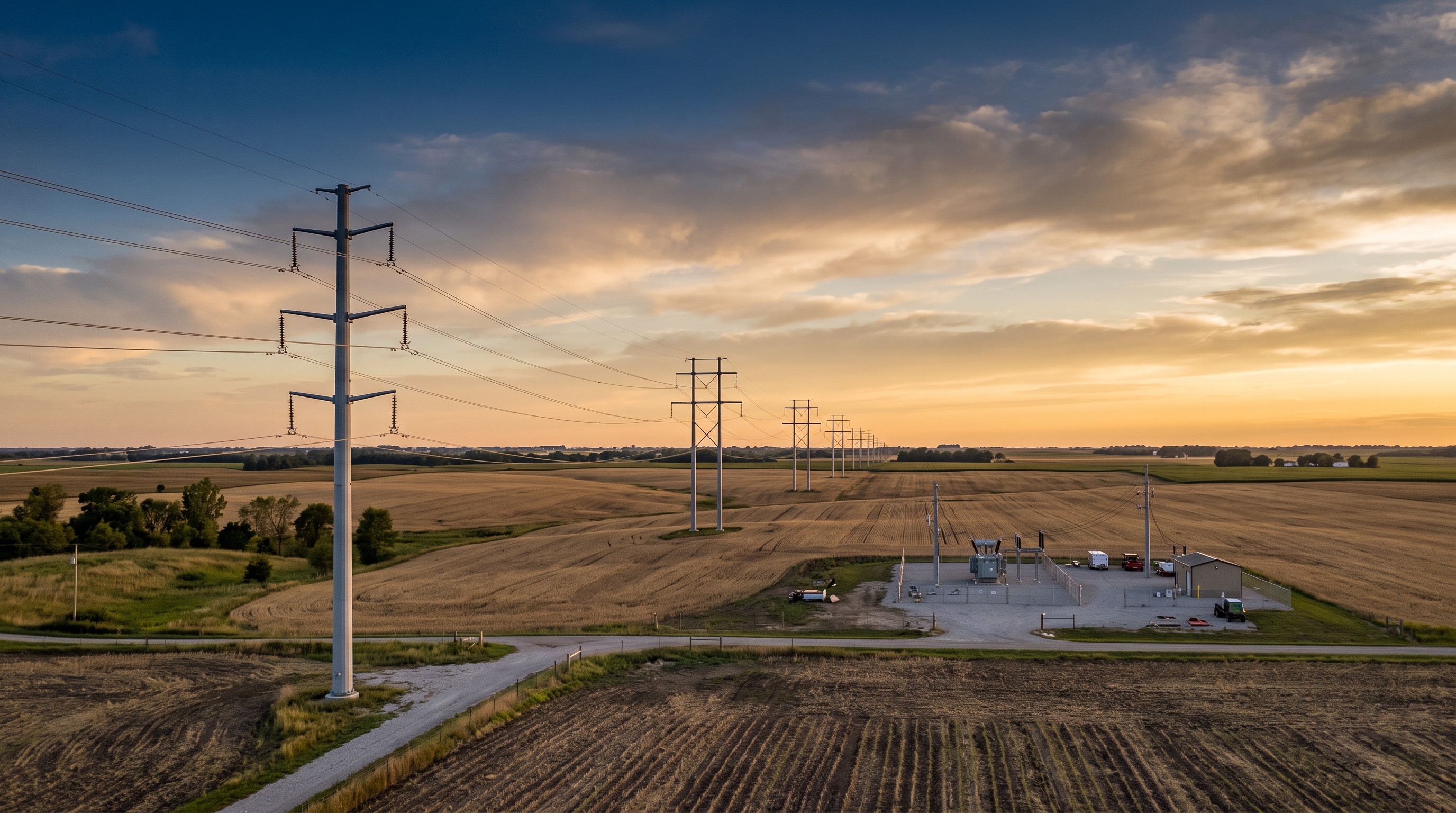
The first money goes into the things that hold the wire up. Citizens Electric is standing full-strength, self-supporting dead-end structures, modern steel monopoles, and H-frame structures in place of older wood framing. This is the durable demand driver behind almost every co-op storm program, and steel monopole hardening is where the capital lands first because a structure that stays up turns a multi-day outage into a few hours.
For a procurement team, this stage reads as poles and structures, foundations, hardware, insulators, and the heavier conductor that goes with stronger spans. It is also where lead-time exposure starts. Steel structures and large conductor are exactly the categories that program-scale buyers have been locking up, which leaves smaller co-ops competing for what is left. We wrote about that squeeze in our look at the 2027 pole and conductor crunch, and it applies directly here.
Move two: see the system with SCADA distribution automation
Structure keeps the lights up. Visibility gets them back faster. Citizens Electric is running a SCADA platform with real-time visibility and electronic relays with integrated fault location, so the system can tell operators where a problem is instead of making a crew drive the line to find it.
This is the layer that turns into distribution automation orders: reclosers, sectionalizers, microprocessor relays, RTUs, and the communications backbone all of it rides on. The shift underneath it is from time-based maintenance to condition-based maintenance. Once a co-op can see asset condition, it can rank equipment by deterioration and feed a prioritized replacement list instead of swapping gear on age alone.
Citizens Electric is not alone here. People’s Electric Cooperative in Oklahoma, a co-op of similar size, integrated drone thermal and visual data straight into its asset-management platform to do the same thing, and it runs 23 substations with only three substation technicians, per T&D World. The visibility tooling is reaching sub-25,000-meter co-ops now, not just the big investor-owned utilities.
Move three: step up to transmission voltage
Here the spec sheet jumps. Citizens Electric is building new transmission for redundancy, including a 21-mile, 69 kV line from its Salem Bulk substation to Valley View. It is also working alongside neighboring utility Ameren on two larger projects: the Limestone Ridge work, which involves 138 kV and 161 kV facilities plus a Mississippi River crossing rebuild, and the Grand Tower Crossing, where Citizens Electric is building a 22-mile, 138 kV line into its Sycamore substation. That line is targeted for service by the end of 2028 and helps support more than 300,000 homes across the bi-state region.
A co-op buying at 69 kV, 138 kV, and 161 kV is shopping a different catalog than a pure distribution buyer at 15 kV to 35 kV. Power transformers, transmission-class breakers, and substation switchgear at those ratings carry their own long lead times and their own domestic-content questions. The partnership model matters too. Co-developing lines with an investor-owned neighbor and a generation-and-transmission cooperative spreads the capital and the risk, but it also means the procurement clock is set by the largest partner’s schedule.
The real tell: a distribution co-op becomes a MISO Transmission Owner
Strategies five and six are the ones a supplier should circle. Citizens Electric reacquired transmission assets from its generation-and-transmission provider in 2025, registered with NERC in the SERC region as a Distribution Provider, Transmission Owner, and Transmission Planner, and became a MISO Transmission Owner. It then registered as a MISO Market Participant in mid-2025 to source its own wholesale power.
Read that as a buyer changing shape. When a distribution co-op becomes a MISO Transmission Owner, it pulls capital and procurement decisions in-house that it used to push up to its G&T. The dollar value of what it buys goes up, the technical breadth goes up, and the compliance burden goes up with it. The work near headquarters bears this out: Wabash Valley Power Alliance, a G&T cooperative, co-developed the T17 upgrade in the territory, with construction starting in March and finishing around October.
None of this happens in a vacuum. MISO raised its 2026 transmission plan to roughly $15 billion and is forecasting about 35 percent load growth across the next decade, much of it from data centers. Citizens Electric is one small picture of how a single co-op inside that footprint answers the call. For the wider view, see our analysis of MISO data center power demand.
What this means for distribution cooperative procurement
Strip away the strategy headings and the co-op grid hardening playbook is a buying sequence: structure first, visibility second, transmission-class equipment third, and ownership of all of it fourth. A supplier or a procurement officer can use that order to anticipate what a hardening co-op needs next.
The harder truth is the staffing gap. A co-op stepping into transmission ownership faces the same transformer and substation lead times as a large utility, but it does it with a fraction of the procurement staff. People’s Electric runs its program with 83 total employees. Citizens Electric is taking on Transmission Owner and Market Participant duties without a procurement department that looks anything like an investor-owned utility’s. That mismatch, a widening spec sheet against a thin bench, is the exact gap a smaller buyer feels first and feels hardest.
If you sit on a co-op or municipal buying team watching this pattern, the move is to map your own sequence now, before the storm forces it. Know which structure, automation, and transmission-class categories you will need over the next three years, and start tracking lead times and supplier availability on the long-pole items today. The co-ops that locked supply early in 2025 are the ones not waiting on it in 2027. For a fuller read on how municipal and cooperative buyers should approach the next two procurement cycles, our muni and co-op procurement field guide breaks down the spec language showing up on vendor floors.
Want the research behind this?
The six-move sequence above generalizes past Citizens Electric; the equipment-class lead times and supplier detail behind each move are what our manufacturer and utility dossiers track for co-ops planning their own hardening order. The Insider library holds the deeper version: topic deep-dives, manufacturer and utility dossiers, the RFQ and spec template set, and the full report archive. Membership runs $9.99 a month and opens all of it.
Related reading
- Pole and Conductor Procurement: The 2027 Supply Crunch
- IEEE PES T&D 2026: A Muni and Co-op Procurement Field Guide
- MISO Data Center Power Demand Is Reshaping the Grid
Track this beat without paying per report
Free Member tier. Pick your topics. Get a weekly digest filtered to what you actually buy.