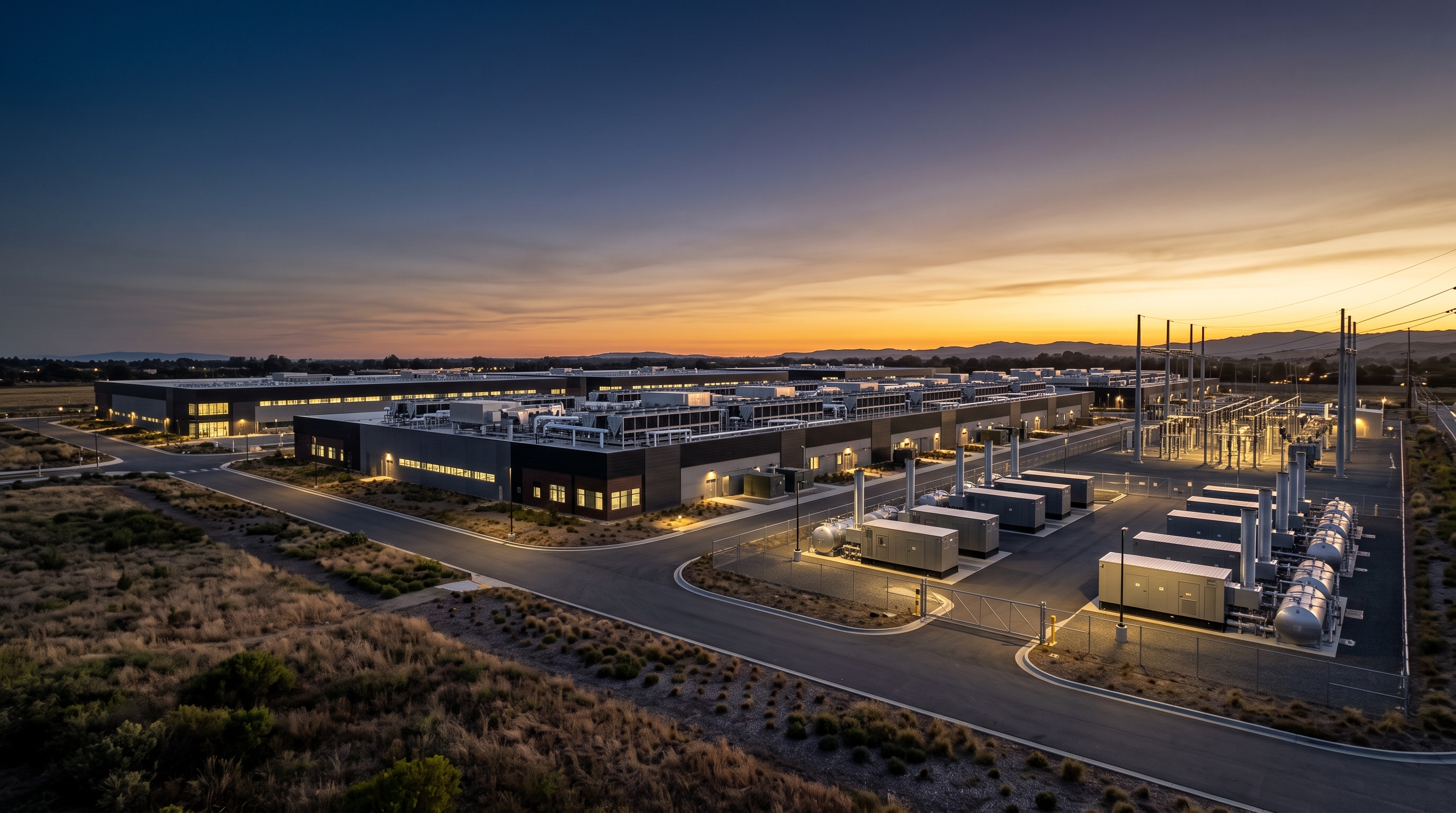
Data Center Construction Equipment Constraint: 3 Risks
CBRE flags a data center construction equipment constraint, Ceres counts power-plant water withdrawals, and a noise suit targets operating gear.
A data center construction equipment constraint used to mean a late substation or a slow utility hookup. Three documents published since late August show the risk now reaches further: into fit-outs at buildings that already exist, into the power plants that supply the site, and into the equipment that runs after commissioning. None of these replaces the others. A buyer serving large loads now has to track all three at once.
The Equipment Constraint Has Reached Existing Buildings
CBRE’s North America Data Center Trends H1 2026, published August 27, reports that “total under-construction capacity across primary markets increased by 24.8% in H1 to a record high of 7,481.1 MW.” Commitments cover 80.4% of that capacity, and CBRE says less than 1,500 MW of future capacity across primary markets remains available, “approximately six months of demand at the current absorption rate.” Primary-market vacancy fell to a record low of 1.4%.
The line that matters most for equipment buyers is this one: “Mechanical, electrical and plumbing equipment constraints are now impacting existing facilities in addition to new projects.” CBRE adds that ready-for-service fit-out dates “are expanding from weeks to several months,” and that for air-cooled facilities converting to liquid cooling, “delays can extend beyond six months.”
Two limits on reading that. A preleasing commitment is a lease, not a placed equipment order or a booked factory slot. And CBRE’s MEP observation is not a lead-time quote for any transformer, switchgear lineup or cooling unit. It tells you where schedule risk is showing up, not how long a specific product takes. Read it as a data center construction equipment constraint on the fit-out schedule, not as a supply forecast for utility gear.
Permitting has not gone away either. The same report says Northern Virginia construction grew at “a slower pace than last year due to land and permitting constraints,” that “power availability and infrastructure delivery timelines remain the most decisive factors influencing site selection,” and that developers face energization delays as last-mile projects meet hurdles in permitting. A large load interconnection delay is still in play; the equipment constraint sits on top of it.
Water Risk Sits Mostly in the Electricity Supply
Ceres’ August report, Water Behind the Watts, looks at the water used to generate the electricity data centers buy, across seven states that together hold about 50% of US data centers: Virginia, Texas, California, Illinois, Georgia, Ohio and Arizona.
Its headline estimate: powering data centers in those states “used an estimated 3.4 trillion gallons of water withdrawals in 2024, applying EPRI state estimates,” ranging from 25 billion gallons in Ohio to 1.4 trillion gallons in California. Applying EPRI’s growth scenarios, Ceres puts 2030 at an estimated 4.1 to 7.6 trillion gallons withdrawn.
The data center water use withdrawal vs consumption distinction carries the whole finding. Ceres says the estimates “are based on withdrawals (not consumption) and include hydropower.” Consumption is water permanently lost from the local system; withdrawal is the full volume a plant depends on to operate, which Ceres treats as an indicator of risk exposure. The report calls its findings “directional estimates” and leaves on-site, behind-the-meter generation out of scope.
For a procurement team, the practical reading is that a site’s water exposure depends heavily on where its purchased electricity comes from, and that a withdrawal figure measures dependency, not water used up.
Noise Claims Target the Equipment That Runs After Commissioning
The third layer arrives after the building is energized. In Ostergaard v. Microsoft, a putative class action in the Eastern District of Wisconsin, the second amended complaint filed August 31, 2026 alleges noise from backup generators and HVAC systems, “including chillers, cooling towers, air-handling units, and condenser fans.” It also alleges that A-weighted decibel (dBA) measurements miss low-frequency “low hum” noise. The complaint pleads private nuisance and negligence and asks for relief that includes damages and an injunction.
These are allegations. No court has made findings on them, and no class has been certified. On September 22, the parties filed a notice that they had agreed on the material terms of a settlement in principle and jointly asked for a 90-day stay of all deadlines except those related to settlement approval. As of that September 22 filing, the settlement terms were not public and no settlement had been approved.
Nothing in the case sets an acoustic standard or a precedent. What it shows is that the equipment list behind a data center noise lawsuit is the same one on a buyer’s spec sheet: generators, chillers, cooling towers and fans.
What to Track on a Large-Load Project
The data center construction equipment constraint, the water dependency and the operating-noise exposure overlap in time; they do not arrive in sequence. This is our editorial read of the three documents, not a finding from any of them:
- Track release, delivery, energization and commissioning as separate milestones. CBRE’s data shows delay can enter at fit-out even after a building stands.
- Ask where the site’s electricity comes from, and how water dependency is measured. A withdrawal figure and a consumption figure answer different questions.
- Ask for project-specific acoustic design and acceptance evidence for generators and cooling equipment, from qualified parties, including how low-frequency sound was considered. No specification on its own prevents an objection or removes nuisance exposure.
If you are sizing the electrical side of these projects, our pieces on data center substation design as a procurement decision and on discounting the data center load pipeline against contracted load cover the upstream questions. Load flexibility as an equipment spec covers what the utility side is starting to ask for.
The Feeder is our free read on the procurement, supply and regulatory signals that move grid equipment demand, written for the people who place the orders. Subscribe to The Feeder.
Related Reading
- Data Center Substation Design Is a Procurement Decision
- Data Center Load Pipeline vs Contracted: How to Discount It
- Data Center Load Flexibility Is Now an Equipment Spec
Track this beat without paying per report
Free Member tier. Pick your topics. Get a weekly digest filtered to what you actually buy.