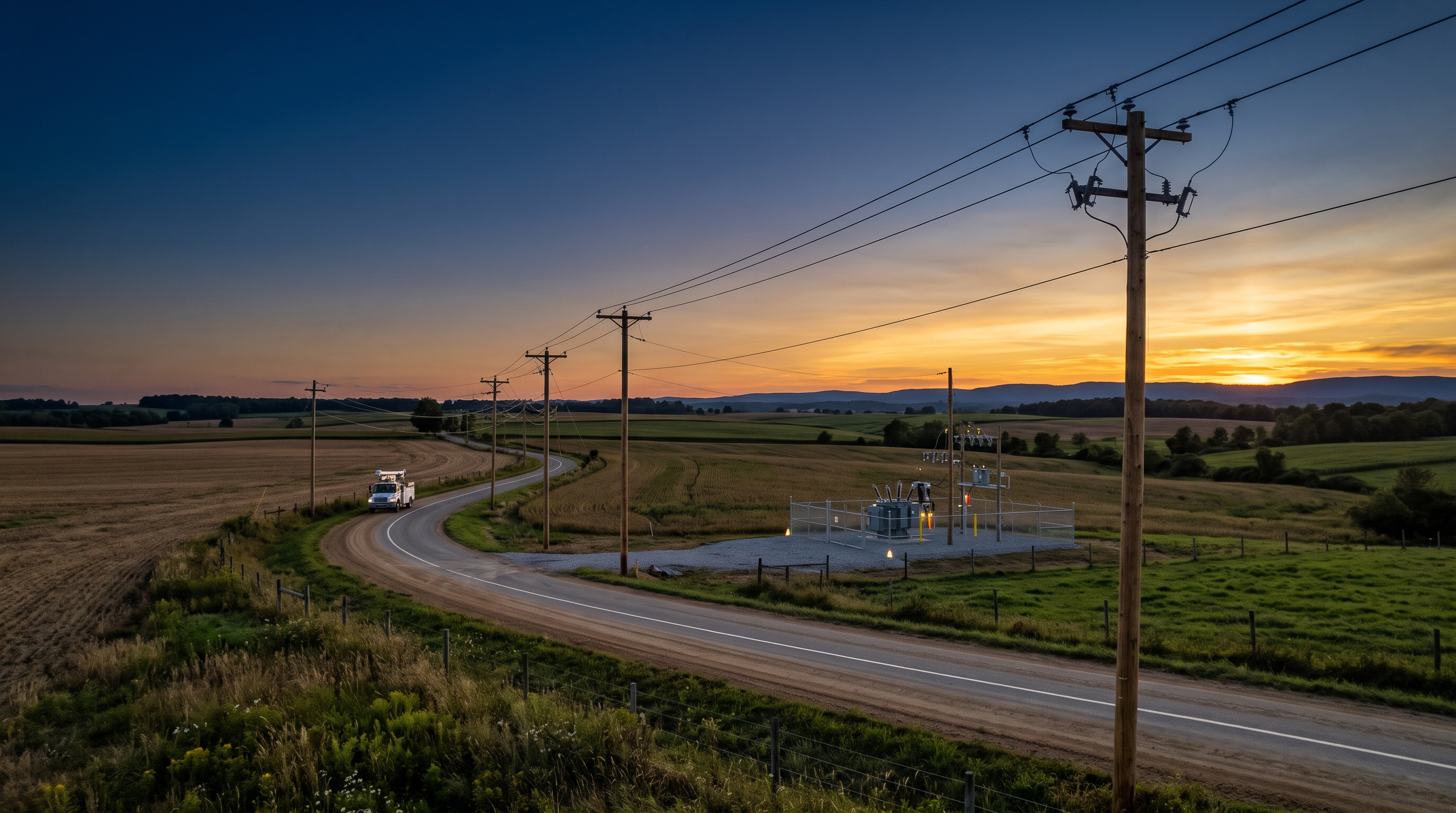
Grid Resilience Formula Grants: How Munis and Co-ops Get In
DOE allocated $967 million in grid resilience formula grants to states, territories and tribes. Here is how a municipal utility or co-op reaches that money, the match it carries, and what it can buy.
DOE announced on October 20, 2026 “approximately $967 million in additional funding” through its Grid Resilience State and Tribal Formula Grant program. The NETL allocation table puts the exact combined figure for fiscal years 2025 and 2026 at $967,104,372. If you run a municipal utility or a co-op, the first thing to know about these grid resilience formula grants is who the money goes to. It goes to states, territories and tribes, not to utilities. Your utility reaches it only as a sub-grantee, and the state decides how.
The program was created by section 40101(d) of the Infrastructure Investment and Jobs Act. DOE’s Office of Electricity describes this round as “Years 4 and 5 out of the 5-year program,” so it covers the program’s final two years of funding.
What DOE actually released
Four documents carry the facts.
- The release (October 20) announces the funding and says it will support projects across states, territories and tribes. It names no utilities and carries no per-state figures.
- The program page says Amendment 10 of the program’s Administrative and Legal Requirements Document was issued October 20. It opens a 120-day application period for existing grant recipients and new applicants. The deadline is February 17, 2027 at 11:59pm EST. DOE also says it added previous years’ unclaimed funds to this round’s pool.
- The NETL allocation table lists each eligible state, territory and tribe. A few examples: California $69,814,909, Texas $50,336,809, Florida $31,870,636, New York $21,534,423, Colorado $14,287,976, Nebraska $9,284,035, Maine $5,243,221 and Vermont $4,039,556.
- DOE’s program FAQ (dated October 28) carries the working rules on match, allowable projects and federal conditions used below. The full requirements document and your state’s own terms control.
That February date binds your state energy office or tribe, not you. Your own deadline will be whatever the state sets. DOE’s FAQ says the sub-grant process will likely come after DOE awards the state’s grant, and that state methods can include competitive solicitations, direct awards and the use of financial institutions.
How grid resilience formula grants reach a municipal utility or co-op
The statute, 42 U.S.C. 18711, sets the path. DOE makes grants to states and tribes, “which each State or Indian Tribe may use to award grants to eligible entities.” A distribution provider is on the list of eligible entities, along with grid operators, storage operators, generators, transmission owners or operators, and fuel suppliers.
Each state’s application rests on a plan. The statute says that plan must describe the criteria and methods the state will use to pick sub-grantees and the proposed distributions, and it must be “adopted after notice and a public hearing.” DOE describes the plan as part of the state’s Program Narrative.
That hearing may not happen again this round. DOE’s program FAQ says existing grant recipients do not need to submit a revised Program Narrative, or meet the associated public notice and hearing requirements, for the FY2025-FY2026 funds unless their implementation plans have changed or their original narrative did not account for resilience projects beyond those funded with FY2022-FY2024 money. A state applying for the first time does need a plan adopted after notice and a hearing. So if your state already runs this program, start with its existing Program Narrative and its sub-grant process rather than waiting for a hearing notice. Where a hearing is required, DOE says it must be completed before the application goes in.
On the formula path, two provisions protect smaller systems. One is the lower match covered below. The other is a floor. Inside each state, the share of sub-grant money made available to entities that sell not more than 4,000,000 megawatt hours a year can be no less than the share of the state’s customers those entities serve. That is section 18711(d)(6). The statute’s separate 30 percent small-utility set-aside, in section 18711(c)(5), applies to the grants DOE makes directly to eligible entities, a different half of the program, not to the state formula grants this round funds.
That floor covers small utilities as a class. It reserves nothing for any one utility, and DOE’s FAQ says funds may go to other eligible entities if small utilities do not take up the opportunity or their projects are not selected.
The 40101(d) match is the real gate
The statute requires two separate matches.
- The state or tribe matches 15 percent of its own grant. DOE’s FAQ says nothing prohibits it from requiring an additional 15 percent from sub-grantees to meet that match, so ask.
- The eligible entity, meaning your utility, matches 100 percent of its sub-grant. An entity selling not more than 4,000,000 MWh a year matches one-third instead.
To make the difference concrete with round numbers: on a $300,000 sub-grant, a small utility would put up $100,000 and a larger one would put up $300,000, before any additional share the state passes down. That is arithmetic on the statute, not a figure from any state’s program. The statute also bars a sub-grantee from seeking rate recovery for the grant-funded portion of the equipment. The portion you pay for yourself can still go through normal ratemaking.
DOE’s FAQ also addresses where the match can come from. Utility funds derived from ratepayers can count, subject to any state limits. In-kind contributions can count where applicable. Other appropriated federal funds are excluded.
If you are weighing this against other federal money, the match rules differ. The USDA rural utility loan program sets its own match terms, and a project cannot assume one program’s rules carry over to the other.
What grid resilience grants can buy
Section 18711(e) lists examples of allowed uses for reducing the likelihood and consequences of disruptive events. For equipment buyers, the relevant ones include:
- monitoring and control technologies
- undergrounding of electrical equipment
- utility pole management
- relocating power lines, or reconductoring them with low-sag advanced conductors
- hardening of power lines, facilities and substations
- replacement of old overhead conductors and underground cables
- weatherization and fire-resistant technologies
The statute bars construction of a new electric generating facility, bars a new large-scale battery-storage facility that is not used for adaptive capacity during disruptive events, and bars cybersecurity spending. DOE’s program FAQ allows combustion-based generation configured to provide emergency backup during a disruptive event, and battery storage, including mobile units, to keep supplying electricity where needed during disruptive events. Its definitions section still counts emergency back-up generation as new generation, so confirm any generation project with your state.
The FAQ draws other lines too:
- Buying land or easements is not allowable, which matters for undergrounding and relocation routes.
- A new distribution line below 69 kV can qualify when it provides redundancy or fail-over, but not to reach new service territory. A new line at 69 kV or above must complete a radial loop or solve an N-1 contingency.
- Behind-the-meter projects are generally not allowable, apart from emergency backup generation and battery storage used for outage response.
The FAQ also says recipients may buy equipment commonly used to restore power after an outage, such as pole- or pad-mounted transformers, utility poles, cross arms and conductor, to build an Emergency Equipment Inventory. The equipment and quantities need to be clearly tied to emergency grid restoration. Equipment bought for a specific project must be installed as part of it.
None of this means a state will fund any particular category. Each state’s plan sets its own criteria. Use the list and the FAQ to screen a project before you take it to the state, not to settle its eligibility. Our co-op grid hardening playbook walks through how one Missouri cooperative ordered its hardening plan.
What to do this quarter
- Find your state’s administering office for the grid resilience formula grants and ask how it will make sub-awards this round, and when.
- Read your state’s current Program Narrative and its award criteria. If your state is a new applicant, is changing its plans, or has a narrative that did not contemplate later projects, it must hold a public hearing before it applies, so ask whether one is scheduled.
- Confirm whether you sell 4,000,000 MWh a year or less. It decides both your match and whether you fall inside the state’s small-utility floor.
- Line up the match now, but do not spend it. A one-third match still has to come from somewhere, and a board conversation takes longer than an application. DOE’s FAQ says pre-award costs for resilience projects, whether grant funds or match, are most likely unallowable, so hold the project until your sub-award is approved.
- Map candidate projects to the allowed-use list before the state’s process opens, so you are not rescoping under deadline.
- Plan for Build America, Buy America and Davis-Bacon. DOE’s FAQ says both apply to grant recipients and subawardees. Its BABA small-grants waiver covers individual projects or subawards with a total project cost under $250,000. Our BABA compliance guide covers how to document domestic content. This is general information, not legal advice. Confirm requirements with your state and your award terms.
This round adds a funding calendar, not an order book. The money moves from DOE to states and from states to sub-grantees, and DOE’s written concurrence on the projects and sub-awards comes before purchase orders. DOE says to allow at least 45 days for that review, and NEPA review can take weeks to months, or longer for a project that needs an environmental impact statement. For where this fits among other federal grid programs, see the grid modernization procurement guide.
Related Reading
- The co-op grid hardening playbook: six resilience moves
- USDA’s forgivable rural utility loans: why the match cannot be borrowed
- The SPARK deadline: what utility procurement teams need to know
Keep federal funding on your procurement calendar. The Feeder is our free weekly brief on the regulatory shifts and supply signals that affect utility equipment procurement. Subscribe to The Feeder.
Frequently Asked Questions
Did DOE award $967 million to utilities?
No. DOE allocated $967,104,372 for fiscal years 2025 and 2026 combined to states, territories and tribes under IIJA section 40101(d), according to the NETL allocation table for ALRD Amendment 010. Each state or tribe must apply for its allocation by February 17, 2027. Utilities receive money only as sub-grantees of a state or tribe.
Can a municipal utility or electric cooperative get grid resilience formula grant money?
Yes, through its state or tribe. Under 42 U.S.C. 18711, a state or tribe may use its grant to award grants to eligible entities, and the statute lists distribution providers among them. The state's plan must describe its award criteria and be adopted after notice and a public hearing. DOE's program FAQ says a state that already holds a grant from earlier years does not need a revised Program Narrative or a new hearing for the FY2025-FY2026 funds unless its implementation plans changed or its original narrative did not contemplate later projects, so in that case the existing plan and the state's sub-grant process are the things to read.
What match does a small utility pay under the 40101(d) program?
Under 42 U.S.C. 18711(h), an eligible entity matches 100 percent of its grant. An entity that sells not more than 4,000,000 megawatt hours of electricity a year matches one-third instead. The state or tribe separately matches 15 percent of its own grant, and DOE's program FAQ says nothing prohibits it from requiring an additional 15 percent from sub-grantees to meet that match.
What equipment can 40101(d) formula grants pay for?
The statute lists weatherization, fire-resistant technologies, monitoring and control technologies, undergrounding, utility pole management, reconductoring with low-sag advanced conductors, hardening of power lines, facilities and substations, and replacement of old overhead conductors and underground cables, among other uses. It bars new generating facilities, large-scale battery storage not used for adaptive capacity during disruptive events, and cybersecurity. DOE's program FAQ allows combustion-based generation configured to provide emergency backup during a disruptive event, and battery storage, including mobile units, that keeps supplying electricity where needed during disruptive events. The FAQ also rules out land and easement purchases.
Free RFQ templates. Weekly digest. Yours.
Free Member tier. Pick your topics. Get a weekly digest filtered to what you actually buy.