USDA Will Forgive 40% of These Rural Utility Loans. The Match Cannot Be Borrowed.
The USDA rural utility loan program 2026 forgives up to 40% of a loan. Letters of interest are rolling from September 8, and the match cannot be debt.
USDA opened the Powering Affordable Reliable Technology program on August 3, and nearly every account of it has been framed the same way: $410 million in partially forgivable loans for rural utilities, letters of interest due by October 9. Every piece of that is true. A cooperative that plans around it will still be late.
The USDA rural utility loan program 2026 does not collect applications and then score them after a closing date. According to the grants.gov record, the Rural Utilities Service “will process and evaluate complete LOI on a rolling basis in the order they are received,” against roughly 100 expected awards. October 9 is when the door shuts. September 8 is when the money starts moving.
That distinction is the whole story for a small buyer, and it is one of four things in the public record that change how a co-op board should read this program.
What the USDA rural utility loan program 2026 actually puts on the table
PART is an RUS lending program, published as a notice of funding opportunity in the Federal Register on August 4 under Docket No. RUS-26-ELECTRIC-0232, with the authority line citing 7 U.S.C. 901. Its funding opportunity number is RUS-PART-2026 and its assistance listing is 10.757.
The money is Inflation Reduction Act money. Per the grants.gov record, the program makes roughly $410 million in appropriated budget authority available under Section 22001 of the IRA, which amended Section 9003 of the Farm Security and Rural Investment Act of 2002 and provided RUS with funds “for the cost of loans under Section 317 of the RE Act.” Individual awards run from $1 million to $100 million.
Worth noting for anyone who builds a source list: the Federal Register notice states that in future years this opportunity will be announced only on the agency website and grants.gov, with no Federal Register notice at all. If your funding watch is keyed to the Federal Register, it will go quiet on PART after this cycle while the program keeps running.
Partially forgivable utility loans, and what the 40% is attached to
Secondary coverage has uniformly said “partially forgivable” and stopped there. The grants.gov record is more specific. Project loans and system loans “will be forgiven up to forty percent (40%), provided the Awardee and the Project otherwise meet the terms and conditions of the loan forgiveness.”
Two words in that sentence carry weight. “Up to” means 40% is a ceiling and not an entitlement. “Provided” means forgiveness is conditioned on terms that live in the full notice, which is not yet posted publicly. Anyone modeling a 40% write-down today is modeling the best case of a condition they have not read.
There is a second financial term hiding in the statute rather than the notice. Section 317 sets the rate of a loan under that section equal to the average tax-exempt municipal bond rate of similar maturities. For a co-op comparing PART against its usual lender, that is the number the comparison turns on, and it comes from the statute rather than from any USDA announcement.
September 8 matters more than October 9
Rolling evaluation in order received, roughly 100 expected awards, and a fixed pool of budget authority together mean the window behaves like a queue rather than a deadline. A complete letter filed on the first morning is evaluated ahead of a better project filed in late September.
The times are the trap. Letters may be submitted “beginning at 11:59 a.m. Eastern Time (ET) on September 8, 2026, until 11:59 a.m. ET on October 9, 2026.” Both are a.m. An applicant who reads that as the customary 11:59 p.m. and files on the final day misses by twelve hours.
One more scheduling detail sits in the grants.gov record: the forecast entry archives on September 7 and the posted synopsis appears September 8. The full notice, with the forgiveness conditions and the operative definitions, becomes public on the same morning the queue opens. Scoping work has to happen before the document that governs it is available, which is an odd position to be in and an argument for having the internal questions ready rather than the answers.
The 25% match cannot be borrowed, which reshapes co-op capital equipment financing
This is the clause most likely to decide whether a given cooperative can participate at all, and it has not appeared in any coverage of the program.
For project loans, awards finance up to 75% of a project’s total capitalized cost. The awardee must supply at least 25% of that cost “in the form of cash or equity investments, which may not be derived from debt instruments.”
A co-op that intended to cover its share with a supplemental loan from its usual lender cannot. The match has to come from reserves, from margins, or from member equity. For a distribution cooperative running thin margins and a heavy existing debt load, that single sentence can be the difference between a viable application and a dead one, and it is a board-level question rather than an engineering one.
Two exits exist in the same paragraph. System loans may cover up to 100% of total project cost. And RUS may use its authority under Section 306F of the RE Act to finance up to 100% of projects benefiting substantially underserved trust areas, which the statute defines as communities in trust land the Secretary determines have a high need. A tribal utility reading this program should start at that provision rather than at the 75% figure.
Rural electric cooperative federal funding, but not for cooperatives only
The eligible-applicant class is broader than the program’s rural framing suggests. Per the grants.gov record, eligible entities operating as utilities include for-profit organizations; state or local governments; Indian Tribes and their wholly owned arms and instrumentalities; Alaska Native Corporations; nonprofits; distribution and generation and transmission electric cooperatives; and certificated electric utilities.
Distribution cooperatives are named outright, which settles the eligibility question our earlier reading had to leave open. The more useful finding is the company they keep. For-profit organizations and certificated electric utilities sit in the same first-come queue, which means a 40,000-meter co-op preparing a letter is not competing only against other co-ops of its size. In a program evaluated in order received, an applicant with in-house project finance staff has a structural advantage measured in days.
The USDA energy storage loan has a condition attached
Coverage of PART, including our own first read, treated energy storage as a straightforwardly eligible category. The grants.gov description is narrower. Loans finance “power generation Projects for Renewable Energy Resource (RER) systems or Energy Storage Systems (ESS) that support RER Projects.”
Storage has to support an eligible renewable resource project. A standalone battery installed for peak shaving, distribution deferral, or resilience does not obviously qualify on the face of that language, and those are the three reasons a distribution co-op is most likely to want one.
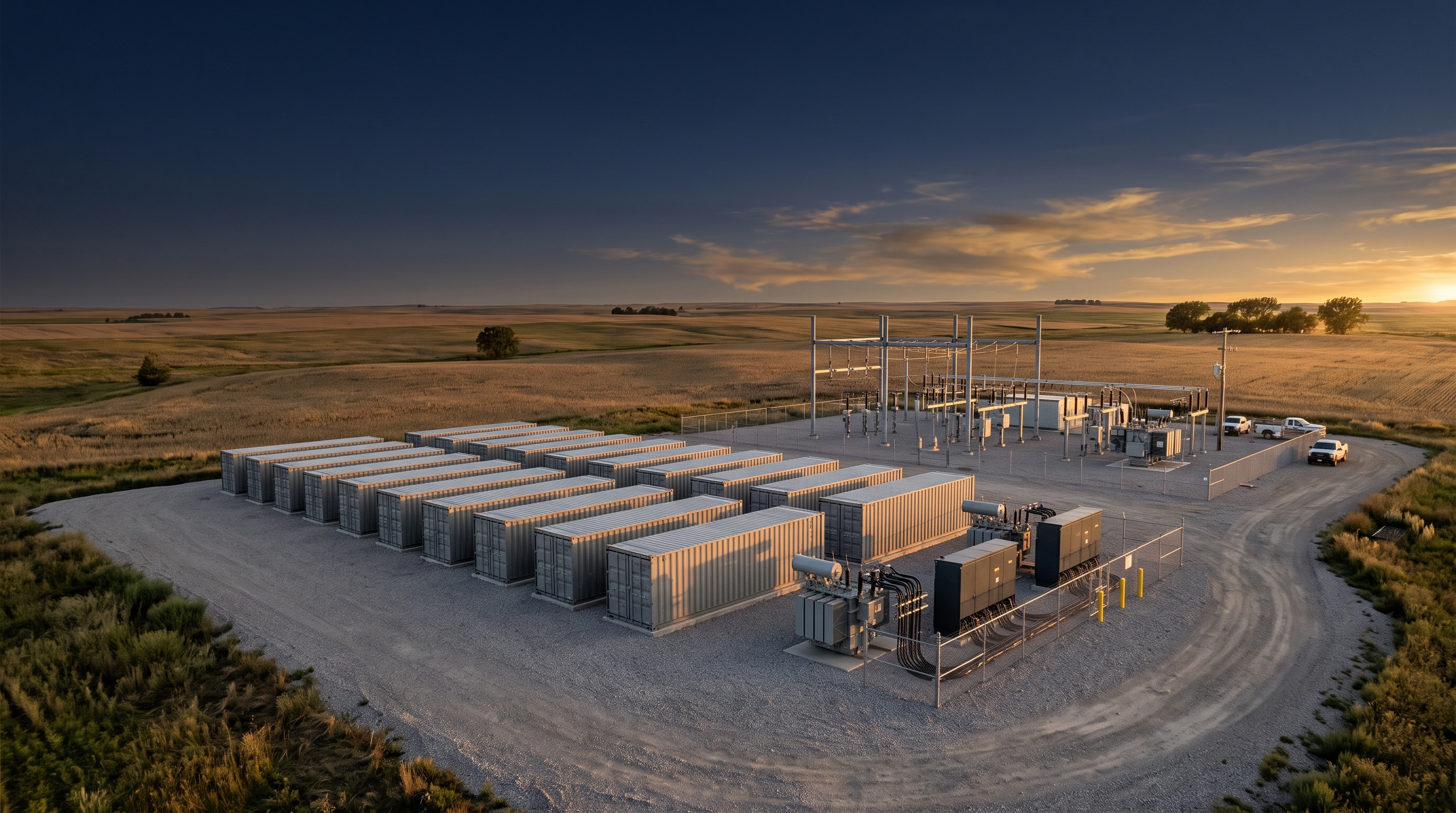
Where the program does reach our lane is the bill of materials underneath a qualifying storage project. Power conversion equipment, medium-voltage collection, step-up transformers, switchgear and protection all sit inside a battery project whether the battery is charging from a co-op’s biomass plant or from anything else. If a meaningful share of roughly 100 awards lands as co-op-scale storage between this fall and the close of the fiscal year, that is a cohort of similar equipment packages entering procurement in the same quarter, against lead times that were already long before this program existed.
Five sources in the statute, three in the announcement
Section 317, codified at 7 U.S.C. 940g, defines a renewable energy source as “an energy conversion system fueled from a solar, wind, hydropower, biomass, or geothermal source of energy.” Five sources.
USDA’s own announcement describes PART as funding hydro, geothermal and biomass, plus storage. Three sources. Solar and wind appear nowhere in it.
The grants.gov description uses the general term “Renewable Energy Resource” without enumerating anything, so the operative definition is in the full notice that posts September 8. That gap is worth naming plainly rather than resolving by assumption: the statute the program draws on is broader than the program as announced, and a cooperative scoping a solar-charged storage project should confirm eligibility in the notice before it spends money on engineering. Confirming it is a phone call to the PART help desk, not a guess.
Taking the loan changes what you are allowed to buy
The last consequence is the one furthest from the press release and closest to the equipment.
A PART award makes the recipient an RUS borrower, and RUS borrowers are subject to 7 CFR 1728.70(a): “When purchasing the type of materials included in the List of Materials, RUS borrowers shall purchase only materials listed in the List of Materials, or materials which have a current technical acceptance by RUS and meet the ‘Buy American’ requirement.”
That rule binds only for the material categories the List covers, which is the question to put on the table early. Distribution-side hardware in a storage project’s balance of plant is far more likely to fall inside a listed category than the battery enclosures themselves. A supplier who has never held RUS technical acceptance can meet every salient characteristic in your specification and still be unusable on the resulting system, which is the same boundary we walked through in writing an or-equal specification. Federal money and federal materials rules arrive together, and the second one is what reaches the purchase order.
What to do before the window opens
The record supports four steps, and none of them require the full notice to be published first.
Confirm the match. Establish now whether 25% of the project’s capitalized cost is available as cash or equity, because no amount of engineering work fixes it later if it is not. Check whether a system loan or the Section 306F pathway applies to you before assuming the 75% ceiling is your ceiling.
Settle the eligibility question you actually have. If your project is storage, write down what renewable resource it supports. Where that resource is solar or wind, treat eligibility as open until the notice says otherwise. Questions go to the PART help desk at [email protected], and asking in August is cheaper than discovering in October.
Read the materials constraint into the specification rather than into the award. Ask which line items fall under the List of Materials and whether your preferred suppliers hold current technical acceptance.
Calendar September 8 at 11:59 a.m. Eastern, not October 9. The notice posts that morning and the queue opens the same moment.
Federal programs that reach cooperative equipment budgets are rare, and the USDA rural utility loan program 2026 arrived with its most consequential terms sitting in a grants.gov field rather than in the announcement. The Feeder is our free weekly briefing on the rules that move equipment timing and what they mean for buyers who do not have a policy team. Sign up here.
Related Reading
- The Co-op Grid Hardening Playbook: Six Resilience Moves
- DOE Transmission Loans: The $3.26B AEP Texas Close
- Sodium-Ion Grid Storage Goes Domestic: A Procurement Read
Frequently Asked Questions
When do letters of interest for the USDA PART program open and close?
Letters of interest can be submitted beginning at 11:59 a.m. Eastern Time on September 8, 2026, until 11:59 a.m. Eastern Time on October 9, 2026. Both times are a.m., not p.m. RUS evaluates complete letters on a rolling basis in the order received, so the opening time matters more than the closing one.
How much of a PART loan is forgiven?
The grants.gov record states that project loans or system loans will be forgiven up to forty percent, provided the awardee and the project meet the terms and conditions of the loan forgiveness. Those conditions are set out in the full notice of funding opportunity rather than in the Federal Register notice.
Can a cooperative borrow the 25% match?
No. For project loans, the awardee must provide at least 25% of the project's total capitalized cost in the form of cash or equity investments, which may not be derived from debt instruments. System loans may cover up to 100% of project cost, and RUS may finance up to 100% for projects benefiting substantially underserved trust areas.
Track this beat without paying per report
Free Member tier. Pick your topics. Get a weekly digest filtered to what you actually buy.