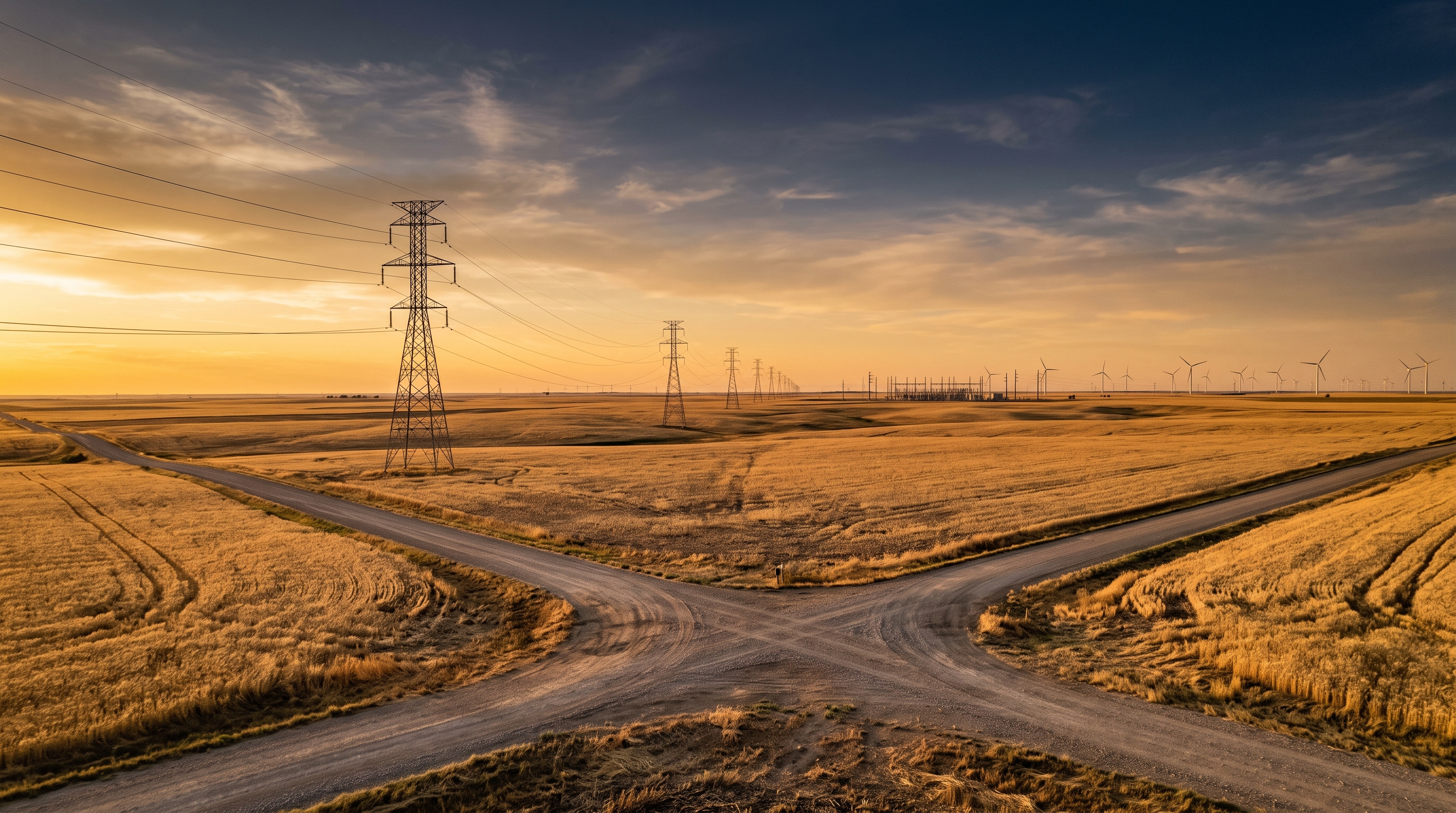
Gen-Tie Line Eminent Domain: 550 Feet Stops 1,053 MW
A Colorado judge found gen-tie line eminent domain unavailable on a wind interconnection route. 550 feet of easement holds up 1,053 MW of built turbines.
Two wind farms in eastern Colorado are built, or near enough that the difference does not matter. The turbines are up. What is missing is roughly 550 feet of easement across a county road intersection, and in June a Cheyenne County district judge held that gen-tie line eminent domain was not available to take it. Public Service Company of Colorado asked the state Supreme Court to skip the normal appeal and settle the question. In late August the court declined, in a two-paragraph order that did not reach the legal issues, and the case went back to the Colorado Court of Appeals where Xcel’s own spokesperson says it could take more than a year.
The arithmetic is what makes this worth a procurement reader’s time. The 603 MW Singing Grass project and the 450 MW Cheyenne Ridge II project need a 28.8-mile tie-line and a 5.4-mile tie-line respectively to reach the Goose Creek substation, according to figures Xcel gave Utility Dive. That is 34.2 miles of route, and the utility says it holds easements across all of it except the last stretch, negotiated with more than 100 landowners. The unresolved parcel is 550 feet. Three tenths of one percent of the route is holding 1,053 MW of built generation off the grid, and the reason is not price, engineering or permitting. It is that the legal instrument everyone assumed was there turned out not to be.
What the Court Held About Utility Condemnation Authority
Colorado law lets utilities condemn land for transmission lines. Judge Mike Davidson’s June ruling turned on whether these lines qualify. He found they did not, because the lines serve the utility’s own generating assets rather than carrying electricity to homes and businesses, and because PSCo had repeatedly called them generation tie-lines in its own filings and permit documents rather than transmission lines.
That is the part worth carrying away, and it is uncomfortable for anyone who fills out permit paperwork for a living. The accurate, ordinary, engineering-correct term for the facility became the evidence that defeated the condemnation. Nothing in the holding turns on voltage, length or ownership. A 28.8-mile line at transmission voltage owned by a regulated utility was still a gen-tie, because of what it is for and because of what its owner called it.
Two things keep this from being settled law, and both belong in any honest reading of it.
The first is that the ruling rests on more than the classification. Judge Davidson denied the condemnation on four separate grounds: that PSCo lacked the authority, that the taking was not for a public use, that it was not necessary, and that the company had failed to negotiate in good faith. He also found PSCo had selected a route that maximized harm to the landowner while a less damaging alternative existed. An appellate court that wants to resolve this case without writing doctrine can affirm on the bad-faith finding and never touch the transmission question. So the doctrinal holding is real, it is live, and it may never be tested.
The second is the posture. The Supreme Court’s refusal to take the case early was not a ruling on the merits. PSCo argued the question was of “such imperative public importance as to justify the deviation from normal appellate processes.” The Colorado Energy Office and the Sierra Club filed amicus briefs supporting that argument. The court said no in two paragraphs without addressing the substance, which means the utility gets its appeal in the ordinary course and everybody waits.
There is one more detail in PSCo’s petition that is hard to read past. The filing asks whether “a regulated electric utility may condemn easements for transmission lines connecting renewable generation to the grid.” In a petition seeking review of a ruling that these are not transmission lines, the petition calls them transmission lines.
The Counterexample Is Next Door, and It Is Built
The most useful fact in this dispute is not in the ruling. It is in the history of the same parcel.
In 2022 the Dickey family, farming as Dryland Partners, sold Xcel about 90 acres for $585,000 as the site of the Goose Creek substation, and worked with the utility to draw up corridors for the lines that would reach it, according to the Colorado Sun’s reporting. The right of way PSCo later sought is not one of those corridors. Dryland then negotiated a separate right of way so that NextEra Energy Resources’ Dusty Rose wind farm, in neighboring Kit Carson County, could connect to the same substation. That project is built.
So the same landowner, at the same substation, granted a gen-tie easement to a different developer by negotiation, and that developer energized. The landowner’s attorney has said publicly that Dryland “remains open to resolution for any of the available corridors PSCo approved and on the same terms the built-project (Dusty Rose).” Xcel’s position is that its offer, reported at $19,000 by the Colorado Sun, was far above fair market value and that the landowner’s alternative routes are prohibitively expensive. The landowner’s objection to the preferred route is specific: a tower beside the road creates a hazard for heavy farm equipment and sits on a gas pipeline right of way the partnership holds.
Read it as a procurement fact rather than a property dispute and the shape is plain. This is not a story about an unreasonable holdout stopping a project. It is a story about two developers reaching the same substation, one by negotiating and one by relying on a backstop that turned out not to exist. Whatever the Court of Appeals decides, the project that negotiated is generating and the project that did not is standing still.
Same Utility, Same State, Same Year, Opposite Result
The strongest evidence that the classification is doing real work sits in another county on the same Eastern Plains.
Xcel’s $1.7 billion Power Pathway is a 345 kV, 550-mile loop built in five segments. Elbert County denied siting permits for Segment 5 in June 2025 after resident opposition. Xcel went to the Colorado Public Utilities Commission and invoked a backstop siting statute that lets regulators override local land-use decisions on electric and gas infrastructure, a provision used three times in the previous 21 years. The Colorado Energy Office and commission staff supported the request, and on April 10, 2026 the PUC voted 3-0 to override the county and let the segment proceed, per the Colorado Sun’s account of the hearing. The El Paso County case was still pending.
Nobody in that proceeding argued Xcel lacked condemnation authority. The county had sought to move the route farther east rather than to stop the line. The same Colorado Sun reporting notes that Xcel had begun condemnation proceedings against Elbert County residents before it had obtained permits, needing rights of way on 48 properties and holding agreements on 27.
Set the two side by side. On the public transmission line the state stepped in over a county’s objection, using a statute it almost never uses, and the utility’s power to take land was never the question. On the gen-tie the authority was found not to exist at all, and 550 feet was enough. Same utility, same state, months apart. The classification is the entire difference, and it is a classification most project schedules never make explicit.
The Legislature Looked at This and Declined
One correction to the way this case has been described elsewhere, including in our own research file before we checked it.
In early March 2026, coverage reported that Colorado lawmakers were moving to curb utility eminent-domain powers in response to these disputes. The bill was HB26-1278, Local Government Approval of Transmission Infrastructure, which would have required a utility to hold both a certificate of public convenience and necessity and all local land-use approvals before starting condemnation. It did not become law. The House Energy and Environment Committee voted 7-4 to postpone it indefinitely on March 5, 2026, one day after the coverage describing the effort, after adopting four amendments in the same hearing.
It would be easy to write that the political direction in Colorado runs against utility condemnation regardless of how the appeal comes out. The record does not support it. The legislature took up the question and dropped it inside three weeks of introduction. Which leaves the courts as the only venue, and leaves the gen-tie line eminent domain question where it currently sits, unresolved, at the Court of Appeals, for a year or more.
The Third Chokepoint Is Interconnection Land Rights Delay
Most procurement guidance treats two things as the schedule risks that can strand a project: equipment lead times and interconnection queue position. We have written about both, including ERCOT’s Batch Zero pause and the 220 GW that arrived when PJM reopened its queue. A third one belongs in the same tier, and this case is the clearest evidence of it available right now.
Land rights can strand a finished project as completely as a missing transformer can. Not “permitting takes time,” which everybody already builds into a schedule. Something sharper: the legal mechanism normally relied on to guarantee a route may simply not be available for the asset class you are building, and you will find out after you have spent the capital. Xcel told regulators it was accruing standby time and costs for transmission line crews while this ran. In a mid-May filing with the Colorado PUC the utility reported that all of Cheyenne Ridge II’s turbines were built and that 108 of 134 generators at Singing Grass were topped out. It had expected Cheyenne Ridge II to be operating in May 2026 and Singing Grass three months after that.
The same pattern shows up wherever access rather than hardware controls the calendar. It is the reason federal land permitting delays move pole orders. Access is a schedule input, and it is the one least likely to appear on an equipment plan.
Three Things to Change Before the Next Commitment
Treat the last parcel as the schedule, not the paperwork. Route land rights on generation interconnection should be closed by negotiated easement before construction commitment, and the assembly should be tracked by remaining parcels rather than by percentage complete. PSCo had 99.7 percent of its route. That number was not useful.
Read your own filings with the condemnation question in mind. A utility that calls a line a generation tie-line to a permitting authority is being accurate, and may also be building the record that later defeats its own authority over that line. That is not an argument for writing something untrue in a permit application. It is an argument for knowing, before you file, which legal category the facility sits in and whether the condemnation backstop you are assuming actually reaches it.
Get an answer on gen-tie line eminent domain in your own state before the notice to proceed. Whether the backstop exists differs by jurisdiction, and inside a single jurisdiction it can differ between a public transmission line and a gen-tie serving the same utility’s own generation. Colorado just demonstrated both halves of that in one year.
The turbines on this project are up. The easements are assembled across 34.2 miles of route, and the substation they are meant to reach sits on land the same family sold Xcel to build it. What is missing is one document, and the question of whether anyone can compel it is now scheduled to take longer to answer than the wind farms took to build.
Related Reading
- ERCOT’s data center interconnection pause covers the queue-position version of the same schedule problem.
- Wildfire mitigation federal land permitting is the access-as-schedule-risk argument applied to distribution work on federal land.
- The grid modernization procurement guide is the wider equipment picture these route decisions land on.
Watch the Land Rights, Not Just the Lead Times
Route access is now a live schedule variable and it moves without warning from a courtroom nobody was reading. The Feeder is our free monthly read on what changed in grid policy and regulation and what it does to a project calendar. One email a month, no charge. Subscribe to The Feeder.
Frequently Asked Questions
What is a gen-tie line?
A generation tie-line is the conductor that carries power from a generating facility to the point where it joins the grid, usually a substation. It serves one project rather than the public network, which is the distinction a Colorado district court used in June 2026 to hold that a utility's condemnation authority did not reach it.
Does a utility always have eminent domain over its own interconnection route?
No. Colorado law grants condemnation authority for transmission lines. A Cheyenne County judge found that gen-tie lines serving a utility's own generation are not transmission lines, so gen-tie line eminent domain was unavailable on that route. The question is on appeal at the Colorado Court of Appeals and is unresolved.
What should a buyer do differently because of this case?
Secure route land rights by negotiated easement before committing to construction rather than treating condemnation as a backstop, and read the terminology in your own permit filings, because a court used the applicant's own word choice as evidence.
Know what changed before your next quote
Free Member tier. Pick your topics. Get a weekly digest filtered to what you actually buy.