GIS vs Air Insulated Substation: When the Site Decides
Ameren's Goalby substation shows the real GIS vs air insulated substation test: not whether the lot is small, but whether site cost scales with area.
The usual way to ask whether gas insulated switchgear is worth it goes something like this: is the site too small for a conventional air insulated substation? That question has an answer, and the answer is almost always no, so the conversation ends there and the utility builds air insulated.
A project Ameren Illinois completed just west of downtown Belleville suggests the question is asked backwards. The site was not short of room. What it was short of was ground.
What Ameren built, in Ameren’s words
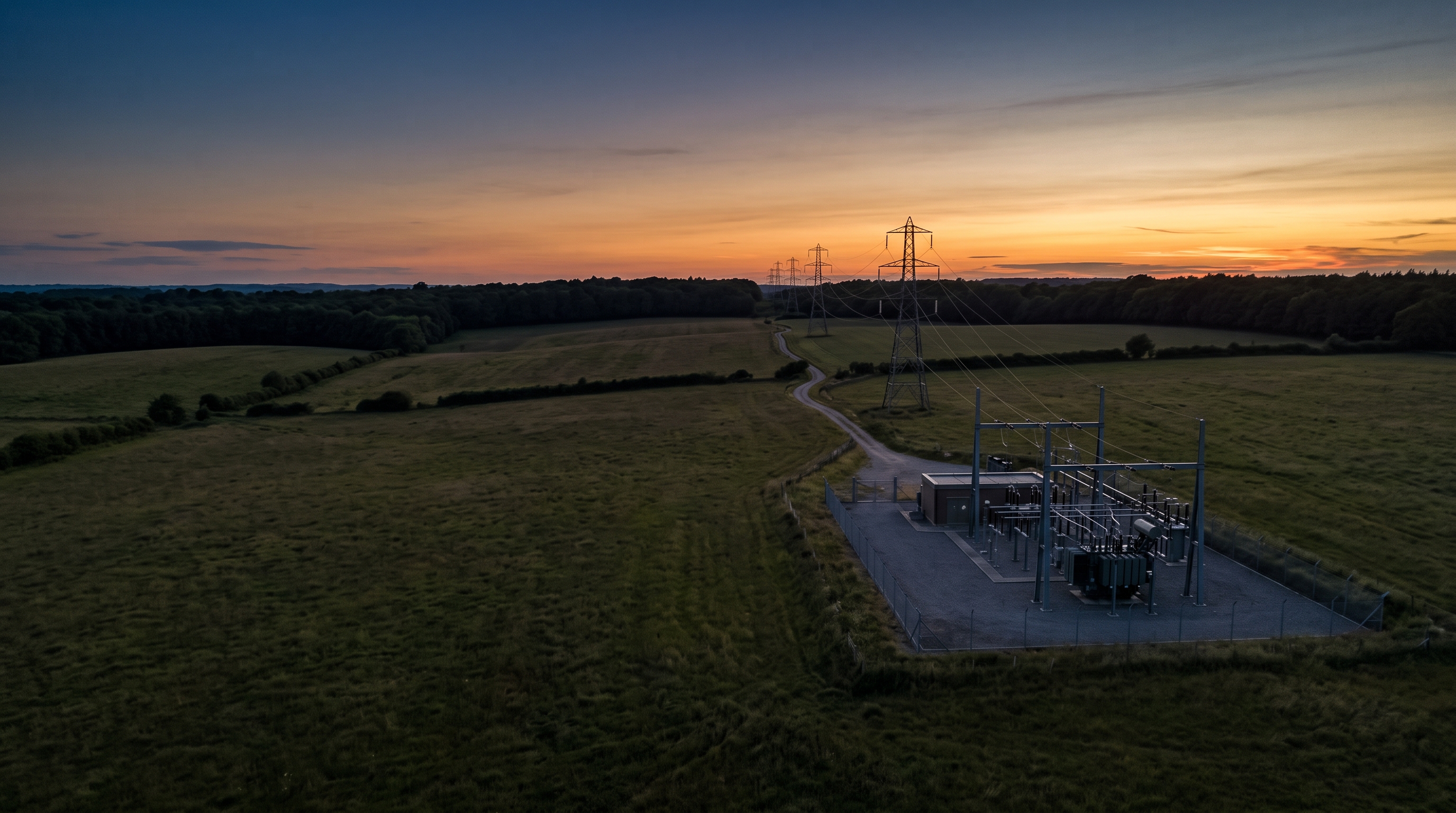
The Goalby Substation, named for Belleville native and PGA golfer Bob Goalby, sits at 1080 S. 20th St. Ameren’s own release describes it as “the first gas insulated substation (GIS) on Ameren’s transmission system,” built to provide “another intersection to reroute power as it flows through the region,” which lets the utility restore service faster after storms.
On the design, the release is direct: “Unlike traditional air insulated substations, this GIS facility uses advanced equipment housed within compact, sealed enclosures. This design results in a footprint about one-third the size of a typical transmission substation, while still delivering the same or even greater capabilities.”
Then comes the sentence that does the real work: “That smaller footprint allowed Ameren to build the substation in an area located above old mine shafts running underground from legacy coal mining industries in Belleville.”
Read it in that order and the causation runs the opposite way from the usual story. The footprint was not the objective. It was the mechanism.
The hardware premium was paid out of a different budget
Harman Ormani, Ameren’s project manager for Goalby, puts the reason plainly: “This GIS design allowed us to keep costs as low as possible for customers while maintaining the highest levels of safety, performance and reliability. The compact layout reduced the amount of engineering work required to mitigate possible issues caused by the mine.”
So the justification was site preparation, not switchgear. Ameren bought a more expensive assembly in order to buy less of something else, and that something else was the work of making undermined ground safe to build on.
Ameren has not published a cost figure for Goalby, and we are not going to supply one. What the utility does say is that the compact layout reduced the mitigation engineering, and that is enough to make the general point without a number attached to it.
Ormani also supplies the contrast that makes this worth writing about at all: “It’s a relatively unique situation. These GIS designs are typically built in very crowded downtown city blocks and other places where space is limited.” The standard use case is scarcity of land. Goalby was scarcity of competent ground on land the utility could otherwise use.
The test that actually decides it
Here is the generalization, offered as arithmetic rather than as a finding, because that is what it is.
Gas insulated switchgear loses to air insulated switchgear on equipment cost. It will keep losing. It wins when some other cost on the site scales with area. If you shrink the station to a third of the footprint and nothing else on the site gets cheaper, you have paid a premium for nothing. If a per-square-foot site cost exists, shrinking the area shrinks that cost too, and the comparison changes.
The qualifying question is therefore not is my site small? It is what does this site cost per square foot to make buildable, and does that cost scale with area?
Mine subsidence is one instance. The same structure holds anywhere a site carries an area-proportional preparation cost:
- Contaminated soil remediation on a brownfield, priced by volume removed or treated.
- Rock excavation where competent bedrock sits close to grade.
- Wetland mitigation, where required acreage tracks disturbed acreage.
- Flood-plain fill, priced by cubic yard.
- Seismic ground improvement, priced by treated area.
- Urban land itself, which is the textbook case and the one Ormani names.
Where the binding site cost is fixed rather than area-proportional, a permit, a study, an interconnection charge, the arithmetic does not work and air insulated wins as usual.
Why buyers miss this trade
This is an observation about how the work is organized, not about engineering.
The civil and geotechnical budget and the equipment budget usually live in different departments, with different approvers and different benchmarks. The department asked to approve the switchgear premium is not the department that books the savings in site preparation, and it is frequently not in the room when the geotechnical scope gets priced.
An engineer comparing bay-for-bay equipment cost will conclude, correctly, that GIS is more expensive. The comparison only comes out differently if someone builds the site-preparation estimate under both footprints and puts the two totals side by side. On most projects nobody is asked to do that, because nobody owns the question. If you take one operational thing from this piece, it is that the GIS evaluation belongs in the siting review, not in the equipment review.
Two things to settle before the footprint conversation
The insulating gas. Nothing Ameren has published says whether Goalby uses SF6 or an SF6-free alternative, and we are not going to assume. For anyone specifying in 2026, gas selection is a lifecycle-cost and regulatory-risk decision in its own right, and it should be resolved before the footprint question rather than after. We have covered the SF6-free switchgear question separately; start there if that is unsettled for your system.
The operating change. A sealed, pressurized assembly removes visual verification of an open point. A lineman cannot look at a gas insulated bay and see an air gap the way they can at an air-break disconnect. That is a general property of the technology, and it means switching orders, tagging practice and operator training all change. Utilities absorb that routinely. It is still work, it lands on operations rather than on the project, and it should be scoped before commitment rather than discovered after energization.
Where this trade is available and unrecognized
Ameren’s release says the compact design is what made an undermined parcel usable. That is a repeatable situation, not a one-off, and it is findable. State geological surveys publish mined-area and subsidence maps, and state environmental agencies publish brownfield inventories. Put those alongside a utility’s published capital plan and the overlap shows where an area-scaled site cost is about to meet a substation project.
For anyone quoting into that overlap, the useful posture is to offer a compact alternate rather than wait to be asked for one, because the buyer’s own qualifying question is probably still is the lot small enough. Compact designs are showing up in other constrained settings too, particularly around modular substations for data center interconnections and data center substation design, where the constraint is schedule and space rather than ground conditions.
The short version
Goalby is one substation, and one project does not make a rule. What it does is show the rule clearly, because the utility stated the causation itself: the footprint is what allowed the site to be used.
So when the GIS versus air insulated question comes up, do not start with the equipment. Start with what the ground costs, and whether that cost gets smaller when the station does.
Siting decisions like this one surface in filings and utility releases months before they reach a purchase order. The Feeder is our free briefing on the regulatory shifts, supply chain signals and market forces that shape equipment procurement. Sign up here.
Related Reading
- SF6-Free Switchgear in Utility Procurement
- Modular Substations for Data Center Interconnection
- Data Center Substation Design and Procurement
Frequently Asked Questions
When does a GIS substation beat an air insulated substation?
When some other cost on the site scales with area. Gas insulated switchgear costs more as equipment, so it wins where shrinking the footprint shrinks a site-preparation cost, such as ground stabilization, contaminated soil remediation, rock excavation, wetland mitigation acreage or urban land.
How much smaller is a GIS substation?
Ameren says its Goalby Substation in Belleville, Illinois has a footprint about one-third the size of a typical transmission substation while still delivering the same or even greater capabilities.
Why did Ameren choose GIS for the Goalby Substation?
Ameren's release says the smaller footprint allowed the substation to be built above old mine shafts left by legacy coal mining in Belleville. Project manager Harman Ormani says the compact layout reduced the amount of engineering work required to mitigate possible issues caused by the mine.
What should a buyer settle before comparing GIS and air insulated designs?
The insulating gas and the operating impact. Gas selection is a lifecycle and regulatory question that should be resolved first, and a sealed pressurized assembly removes visual open-point verification, which changes switching orders and operator training.
Track this beat without paying per report
Free Member tier. Pick your topics. Get a weekly digest filtered to what you actually buy.