SF6-Free Switchgear Has Crossed the Commercial Threshold. Procurement Specs Are Next.
Hitachi Energy now has 65+ North American orders for 420 kV SF6-free dead tank breakers. Here is what that means for utility switchgear procurement in 2026 and beyond.
The line between pilot project and standard procurement specification is rarely visible until after a technology has crossed it. For SF6-free high-voltage switchgear, that line has now been crossed.
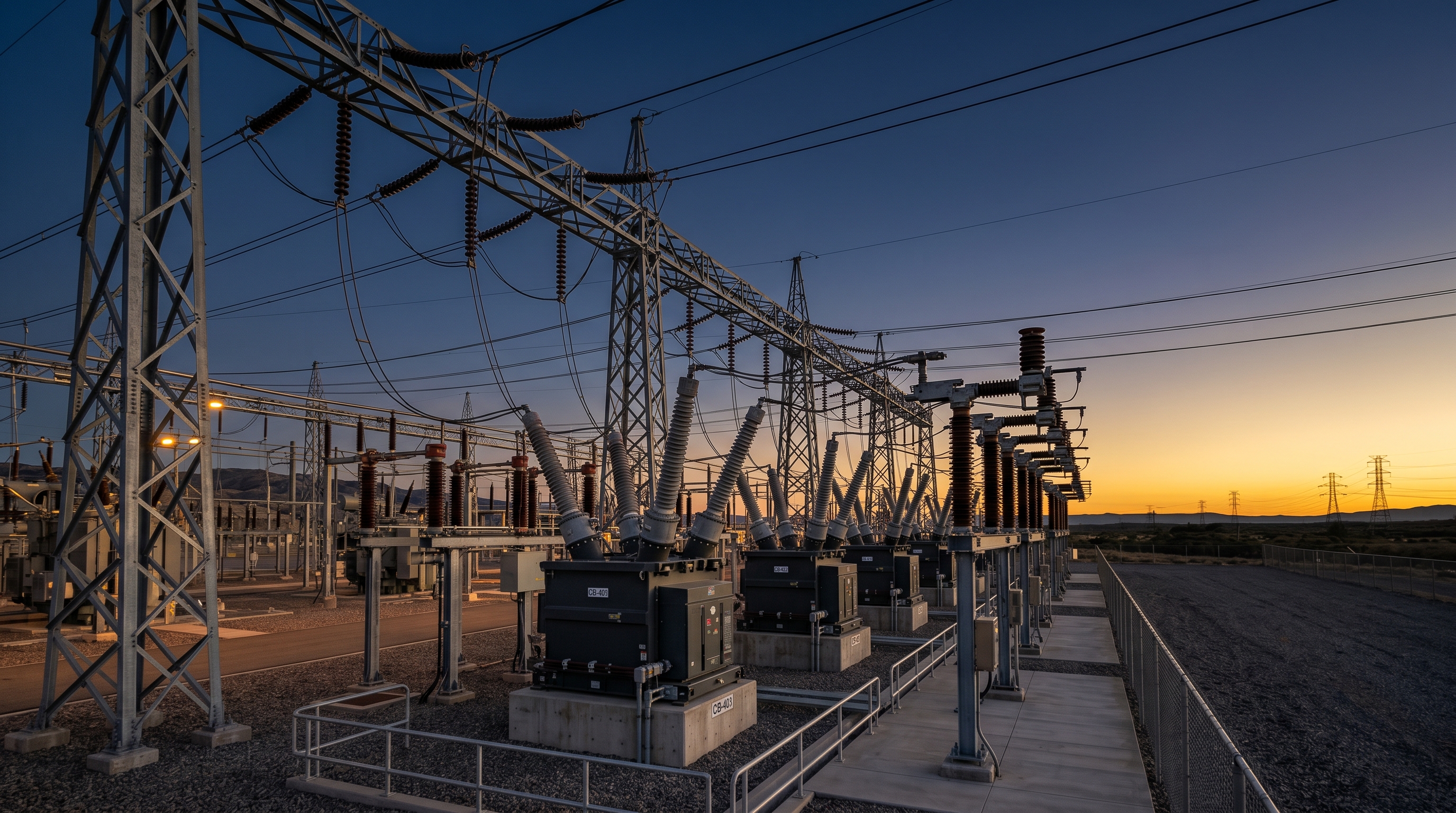
Hitachi Energy reports more than sixty-five North American orders for its EconiQ 420 kV dead tank breaker, the same equipment Eversource installed in late 2023 as the first US deployment at that voltage class. The product line now spans 72.5 to 550 kV, including the world’s first SF6-free 550 kV gas-insulated substation, ordered by Chubu Electric in Japan. That is not a pilot footprint. It is a procurement category.
Utility procurement teams that have been treating SF6 alternatives as a future consideration have a narrower window than they think.
Why this matters now
Sulfur hexafluoride has a global warming potential more than 23,500 times that of carbon dioxide and persists in the atmosphere for over a thousand years. Power grids consume roughly 80 percent of all SF6 produced worldwide, almost entirely as the dielectric and arc-quenching medium in medium- and high-voltage switchgear. For four decades, no commercially available alternative could match SF6 on combined dielectric strength, arc interruption performance, and thermal stability at the voltages that matter most to transmission utilities.
That is no longer true.
The European Union’s 2024 F-gas regulation set a binding timeline to phase down SF6 in new equipment, with restrictions on switchgear above 24 kV taking effect in 2030 and 2032 depending on voltage class. North America has no equivalent federal mandate, but the regulatory differential matters less than three procurement-side forces already reshaping US utility specifications.
First, ESG reporting requirements at the utility holding company level now force public quantification of Scope 1 emissions from switchgear leakage. SF6 leakage from existing substations is a material line item, and it is no longer easy to defend procurement decisions that lock in another 30-year asset life of high-GWP gas inventory. First-mover utilities have already moved on this. Eversource ran the first US installation at 420 kV in 2023. Hydro One ordered 550 kV dead tank breakers. SSEN Transmission, Statnett, TenneT, and ElectraNet have all moved past pilot deployment.
Second, large-load interconnection projects backed by hyperscale data center developers are introducing private-sector buyers with their own ESG mandates. When a hyperscaler co-funds a substation buildout, the gas inventory in the breakers is showing up on its emissions disclosure. That is pulling SF6-free specs into procurement scopes that did not previously include them.
Third, manufacturers have rationalized their forward investment around the eco-efficient portfolio. New product development at Hitachi Energy and GE Vernova above 362 kV is concentrated on SF6-free platforms, not on incremental updates to legacy SF6 designs. Utilities specifying conventional SF6 today are increasingly buying into a maintenance tail rather than a forward roadmap.
The supplier landscape is concentrated
The procurement risk profile differs by voltage class.
Below 145 kV, multiple vendors offer SF6-free or reduced-GWP options across vacuum, dry-air, and fluoronitrile-based gas mixtures. Eaton, Siemens Energy, Hitachi Energy, and Schneider Electric all have product in market. Vacuum interruption is well-established at distribution voltages, which is why much of the medium-voltage segment was never as SF6-dependent as the high-voltage side. At the distribution class itself, the dielectric medium is only one of several specifications that decide a pad-mounted switchgear buy, alongside dead-front construction, way count, and SCADA-ready automation.
Between 145 and 362 kV, the vendor field narrows. Hitachi Energy’s EconiQ live tank and dead tank breakers are commercially available across this range. GE Vernova competes with its g3 gas mixture portfolio. Siemens Energy markets Blue product lines using clean air. Procurement teams have meaningful sourcing alternatives, but the pricing, lead times, and field service ecosystems are not yet comparable to the entrenched SF6 supplier base.
Above 362 kV, the field is effectively two manufacturers. Hitachi Energy’s EconiQ portfolio extends to 550 kV including the world’s first SF6-free GIS at that voltage. GE Vernova has 362 kV product. No other manufacturer has commercialized a comparable solution at scale. For transmission-class procurement, the SF6-free spec choice is meaningful concentration risk: single- or dual-source supply for a category that historically had four to six bidders.
That concentration cuts both ways. The first utilities to specify SF6-free at 420 kV and above are getting first-mover allocation from constrained capacity. The utilities arriving in 2027 and 2028 will be quoting into a tighter market where the manufacturers’ books are already partly committed.
The retrofit question
The deployment economics that allowed Hitachi Energy to scale EconiQ this quickly come down to one engineering decision: same footprint, same dimensions, same connection geometry as the corresponding SF6 product. A utility replacing a 420 kV dead tank breaker on a like-for-like basis does not need to redesign the substation. The structural, foundation, and protection scheme work that dominates a substation rebuild does not change.
That engineering compatibility is what turned EconiQ from a green-premium product into a procurement substitute. Procurement teams that internalized “SF6-free means substation redesign” as recently as 2022 should retest that assumption. For mainstream replacement programs, the spec change is now mostly a paperwork change.
The exception is utilities running in-house gas handling and recycling programs. SF6 reclamation infrastructure represents real capital and operational investment, and the transition timeline for that infrastructure does not move at the same pace as new equipment procurement. Plan for a multi-year period where both SF6 and SF6-free assets are operating in the same fleet, and budget for dual-system gas handling capability through at least 2030.
What procurement teams should do this quarter
Five actions follow from where the SF6-free market actually is.
First, audit your current standard equipment specifications. If your high-voltage breaker spec still defaults to SF6 or to “SF6 or approved equivalent,” update it now. The specification is the slowest-moving piece of the procurement system, and the buyers who update first are the buyers whose RFPs reach the manufacturers’ available capacity.
Second, segment your forecast horizon by voltage class. For distribution and lower medium-voltage equipment, SF6-free or vacuum alternatives are commodity-available. For 145 to 362 kV, build dual-supplier qualification into your procurement plan. For 362 kV and above, treat SF6-free as a named single-supplier or dual-supplier sourcing category with appropriate lead time buffers.
Third, build a fleet-level emissions baseline. ESG disclosure pressure on Scope 1 SF6 leakage is increasing, and utilities without a defensible inventory and leakage rate are exposed in rate cases and in holding-company reporting.
Fourth, engage your protection and substation engineering teams early. The EconiQ and equivalent products are dimensionally compatible with SF6 equipment, but interlocks, monitoring systems, and gas density alarms differ. Field commissioning timelines are tighter when engineering reviews are completed before the equipment ships.
Fifth, write the SF6-free option into RFPs even when the project does not require it. Letting manufacturers see consistent demand signal across utility procurement programs is what funds the next round of capacity expansion in this category. Utilities that wait until specs become mandatory will be quoting into the supply tightness, not driving it.
Related Reading
- Data Center Moratoriums Relocate Equipment Demand
- The REWIRE Act and Grid Modernization Equipment Procurement
- Section 232 Tariff Impact on Grid Equipment Procurement
Our reports go deeper, with manufacturer-by-manufacturer SF6-free product availability, lead times by voltage class, and procurement strategy recommendations for utilities updating their high-voltage switchgear specifications. Subscribe to The Feeder for the free monthly read, or see our report catalog.
Know what changed before your next quote
Free Member tier. Pick your topics. Get a weekly digest filtered to what you actually buy.