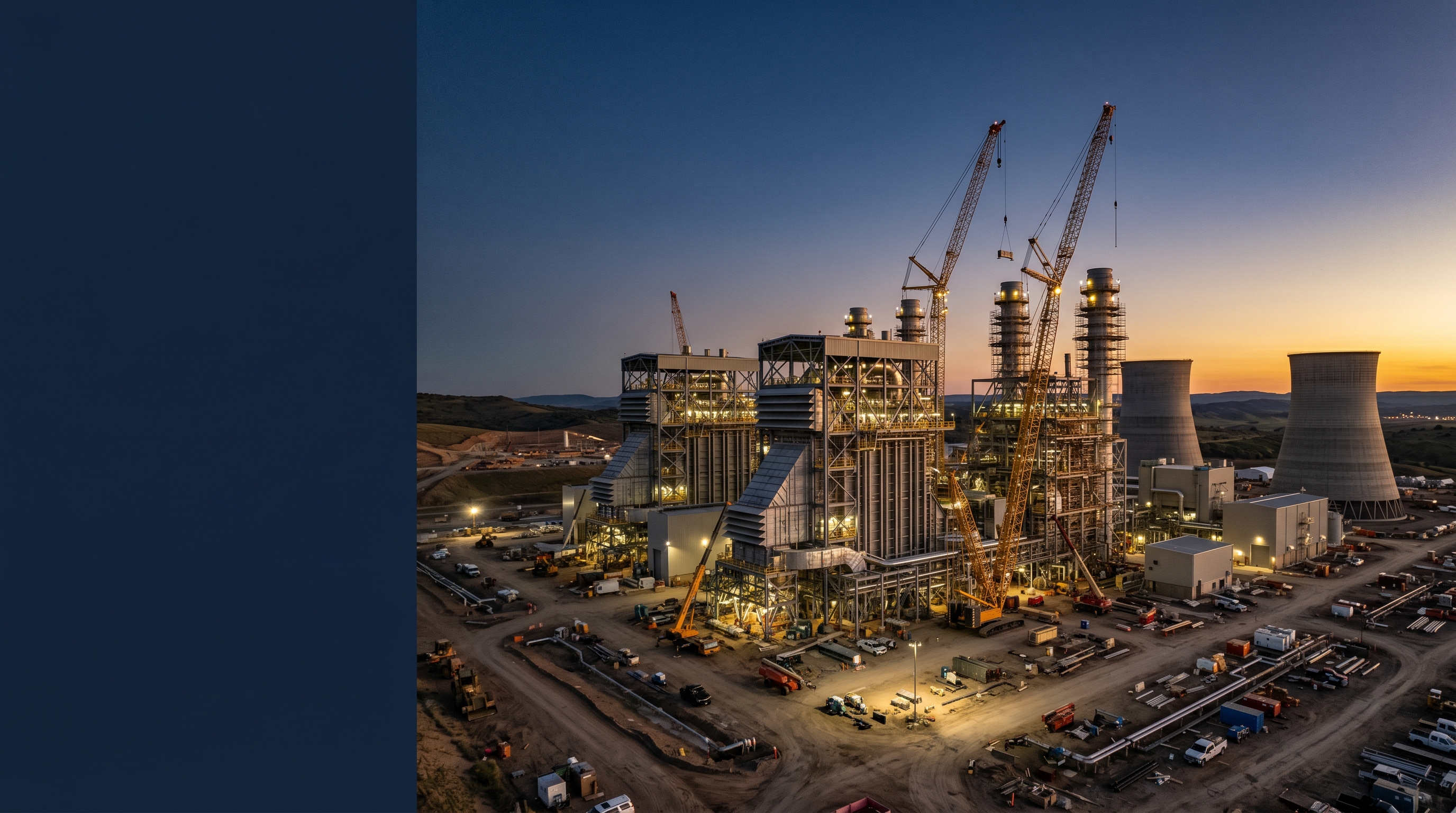
May 2026 Gas Wave: 20 GW of CCGT Decided in 30 Days
Five gigawatt-scale combined-cycle gas projects cleared regulatory or construction milestones in May 2026, adding about 20 GW to the U.S. pipeline. What it does to turbine slots, GSU lead times, and equipment procurement.
About 20 GW of combined-cycle gas capacity cleared a regulatory or construction gate in 30 days, and the gas plant procurement environment in 2026 just shifted accordingly. Dominion’s 3 GW Cumberland Energy Center in Virginia, the Dominion plus Santee Cooper 2,200 MW Canadys Station in South Carolina (approved 7-0 by the SC Public Service Commission on May 14), Duke Energy Indiana’s 470 MW Cayuga expansion (construction start May 19), Evergy’s 1.0 GW SPP gas pivot, and the NRG plus LS Power 13 GW Texas portfolio combine to a single number that the heavy-duty turbine market has not seen this fast in over a decade.
That math has procurement consequences before any of these plants pour concrete. The same five OEMs (GE Vernova, Siemens Energy, Mitsubishi Power, Doosan, and on the steam side Hitachi Energy and Toshiba) supply gas turbines, steam turbines, generator step-up transformers, generator circuit breakers, and high-voltage switchyards for all of these projects. Twenty gigawatts of dispatchable capacity moving through that funnel in a single month is a supply event, not a string of independent announcements.
The five projects, by capacity and timeline
Each of these projects either received a key regulatory approval or began construction in May 2026:
- Cumberland (VA), Dominion Energy, 3 GW. Combined-cycle gas, announced May 7. Commissioning targeted 2033-2034.
- Canadys Station (SC), Dominion plus Santee Cooper, 2,200 MW. SC PSC approval May 14. Brownfield siting on a former coal plant on the Edisto River. Estimated $5B. Commissioning 2030-2032.
- Cayuga (IN), Duke Energy Indiana, 470 MW. Construction began May 19. $3.3B combined-cycle expansion at the existing 1,006 MW Cayuga site. First new unit 2029, second 2030.
- Evergy SPP, 1.0 GW. Q1 IRP raised planned gas to 4.7 GW total and eliminated 2.4 GW of wind plus more than 90% of planned solar. See our Evergy gas pivot procurement analysis.
- NRG plus LS Power Texas portfolio, about 13 GW. NRG’s 415 MW TEF plant near completion plus the closed LS Power 13 GW acquisition consolidate the Texas gas position. ERCOT’s queue mix has gas surpassing wind for the first time since 2016.
Cumberland and Canadys sit inside Dominion. NextEra’s $66.8B acquisition of Dominion (announced May 18) folds both into a single capital plan. The combined entity now owns roughly 5.2 GW of new gas already in development under Dominion, plus FPL’s separate gas program, plus the 130 GW combined large-load interconnection pipeline anchored by Loudoun County. See our NextEra Dominion merger procurement analysis for what consolidation does to the approved manufacturer list.
Why now: the structural demand confirmation
EIA’s May 2026 Short-Term Energy Outlook, released the same week, confirmed the demand side of the trade. Commercial-sector electricity consumption will surpass residential in 2027 for the first time on record. Commercial grows 5.3% in 2027 against 0.5% for residential. The “commercial” bucket is hyperscalers, bitcoin miners, and cloud computing, with West South Central (Texas) showing the strongest growth.
That forecast does two things to the gas pipeline. First, it validates each utility’s IRP load assumption with federal forecasting data, which gets quoted back in rate cases and certificate-of-need proceedings. Second, it isolates commercial as the marginal customer class that is driving capex sequencing. Capital that would have gone to residential feeder reinforcement is being redirected to GSU transformers, HV switchyards, and dual-fed substations sized for data-center campuses.
Why gas, specifically: the renewable substitution
The same week the gas approvals stacked up, Senate Energy Committee Democrats publicly accused Interior Secretary Doug Burgum of slow-walking renewable permits on federal land. About 57.2 GW of wind and solar capacity sit affected by the July 15, 2025 Burgum memo that required the Secretary’s personal approval for every federal-land renewable project. A federal district court enjoined the memo on April 21, 2026; Burgum signaled non-compliance. Senate Democrats now say they will block bipartisan permitting reform until DOI demonstrably advances renewable permits.
For utility planners writing IRPs, that political stall is a procurement input. Dispatchable resources are the substitute, and gas is the dispatchable resource that can clear the longest permitting path with the highest certainty over the next 24 months. The May gas wave is partly the substitution showing up in approval dockets.
What is actually being consumed
Twenty gigawatts of combined-cycle, with first commissioning dates in 2029 and the bulk landing 2030-2034, consumes specific equipment slots that distribution buyers should now treat as part of their own lead-time exposure.
Heavy-duty gas turbines. GE Vernova’s reported gas-turbine backlog already runs about 100 GW with lead times in the 5-to-6-year range. Twenty gigawatts added in 30 days is 20% of a multi-year book of orders, all flowing through the same Greenville (SC), Belfort (FR), and Schenectady (NY) production lines. Siemens Energy’s Berlin and Mitsubishi’s Takasago turbine factories are similarly constrained. Distribution buyers do not buy these units directly, but the OEMs that supply them are the same OEMs allocating production floor for medium-voltage switchgear, transformers, and protective relays. Floorspace allocated to the gas wave is floorspace not available to distribution-class orders.
Generator step-up transformers (large class). A 2,200 MW combined-cycle plant requires roughly 4-6 large GSUs in the 600-750 MVA class at 230 kV or 500 kV, plus steam-turbine GSUs. A 470 MW plant requires 1-2 units in the 250-300 MVA class. Across the May wave, the GSU order pipeline implies somewhere on the order of 25-40 large units, plus their auxiliary and station-service transformers. Lead times for large GSUs are now consistently over 100 weeks at the major OEMs, and the May wave does not improve that number.
HV switchgear and switchyard rebuilds. Canadys is a brownfield with an existing switchyard sized for around 1,000 MW. Doubling the site’s output requires a switchyard rebuild including 500 kV circuit breakers, disconnects, instrument transformers, and likely a GIS option. Cayuga’s existing 138 kV or 345 kV interconnect needs expansion. Each project pulls 8-16 HV breakers and a similar count of disconnects into the supply chain. The same OEMs supply distribution-class circuit breakers; orders compete for engineering and assembly hours.
Generator circuit breakers, iso-phase bus, MV switchgear, station service. The balance-of-plant electrical packages are where distribution buyers feel the indirect squeeze. ABB, Eaton, Siemens, and Hitachi Energy supply both the BoP packages on these plants and the medium-voltage switchgear that distribution buyers order. The May wave moves about $400M-$700M of BoP electrical orders into engineering queues at the same OEMs that distribution buyers depend on for 15 kV and 25 kV class products.
The distribution-side spillover
Twenty gigawatts of new generation does not arrive on the grid through generation equipment alone. Each of these plants requires transmission interconnect upgrades, distribution-feeder reinforcement to deliver the new capacity to growing load centers, and substation capacity adds along the delivery path. The Dominion 3 GW Cumberland plant pulls 500 kV transmission upgrades through PJM. The Canadys 2.2 GW pulls Lowcountry SC transmission and distribution upgrades to serve Charleston metro and the Boeing/Volvo industrial corridor. Cayuga pulls MISO Central upgrades for Indiana data-center and manufacturing load.
For municipal utilities and cooperatives in the delivery path of any of these plants, the procurement implication is that the regional substation transformer queue, HV breaker queue, and protective relay queue are now more crowded than they were 30 days ago, even though no new utility-side capex was announced in that window. The gas-plant orders consume the same OEM capacity that the distribution-side orders rely on. See our GE Vernova Prolec consolidation analysis for the two-source AML structure that this environment now requires.
How this fits the broader pattern
The May gas wave is the dispatchable-resource expression of the three utility strategies we tracked across the first week of the month: embrace-via-gas, resist, or distribute. Embrace dominated May. Five plants in 30 days is the embrace pattern at production scale, and the political and supply-chain pieces (Burgum stall, GE Vernova backlog, NextEra-Dominion consolidation) are all reinforcing the same trade.
The Q1 2026 hyperscaler capex synthesis covered AEP, Entergy, Duke, and Xcel as the four IOUs whose Q1 strategies set the template. The May approvals extend that template to Dominion, Santee Cooper, Duke Indiana, Evergy, and the Texas merchant gas footprint. The buyer behavior is converging on a single playbook in MISO, SPP, PJM-South, and ERCOT.
What procurement teams should do this quarter
Three actions land cleanly in a Q2 or Q3 planning cycle:
-
Audit your OEM exposure to the gas wave. If your two-source AML for distribution transformers, MV switchgear, or HV breakers depends on a single OEM that is also booking heavy-duty turbine, GSU, or 500 kV breaker orders for these projects, your effective lead time is the OEM’s engineering-hour queue, not the product’s nameplate lead time.
-
Reset your transmission-interconnect assumption for any project that touches a host-utility delivery path. Dominion, Santee Cooper, Duke Indiana, Evergy, and the NRG/LS Power Texas footprint will all consume PJM, SPP, ERCOT, and MISO transmission interconnect capacity for studies and engineering through 2030. Your interconnect study queue is now longer.
-
Re-price your dispatchable-resource alternatives. If your IRP or capacity plan was using a federal-land renewable resource for 2028-2030 in-service, the political timeline now suggests gas, behind-the-meter storage, or VPP capacity as the realistic substitute. The DistroForge intelligence report can model the per-MW cost shift by region.
The piece that does not show up in any of the announcement releases is the cost of the unannounced orders. Every utility that has not yet announced a gas plant is now ordering equipment into a tighter market than the one its IRP modeled.
The monthly read on where this is heading
Twenty gigawatts of gas capacity cleared regulatory gates in a single month, and the GSU and HV breaker orders behind it are now competing with distribution buyers for the same OEM engineering hours. The Feeder is our free monthly digest of the procurement signals that move utility and distribution equipment buyers: lead-time shifts, supplier capacity, federal funding, and the RFP language that follows. One email a month, no filler.
Related Reading
- Utility Data Center Strategies: Embrace, Resist, Distribute
- Evergy Gas Pivot: 4.7 GW, 90% Solar Cut, SPP Procurement Wave
- NextEra Dominion Merger: A $66.8B Procurement Reset
- GE Vernova Q1: $42.4B Electrification Backlog and the Two-Source AML
- Hyperscaler Utility Capex 2026: Three Q1 Strategies
- Grid Modernization Procurement Guide (pillar)
Know what changed before your next quote
Free Member tier. Pick your topics. Get a monthly digest filtered to what you actually buy.