NERC Computational Load Standards Pass Final Ballot
NERC's computational load standards passed final ballot Oct. 14. What CLO-003-1 asks of whoever owns the main power transformer at a 50 MW-plus, 100 kV-plus data center site.
The NERC computational load standards cleared their last industry vote on October 14. Five standards in Project 2026-02, including CLO-003-1 on protection coordination and disturbance monitoring, passed a six-day final ballot that closed at 8 p.m. Eastern that night. None of them is in force. NERC’s October 15 release says they now go to its Board of Trustees for adoption and then to FERC “for final regulatory approval.”
For a utility, that makes this the window between a final text and a binding date. One standard in the set has a duty that lands on equipment a distribution utility may own: the main power transformer feeding a large data center.
Who the NERC computational load standards reach
CLO-003-1 applies to Computational Load Sites “with a total connected Load greater than or equal to 50 MW that are supplied through electrical equipment connected at a voltage level greater than or equal to 100 kV.” Below either line, this standard does not apply.
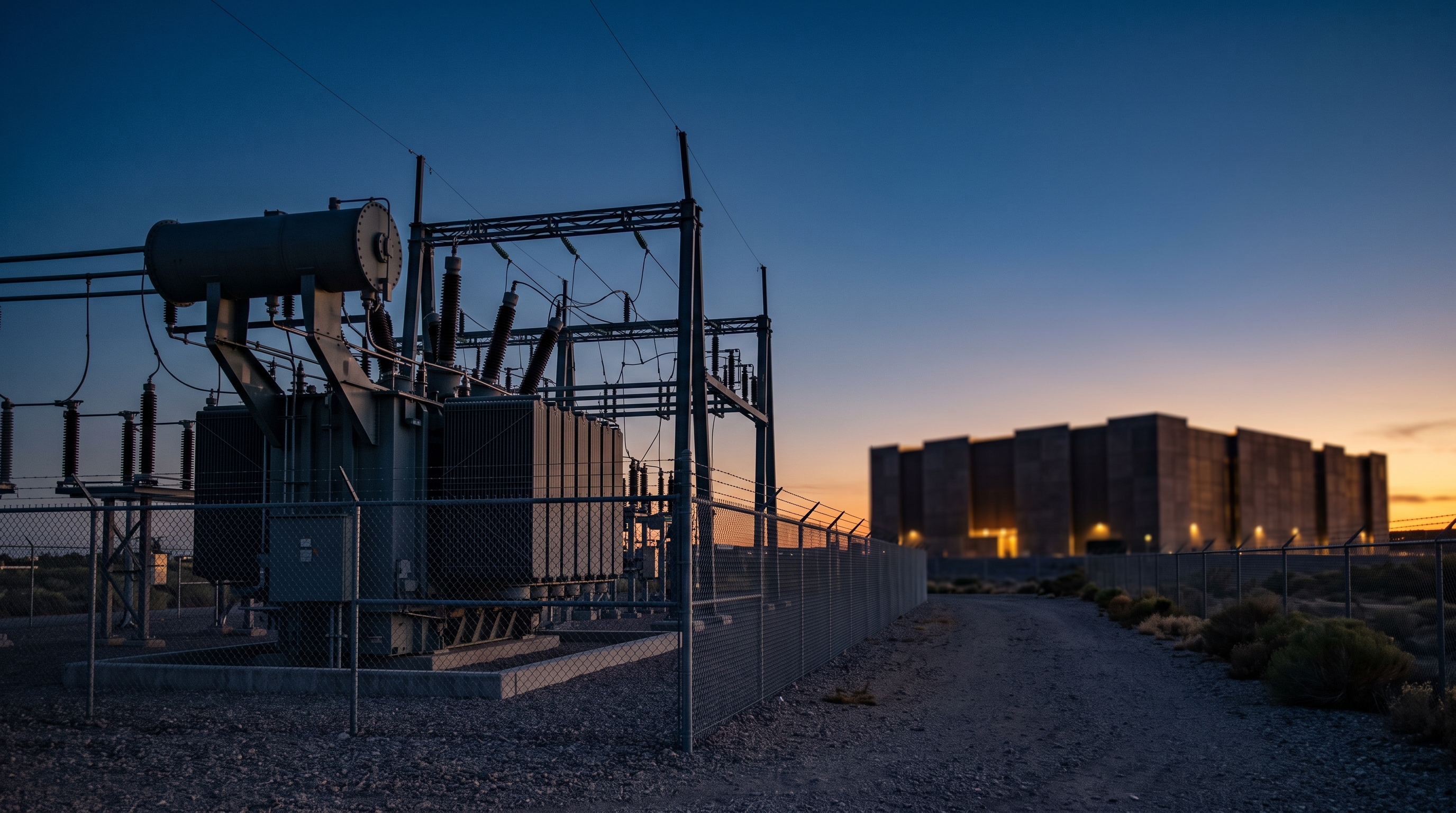
The functional entities it names are the Computational Load Owner, Transmission Owner, Distribution Provider and Generator Owner. Which of them carries a given requirement depends on who owns what. The standard defines the main power transformer as “the power transformer and its associated equipment that steps down the voltage for the Computational Load Site from its nominal transmission/interconnecting system voltage.” If your utility owns that step-down, most of CLO-003-1 is about you.
What CLO-003-1 asks of the transformer owner
The owner of the main power transformer supplying a covered site must have two kinds of recording on the high side of that transformer or at the common point of connection:
- Triggered fault recording (R2, R3): phase-to-neutral voltage, phase and neutral current, and three-phase real and reactive power. Records need at least two cycles of pre-trigger data, at least 2.0 seconds total, and a minimum of 64 samples per cycle, with triggers including neutral overcurrent, over and undervoltage, and over and underfrequency.
- Continuous dynamic disturbance recording (R4, R5): the same quantities plus frequency, with an input sampling rate of at least 960 samples per second and an output recording rate of at least 60 times per second.
Whoever is responsible for that data must also time-synchronize it to UTC with clock accuracy “within ± 1 milliseconds” (R6). Data has to be retrievable for 20 calendar days, provided within 15 calendar days of a request, and delivered in CSV or COMTRADE format (R7). If recording fails, capability has to be restored within 90 calendar days, or a corrective action plan has to go to the Regional Entity in that time (R8).
Sequence-of-events recording for breakers at the site (R1) sits with the Computational Load Owner alone, so a utility that owns the transformer does not carry it.
When it could bind
The CLO-003-1 implementation plan sets the effective date as the first day of the first calendar quarter after regulatory approval. Compliance with R1 through R8 then phases in:
- Sites in service on or before the effective date: 36 months after the effective date.
- Sites placed in service after it: 15 months after the effective date, or the in-service date, whichever is later.
The plan uses April 1, 2027 as a worked example, and it is labeled as one. Like the rest of the NERC computational load standards, CLO-003-1 has no effective date yet. CLO-001-1’s final draft lists Board adoption as anticipated in Q4 2026, and FERC approval comes after that.
The plan also includes an extension route. An entity with a covered site in service within 12 months of the effective date can ask for more time on R1 to R8 if circumstances beyond its control prevent installing the monitoring equipment. NERC lists “supply chain delays associated with the procurement, engineering, installation, or commissioning of disturbance monitoring equipment” among those circumstances. Requests are due no later than three months before the compliance date in question.
The procurement read
What follows is our inference from the text, not a NERC statement. For a distribution utility that owns or is about to build a 100 kV-plus step-down for a 50 MW-plus data center, CLO-003-1 turns three things into specification questions:
- Recorder capability at the transformer high side. Does the planned relay or recorder package meet the R3 and R5 sample rates and record lengths, or does it need a dedicated fault and disturbance recorder?
- Time source. Is there a UTC source at the substation good to ±1 millisecond?
- Data handling. Can the utility retain 20 days of records and deliver them in COMTRADE or CSV within 15 days of a request?
Who owns the transformer is the first question in each case. In some interconnections that is the data center, not the utility. CAISO’s large-load draft points measurement at the same location, as covered in CAISO’s large load technical requirements. The federal side of the same buildout is in FERC’s large load interconnection order.
None of this is a field procedure, and the Board or FERC could still change the text. Read the final drafts themselves before writing any of it into a specification.
The Feeder is our free weekly briefing for utility equipment buyers and suppliers. Subscribe to The Feeder to get the next one in your inbox.
Related Reading
- CAISO Large Load Requirements: Reading the September Draft
- FERC Large Load Interconnection Order: 6 RTOs on the Clock
- Data Center Load Pipeline vs Contracted: How to Discount It
Frequently Asked Questions
Are NERC's computational load standards in effect?
No. The final ballot for Project 2026-02 concluded October 14, 2026. NERC said on October 15 that the standards will go to its Board of Trustees for adoption and, once adopted, will be filed with FERC for final regulatory approval. CLO-001-1's final draft lists Board adoption as anticipated in Q4 2026. Nothing in them binds until that process finishes and an effective date is set.
Which sites does CLO-003-1 apply to?
Computational Load Sites with a total connected load greater than or equal to 50 MW that are supplied through electrical equipment connected at a voltage level greater than or equal to 100 kV from one or more points of connection.
What does CLO-003-1 require of the main power transformer owner?
Whichever Computational Load Owner, Transmission Owner, Distribution Provider or Generator Owner owns the main power transformer supplying a covered site must have triggered fault recording and continuous dynamic disturbance recording on the high side of that transformer or at the common point of connection, time-synchronized to UTC within plus or minus 1 millisecond.
When would CLO-003-1 compliance be due?
Per the implementation plan, the standard becomes effective on the first day of the first calendar quarter after regulatory approval. Requirements R1 through R8 apply 36 months after that effective date for sites already in service, and 15 months after it, or the in-service date if later, for sites placed in service afterwards.
Know what changed before your next quote
Free Member tier. Pick your topics. Get a weekly digest filtered to what you actually buy.