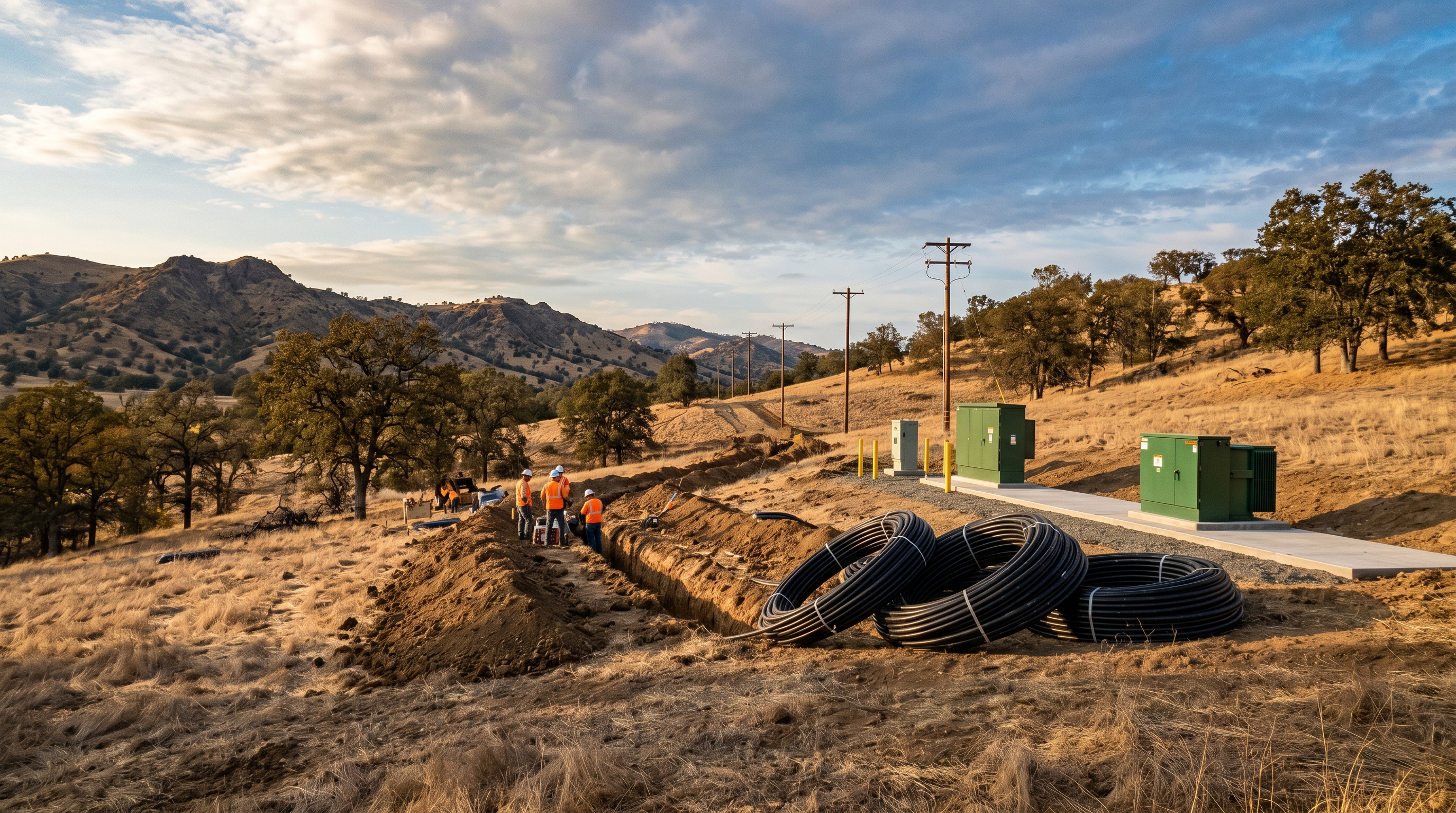
PG&E Undergrounding Filing: 9,000 Miles, $1B/Year to 2037
PG&E's Q3 2026 OEIS undergrounding filing locks in 5,000 miles of underground cable plus 4,000 miles of overhead hardening through 2037. Here is what it means for everyone else.
PG&E CEO Patti Poppe told analysts on the April 23 earnings call that the utility will file a 10-year wildfire mitigation plan with California’s Office of Energy Infrastructure Safety in Q3 2026. The PG&E undergrounding filing covers 2028 through 2037 and totals 9,000 new miles of system hardening: 5,000 miles of undergrounding plus 4,000 miles of overhead hardening. The undergrounding portion alone runs about $1 billion per year for a decade.
That is the largest sustained distribution capital program any U.S. utility has put on paper.
For procurement teams at municipal utilities, cooperatives, and regional distributors who do not buy from PG&E and never will, the filing still matters. It locks in a decade of West Coast equipment allocation that will reshape lead times, pricing, and engineering labor availability for everyone else.
What the filing actually contains
The numbers behind the headline:
- 5,000 miles undergrounded between 2028 and 2037
- 4,000 miles of overhead hardening (composite poles, covered conductor, fortified crossarms) over the same window
- About $1 billion per year in undergrounding capital, roughly $10 billion cumulative
- 1,240 miles already buried as of Q1 2026
- 1,900 miles expected complete by end of 2027 under the current plan
- About 11,000 miles total system-hardened by end of 2037, covering more than 75% of PG&E’s high-fire-threat district
Poppe also noted the program has already deferred more than $100 million in maintenance costs. That number is the financial argument PG&E will use at the California Public Utilities Commission and at OEIS to justify the rate-base treatment.
The trigger event to watch is the Q3 2026 OEIS filing, with a September 30, 2026 cutoff. Once submitted, expect manufacturer purchase orders to flow in the following two quarters.
What gets bought
A 5,000-mile underground build is not abstract. It maps to specific equipment classes in known ratios.
Underground cable. 15 kV, 25 kV, and 35 kV class XLPE/EPR primary cable. At roughly two conductors per mile per phase plus neutral, 5,000 miles is on the order of 40,000+ conductor-miles of new cable. PG&E will absorb a meaningful share of national capacity. The recent McKinney plant capacity opening from Prysmian and Encore Wire closes only part of that gap.
Pad-mount switchgear. Underground loop and radial designs require sectionalizing every 1 to 2 miles. Estimate 2,500 to 5,000 pad-mount switches across the program. Eaton, S&C, G&W, Hubbell, and ABB all play here. Hitachi’s SF6-free switchgear lineup will catch some of the higher-voltage volume as PG&E aligns with state environmental mandates.
Vault and pad-mount transformers. Replacing pole-mounted distribution transformers with vault or pad-mount units at typical residential density runs three to six transformers per circuit-mile. That puts demand at 15,000 to 30,000 distribution transformers over the decade. This compounds an existing pad-mount transformer crisis where lead times already run 40 to 60 weeks. ERMCO, Howard, Prolec-GE, and Schneider will absorb the bulk of the order flow.
Sectionalizers, reclosers, and connectors. Underground loop protection schemes need fault sensing every few thousand feet. Add cable terminations, 200A and 600A separable connectors, and elbows. 3M, Eaton/Cooper, and Hubbell capture this.
Foundation systems. Polymer concrete pads, vaults, and below-grade enclosures. Hubbell, Quazite, and Oldcastle are the typical suppliers.
Overhead hardening. The 4,000-mile portion drives composite, steel, and concrete pole replacements, ACCC and other advanced conductor upgrades from CTC Global, covered tree wire from Hendrix and Southwire, and reinforced crossarms and polymer insulators.
The supply ripple effect
The most important second-order effect is not what PG&E spends. It is what other utilities can no longer easily buy.
Three pressure points to plan around:
Lead times. Manufacturers prioritize anchor customers with $1 billion-class purchase orders. Distribution transformer and pad-mount switchgear lead times that look reasonable today will lengthen as Q4 2026 and Q1 2027 PG&E orders hit factory queues. Munis and co-ops planning 2027 and 2028 capital should issue purchase orders now, not after the OEIS filing clears.
Pricing. PG&E’s volume earns roughly 10 to 15 percent off list. Smaller utilities pay full price or higher as capacity tightens. The triple squeeze on utility equipment supply that defined 2025 is now structural for the West Coast through 2037.
Engineering labor. Distribution engineers, GIS specialists, and underground designers are scarce already. PG&E and its contractors (PAR Electrical, MasTec, Quanta) will absorb the West Coast labor pool. Any utility relying on an engineering services firm for design work should lock multi-year retainers now.
What procurement teams should do this quarter
Five moves for the Q2 and Q3 2026 window:
-
Pull 2027 and 2028 orders into 2026. Pad-mount transformers, 25 kV cable, and pad-mount switchgear specifically. Do not wait for the OEIS filing to land before issuing purchase orders.
-
Re-baseline lead-time assumptions. Move budget assumptions for distribution transformers from 40 to 60 weeks to 60 to 90 weeks for the 2027 cycle. Build the schedule slack now while project planning still has flexibility.
-
Diversify cable sources. If you have been single-sourced to Prysmian or Southwire, qualify Encore Wire’s McKinney output and at least one secondary supplier. PG&E will tilt West Coast cable allocation hard.
-
Lock engineering services. Multi-year design retainers with fixed labor rates beat hourly-billed engagements once PG&E starts sweeping up engineers.
-
Track the Q3 2026 OEIS docket. The filing itself is the trigger to watch, not the CPUC approval that follows. Once OEIS receives the plan, PG&E’s procurement organization will move on multi-year contracts even before final approval.
The deeper question for any procurement leader is not whether PG&E will execute this plan. It is whether your procurement timeline assumes the West Coast equipment market keeps behaving the way it did from 2020 through 2025. That assumption is now wrong for the next 12 years.
Want the full procurement picture?
DistroForge Intelligence Reports go deeper than the headline. Our PG&E impact analysis covers manufacturer capacity allocation by equipment class, lead-time projections through 2030, regional supply pressure indicators, and procurement timing recommendations specific to your utility size and equipment mix. Reach out to discuss a custom report.
Related Reading
- Prysmian and Encore Wire’s McKinney Plant: Domestic Wire Capacity
- Pad-Mount Transformer Procurement: Why 2026 Budgets Are Already Broken
- The Triple Squeeze on Utility Equipment Supply (2026)
- SF6-Free Switchgear Utility Procurement
Know what changed before your next quote
Free Member tier. Pick your topics. Get a weekly digest filtered to what you actually buy.
The Grid Brief
Lead times. Pricing shifts. Funding deadlines. Delivered Thursday mornings.