Prysmian-Encore Wire's McKinney Plant: What New Domestic Wire Capacity Means for Procurement
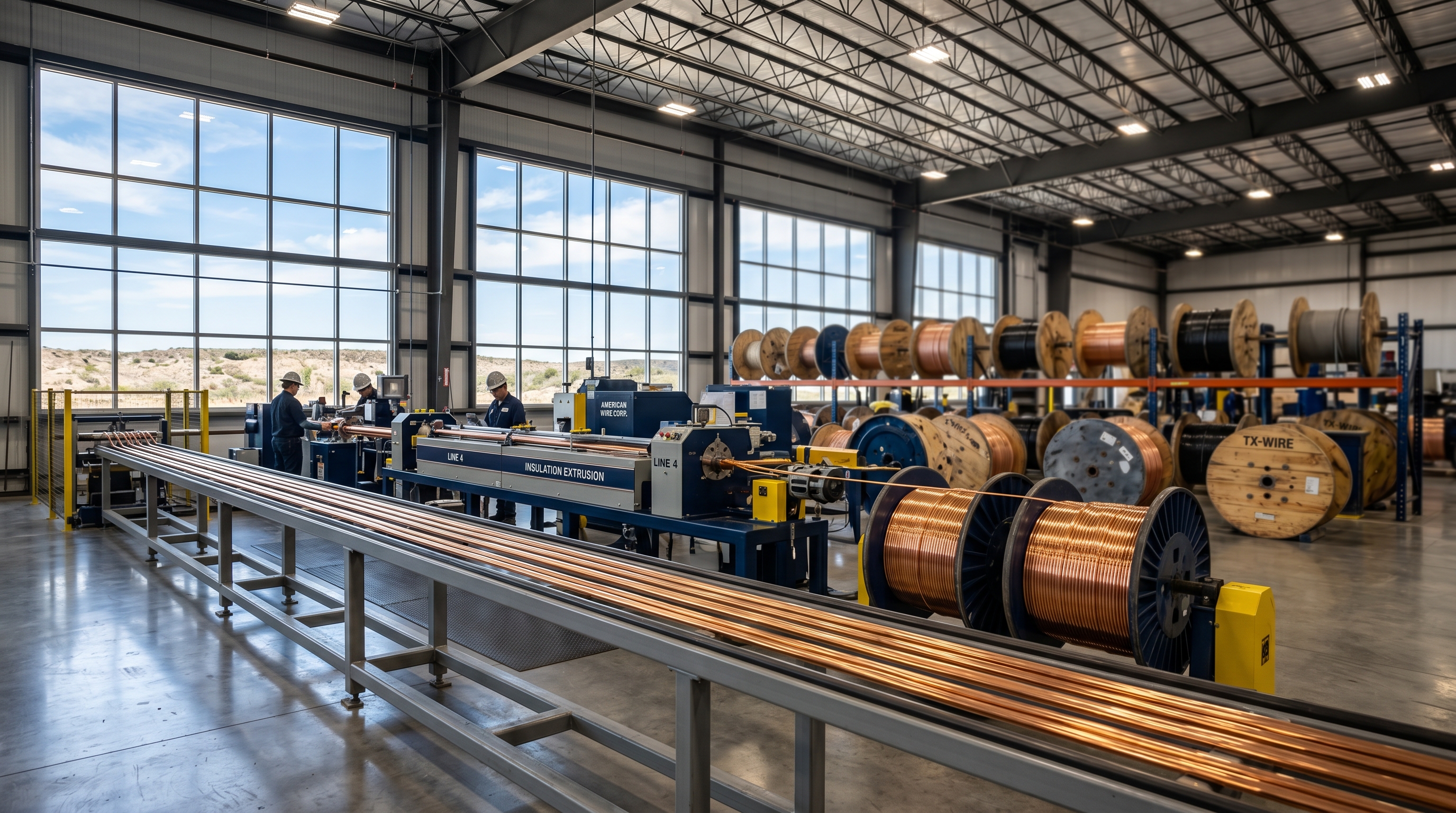
Prysmian and Encore Wire opened a 340,800 sq ft copper building wire plant and a 1 million sq ft service center in McKinney, Texas. Here is what new domestic wire cable manufacturing capacity actually changes for procurement teams.
While the news cycle about utility procurement keeps focusing on what is scarce (transformers, switchgear, gas turbines), one supply leg is quietly getting fixed. On April 13, 2026, Prysmian and Encore Wire opened a new 340,800 square-foot copper building wire plant in McKinney, Texas, alongside a service center that they now describe as the largest in the industry at one million square feet. The combined McKinney campus employs about 1,750 people, with roughly 115 staffing the new plant on a 24/7 schedule.
For procurement teams who have spent two years watching every equipment category move in the same direction (longer lead times, higher prices, less domestic supply), the wire and cable picture is starting to diverge from the rest of the bill of materials. That divergence is what distributors and utility procurement leaders need to plan around in 2026.
Why this matters: domestic wire cable manufacturing capacity is no longer the constraint
The McKinney announcement is the most visible piece of a broader build-out, but it is not isolated. Earlier this year Prysmian’s North American operation profiled its lead-free SuperDri EAM medium-voltage cable production at DuQuoin, Illinois, and Indianapolis, Indiana, both positioned as Buy America compliant for federally funded projects. Add Southwire’s existing Carrollton, Georgia, conductor footprint and Nexans’ US plants and the picture changes: the United States now has expanding domestic wire and cable production specifically aimed at the same data center and grid modernization markets that are squeezing transformer and switchgear suppliers.
The contrast with other equipment categories is sharp. Distribution transformers are running 60 to 100+ week lead times. Medium-voltage switchgear is on a similar curve, with Eaton’s $500M Nebraska and Virginia switchgear expansions only producing equipment in 2027 and beyond. Wire and cable, by contrast, is adding capacity that is operational now.
That is a procurement signal, not a marketing line. When one supply leg moves from constrained to expanding while adjacent legs stay tight, the smart move is to update your category-by-category lead time assumptions before the next bid cycle.
What the McKinney facility actually delivers
A few specifics worth lodging in your procurement notes:
- Product mix. Copper building wire is the headline. The company also produces aluminum building wire and serves the residential, commercial, industrial, data center, and clean energy markets from this footprint.
- Service center scale. One million square feet positioned for next-day shipment and customization. That is not raw capacity, that is logistics throughput. Distributors who hold inventory commitments with Encore Wire should expect the customization side (cut lengths, paralleled conductor assemblies, jobsite kitting) to expand.
- Operating model. A 24/7 manufacturing schedule with 115 dedicated employees in the new plant, supported by 250+ in the service center. Throughput math implies this is a material capacity addition, not a marginal one.
- Strategic positioning. Prysmian named “data center growth, U.S. industrial expansion, and grid modernization” as the three demand drivers the campus is built to serve. Those are the same three drivers cited in nearly every utility long-term plan filed in the last twelve months.
The decoupling thesis: wire-cable pricing should diverge from the broader equipment spiral
The procurement question is whether wire and cable pricing should keep tracking the broader equipment cost spiral or start to decouple. The case for decoupling has three parts.
First, domestic capacity is being added in the categories that data centers consume in volume. Internal data center power distribution is heavily building-wire and medium-voltage cable. New plants supplying those categories operate against demand that is large but not infinitely so. Capacity catches up to demand only when capacity grows.
Second, raw material exposure is real but partially neutralized. Copper still drove the 2025-2026 cost spike, and the Section 232 restructuring keeps that pressure on for the rest of the bill of materials. But Encore Wire has long operated copper recycling and recovery on the McKinney site, which softens the imported copper exposure. The structural domestic-content advantage compounds for federally funded buyers who must meet Buy America thresholds.
Third, lead time fundamentals favor wire and cable already. Wire and cable production is continuous-process manufacturing with relatively short cycle times, unlike a power transformer that may sit on a tank line for nine months. Adding 340,800 square feet to a continuous process produces output measured in weeks, not years.
That said, decoupling is not the same as collapse. Pricing relief from new capacity will flow first to large institutional buyers with multi-year framework contracts. Spot buyers will see it later. Distributors who buy in mixed lot sizes for diverse customer bases should model gradual margin recovery rather than a sudden price drop.
What procurement teams should do this quarter
Three concrete moves while the rest of the equipment supply picture stays tight.
Update category-specific lead time assumptions. If your project schedules still treat wire and cable as a 12 to 16 week commodity, you are probably leaving cash on the table by over-stocking. If you treat it as a constrained item (which made sense in 2024-2025), update your assumption to reflect the new domestic capacity. Misalignment between your wire-cable lead times and your transformer or switchgear lead times is itself a procurement risk: holding wire that waits three quarters for a transformer to arrive is not free.
Re-evaluate domestic-content sourcing for federally funded work. Federal funding pipelines (IIJA, IRA, DOE GRIP and SPARK successors) require Buy America documentation at the component level. Prysmian-Encore Wire’s McKinney plant sits squarely in the qualifying domestic supplier set, as do Prysmian’s other US plants and Southwire’s Georgia operation. For procurement teams managing BABA compliance for federally funded projects, this is one fewer compliance gap to worry about.
Plan inventory against the geographic demand shift. Data center moratoriums in Maine and elsewhere are not erasing demand, they are redirecting it into Ohio, Texas, Indiana, and other receptive states. Texas is now the geographic center of both data center buildout and domestic wire and cable production. Inventory positioning that sits on a Texas service center with next-day shipment to Ohio and Indiana looks better than the same inventory sitting in distant warehouses.
The boundary between supply relief and supply normalization
It is worth saying out loud what the McKinney plant does not do.
It does not relieve the transformer procurement crisis, which is rooted in GOES electrical steel constraints and core-stacking labor shortages. It does not change the medium-voltage switchgear lead time picture. It does not affect gas turbine availability, which Wood Mackenzie projects will worsen through 2027. And it does not, on its own, reverse copper’s cost trajectory if Section 232 enforcement intensifies.
What it does do is take one row in the procurement risk matrix from red to yellow. That is a real and useful change. It also signals that domestic manufacturers are willing to deploy capital against multi-year demand visibility, which is the precondition for relief in the harder categories. The North Carolina manufacturing hub buildout and Eaton’s Nebraska/Virginia switchgear plants point in the same direction. The capital is moving. It just hits different categories at different times.
Related Reading
- Section 232 Tariff Restructuring: What the New 15% Grid Equipment Rate Means
- North Carolina Grid Equipment Manufacturing Hub: $185M+ Invested
- The Triple Squeeze: Why Utility Equipment Supply Stays Tight in 2026
- Data Center Demand Tsunami: 50 GW and the Grid Infrastructure Procurement Wave
Our Intelligence Reports go deeper, with manufacturer capacity tracking, lead time differentials by equipment category, and procurement timing recommendations for projects coming online in 2027 and 2028. Talk to us about a custom report for your buying program.
Transformer Market Outlook — Q2 2026
National supply analysis, lead time data, and pricing benchmarks across the U.S. transformer market. 18 pages of sourced intelligence.
The Grid Brief
Lead times. Pricing shifts. Funding deadlines. Delivered Thursday mornings.