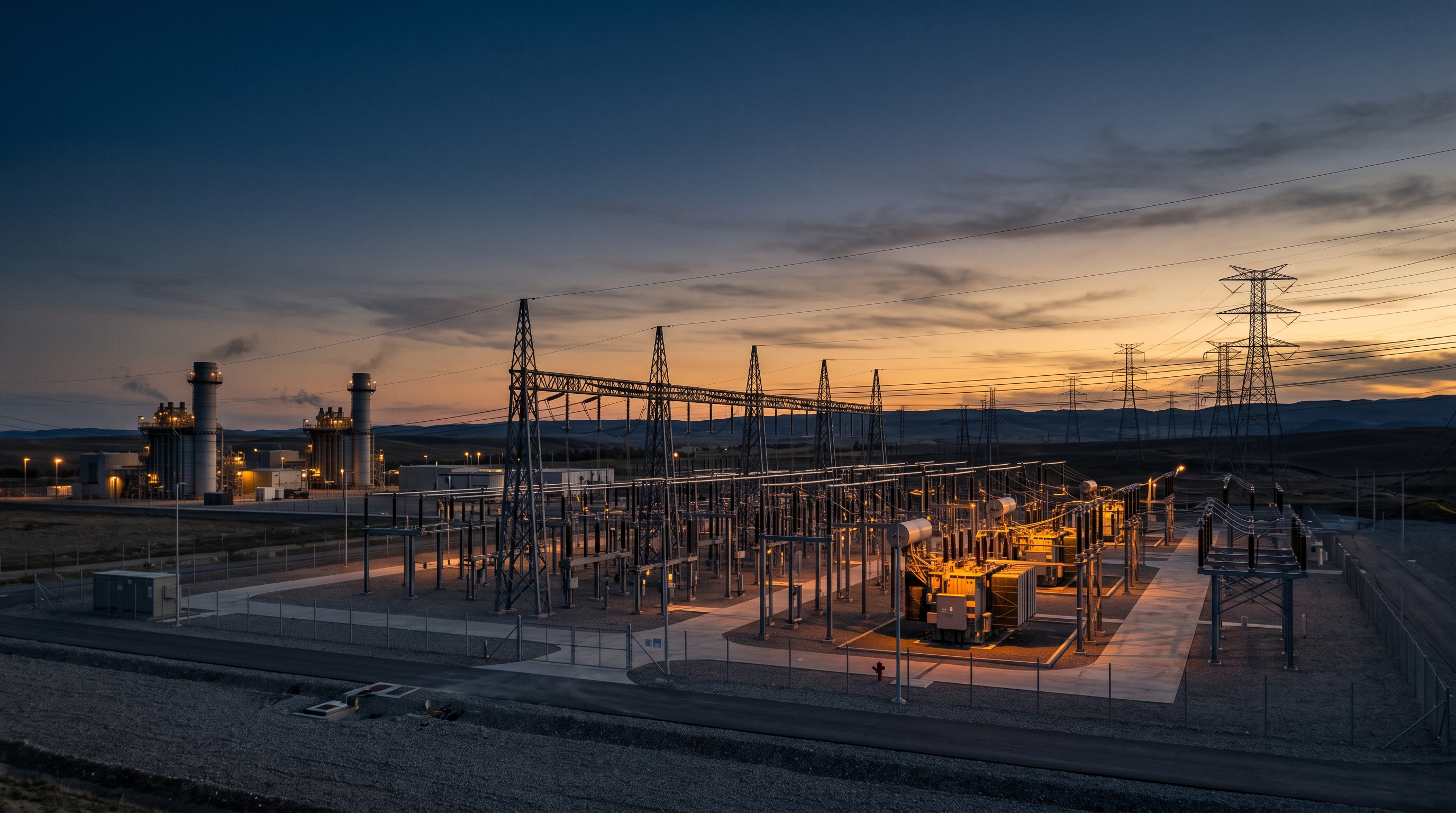
PJM Capacity Auction Results: A Cap-Clear, No New Steel
PJM's 2028/2029 capacity auction results clear at the $325/MW-day cap with almost no new supply. The procurement read for equipment buyers.
The PJM capacity auction results for the 2028/2029 delivery year are in, and the headline price is the least interesting number in the file. PJM’s Base Residual Auction cleared at the FERC-approved cap of $325/MW-day, the second consecutive auction to pin the ceiling. For the municipal utilities, cooperatives, and regional distributors buying into the largest grid in the country, the number that should reorganize your 2027 to 2030 planning sits three lines lower: only 525 MW of new resources cleared. A record price, and the market answered with almost no new steel.
That is the whole story in one data point. When we read this auction ahead of results day, the open question was whether a ceiling-bound price would finally pull generation into the ground. It did not. The construct paid the maximum it is allowed to pay and got 525 MW, including 208 MW of uprates on existing plants. Demand response did not rise to meet the price either; it fell by 277 MW. The capacity payment is doing everything it can, and the supply curve is barely moving.
What the PJM capacity auction results actually say
Start with the mechanics, because the cap hides them. The auction procured 138,318 MW of unforced capacity and still came in 6,831 MW short of the 20 percent reserve margin PJM targets for a one-in-ten reliability standard. That shortfall is wider than the roughly 6.5 GW gap in the prior auction. So the second straight cap-clear did not close the reserve hole. It widened it.
The cap is also the only thing holding the price down. PJM’s filing put the uncapped clearing price at $555/MW-day across the footprint and $777/MW-day in the ComEd zone, per Utility Dive. The $325 you see is a policy ceiling, not a market signal that pressure eased. Cleared value came in at $16.4 billion against an uncapped figure near $29.7 billion. The capacity market wanted to charge far more, and the collar is what stands between buyers and that larger number.
Nearly all the demand growth is one customer class. Demand rose about 2 GW, largely data-center driven, which means the capacity market in the biggest load region is now priced by hyperscale load. The winners are the incumbent merchant fleets that already own steel: Constellation Energy cleared 18,875 MW, Vistra 10,924 MW, and Talen Energy 10,180 MW. New entrants are not who cleared. Owners of existing plants are.
Why the capacity market summoned no new supply
Aurora Energy Research’s Julia Hoos put the read plainly: the construct “doesn’t work to bring online new capacity.” A cap-clear that draws 525 MW is the clearest signal available that the capacity payment is no longer the binding constraint on the buildout. The queue, permitting, siting, and gas-turbine and transformer lead times are.
This is the tension every procurement team in the footprint now has to plan around. A high capacity price is telling you the demand is real and durable through 2028 and beyond. The 525 MW of new supply is telling you the physical system cannot answer that demand on the market’s timeline. Those two facts do not cancel. They compound. A market that cannot build its way out of a shortfall stays short, and a grid that stays short keeps paying the ceiling while the reserve gap grows. That is the pattern two auctions in a row now describe.
The customer-pain signal underneath is already landing on the buyers our audience serves and competes with. Unison Energy’s Peter Cavan cited one industrial customer whose monthly capacity charge climbs from roughly $6,000 in 2024 to about $70,000 by 2028. A jump of that size hardens the business case for on-site generation and load management long before any new merchant plant clears an auction.
Where the capacity comes from instead, and why it lands on distribution
Here is the part that matters most for equipment demand. When the centralized market cannot deliver, the response does not stop. It migrates out of the market. Utilities self-build. Large loads put generation behind the meter. Aggregators stitch together flexible, curtailable load and distributed resources into virtual capacity. Every one of those substitutes bypasses the auction, and every one of them lands on the distribution system rather than the bulk transmission network.
That is a tailwind for distribution-grade equipment demand, not a headwind. Self-build, behind-the-meter, and DER or VPP aggregation all pull pad-mount transformers, medium-voltage switchgear, reclosers, protection relays, and interconnection hardware. A persistent capacity gap in PJM, on top of the 220 GW interconnection queue already stacked up, means the distribution layer inherits the demand the wholesale market could not clear. For a municipal or cooperative buyer, the auction result is not abstract market news. It is a forecast that the equipment competition on your side of the meter gets tighter, because the out-of-market response is the response.
The September reliability backstop procurement and the July 23 FERC conference
Two events on the near-term calendar decide how fast this pressure converts into orders. First, PJM plans to ask FERC to run a special PJM reliability backstop procurement in September 2026 to plug the near-term gap ahead of the June 1, 2028 delivery year. Watch whether it buys emergency capacity and what form that capacity takes, because whatever it procures competes for the same factory slots buyers are already waiting on.
Second, FERC holds a Commission-led technical conference on PJM governance and stakeholder reform on July 23, 2026. FERC Chair Laura Swett has said PJM may be “too big to function” and faces “a serious legitimacy crisis.” A capacity market that cannot summon supply at its own ceiling is exactly the failure that pushes structural redesign, and the redesign is what will reset the rules the large-load tariff fights already underway are trying to standardize.
The read for a buyer is steady across both. The month a capacity auction clears at its cap with no new supply is the month to have your lead-time intelligence current, not the month to start gathering it. Our free monthly briefing, The Feeder, tracks the interconnection, tariff, and equipment-supply signals that move procurement windows across the PJM footprint and beyond. Subscribe to The Feeder and keep the buildout in view before it reaches your order book.
Related Reading
- PJM 2028/2029 Capacity Auction: The Procurement Read
- PJM’s 220 GW Interconnection Queue: The Equipment Wave Behind the Price
- Hyperscaler-Owned Generation: The Behind-the-Meter Procurement Shift
Frequently Asked Questions
What were the PJM 2028/2029 capacity auction results?
The Base Residual Auction cleared at the FERC-approved price cap of $325/MW-day (results announced July 14, 2026). It procured 138,318 MW yet still landed 6,831 MW short of PJM's reliability target, and only 525 MW of new resources cleared. Cleared value was $16.4 billion, per Utility Dive and PJM Inside Lines.
What is the PJM reliability backstop procurement?
PJM plans to ask FERC to run a special Reliability Backstop Procurement in September 2026 to buy emergency capacity for the near-term gap ahead of the June 1, 2028 delivery year. It is a signal to watch because the equipment behind any emergency capacity competes for the same factory slots buyers are already waiting on.
Why did a record capacity price bring almost no new supply?
Only 525 MW of new resources cleared and demand response actually declined. Analysts read this as evidence that the capacity payment is no longer the binding constraint. Interconnection queues, permitting, siting, and multi-year equipment lead times are, so a higher price cannot summon steel on the auction's timeline.
Track this beat without paying per report
Free Member tier. Pick your topics. Get a monthly digest filtered to what you actually buy.