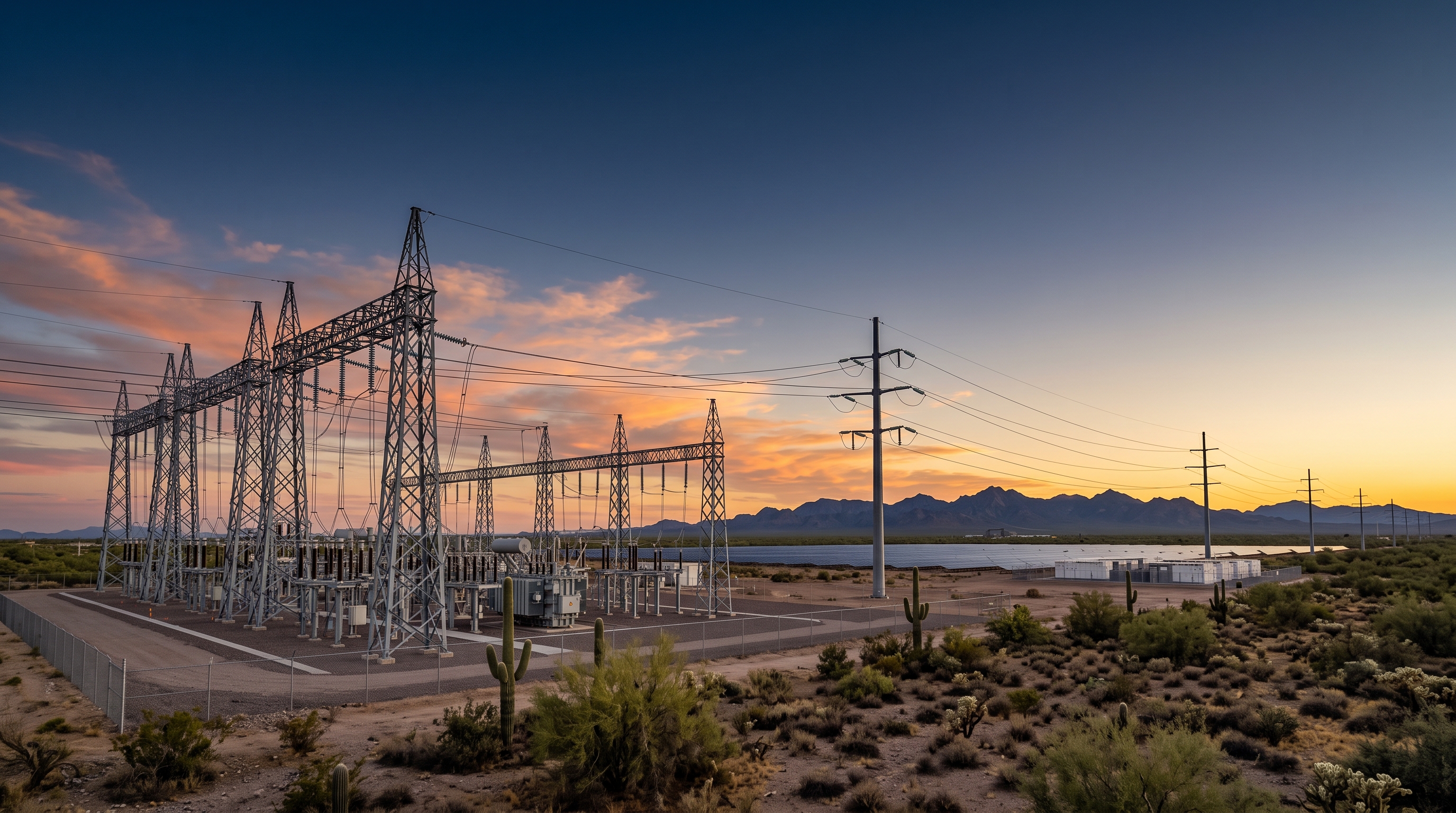
SRP Marigold Energy Center: What the Substation Scope Shows
SRP approved Marigold on Sept. 14. What the SRP Marigold Energy Center substation scope discloses, and what the ACC siting hearing does not cover.
Salt River Project’s board approved the Marigold Energy Center on September 14, and the SRP Marigold Energy Center substation now has a defined scope on paper: a new 500/230 kV station tying solar, 8-hour storage and a three-unit gas plant to the regional grid. Board approval is not the finish line. SRP says it still needs a Certificate of Environmental Compatibility from the Arizona Corporation Commission, the siting committee hearing runs September 21 through 25 in Casa Grande, and SRP expects a Commission decision in November.
For a buyer or planner at a neighboring utility, the useful part is not the megawatt headline. It is what SRP has disclosed about the interfaces: which pieces sit inside the regulatory hearing, which sit outside it, and where a smaller public power system could plug in.
What SRP approved
SRP’s board release and its August transmission application describe the same project with slightly different precision. Every figure below is SRP’s.
| Component | What SRP has disclosed |
|---|---|
| Solar | 600 MW (the application says “up to 600 MW”) |
| Battery storage | 400 MW, 8-hour; the application puts storage at up to 3,200 MWh |
| Gas generation | 675 MW; the application describes a three-unit plant |
| Substation | New 500/230 kV Marigold Substation |
| 230 kV lines | Two double-circuit lines to a battery collector substation and a solar collector substation |
| 500 kV tie | Two short 500 kV lines into the Duke to Pinal Central 500 kV line |
One number differs between the two documents. The board release says approximately four miles of new 230 kV line. SRP’s transmission application, filed August 14, says approximately 4.5 miles. Use the application figure if you are sizing anything, and treat both as SRP estimates until a certificate issues.
SRP ties the need to growth in Maricopa and Pinal counties. Its application says SRP anticipates approximately 8 percent annual energy growth in the region over the next decade.
The SRP Marigold Energy Center substation sits outside the hearing
SRP’s transmission application states that the solar generation, the battery system, the Marigold Substation, and the short 230 kV and 500 kV lines are not under Arizona Corporation Commission jurisdiction and are not part of that application. SRP filed two certificate applications, on August 14 and August 18, covering the 230 kV transmission lines and the thermal plant.
So the September hearing and the November decision gate the collector lines and the gas units. They do not gate the SRP Marigold Energy Center substation itself, the 500/230 kV station. That matters for anyone reading the schedule. A delay at the Commission would hold up the pieces the certificate covers, and the substation would still have nothing to connect until those pieces clear, but the station’s own design path does not run through that hearing.
230 kV transmission: collector substations and spare positions
The 230 kV transmission design says more about SRP’s intent than the resource mix does. SRP plans two double-circuit 230 kV lines, one to a battery collector substation and one continuing to a solar collector substation, with storage and solar on separate structures so one line outage does not strand both resources.
According to the application, the two double-circuit lines can support up to 12 conductors, while the solar and battery systems require a minimum of six conductors, or two circuits. SRP says the design leaves two positions available for future generation and transmission projects, giving “transmission and Marigold Substation access opportunities for future SRP and third-party projects.” It is a stated plan to build line capacity ahead of the resources that will use it. For a different utility’s approach to a large substation build on a renewable interconnection, see our ComEd 345 kV piece.
ED3 and the 69 kV underbuild
Electrical District No. 3, a public power utility serving Maricopa, Stanfield and the surrounding area, is the local interface to watch. SRP’s application describes ED3 as a full-service utility with a 384-square-mile service area that primarily buys power under long-term agreements.
The two SRP documents describe ED3’s role differently. The September 14 release says ED3 is evaluating a potential partnership to buy a portion of the energy. In the August transmission application, ED3 intends to purchase a portion of the generation capacity in the future. Neither describes a signed agreement, so treat it as a stated interest, not a contract.
The more concrete interface is physical. SRP is proposing that the 230 kV lines be capable of supporting 69 kV underbuild, which SRP says ED3 or other local energy providers may use. That underbuild is outside the Commission application. For a small public power system near a large utility’s new corridor, the question worth asking early is whether the host utility has designed room for local circuits on its structures, and on what terms.
We flagged ED3’s offtake interest when Marigold first headed to SRP’s board. The filings now show the relationship has a physical side as well as a contractual one.
The dates are expectations
SRP says construction is expected to begin in January 2027 and the project is scheduled to be online in 2032. Both depend on the certificate. On the gas side, SRP’s August 18 thermal application says SRP selected three GE Vernova 7F.05 simple-cycle combustion turbines, 225 MW each under ISO conditions, for the 675 MW plant. For the wider gas buildout this year, see the May 2026 gas wave. Read 2032 as SRP’s plan, not a date anyone outside SRP can bank on.
What to track through November
- The siting committee record, September 21 to 25. Route changes or conditions on the 230 kV lines will show up here first.
- The Commission decision SRP expects in November 2026. This is what SRP says it needs to move forward.
- Any executed ED3 agreement. Until one is announced, ED3’s share is an intention, not a quantity.
- The 69 kV underbuild terms. Whether local providers actually take space on the corridor is the reusable lesson for other public power systems.
None of this is an invitation to bid. It is a dated case study in how a large public power utility is packaging generation, storage and a new transmission station into one site.
Large public power projects move through filings long before they reach purchasing. The Feeder is our free weekly briefing on the regulatory shifts, supply chain signals and market forces that affect equipment procurement. Sign up here.
Related Reading
- Data Center Nuclear Power Procurement Update
- Transmission Substation Procurement: ComEd Beat the Backlog
- May 2026 Gas Wave: 20 GW of CCGT Decided in 30 Days
Frequently Asked Questions
What did SRP's board approve for the Marigold Energy Center?
On Sept. 14, 2026, SRP's board approved development of the Marigold Energy Center in Stanfield, Arizona. SRP describes it as 600 MW of solar, 400 MW of 8-hour battery storage, 675 MW of natural gas generation, a 230 kV/500 kV substation and new 230 kV transmission lines.
Does the Sept. 21 ACC siting hearing cover the Marigold substation?
No. SRP's transmission application says the solar, the battery system, the Marigold Substation and the short 230 kV and 500 kV lines are not under Arizona Corporation Commission jurisdiction. SRP filed certificate applications for the 230 kV transmission lines and the gas plant, and SRP expects an ACC decision in November 2026.
Is Electrical District No. 3 buying power from Marigold?
Not under any agreement SRP has announced. SRP's Sept. 14 release says ED3 is evaluating a potential partnership to buy a portion of the energy. SRP's August transmission application says ED3 intends to purchase a portion of the capacity in the future. Neither describes a signed contract.
Track this beat without paying per report
Free Member tier. Pick your topics. Get a weekly digest filtered to what you actually buy.