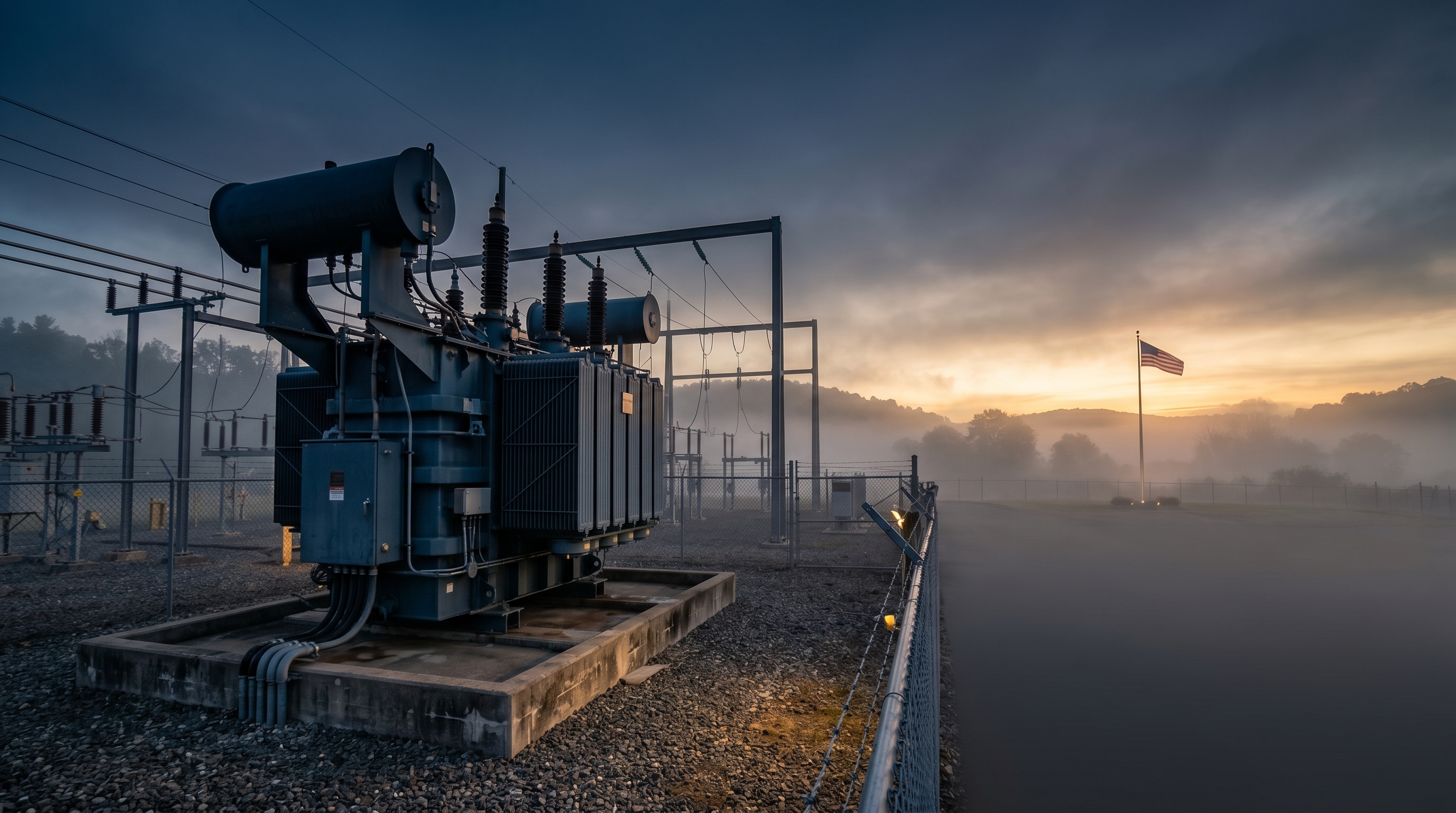
Trump's Wartime Powers on the Transformer Shortage
Trump's DPA order targets transformer shortage, grid equipment supply. NEMA says impact depends on ~$323M FY26 funding. What distributors watch.
On April 20, 2026, the President signed five presidential determinations under Section 303 of the Defense Production Act. One of them targets the transformer shortage, wartime powers applied to grid equipment manufacturing, substations, high-voltage transmission components, advanced conductors, and power electronics. The White House framing is national defense. For utility distribution buyers, the procurement question sitting in front of everyone is narrower: does a DPA invocation actually shorten the line on a distribution transformer order, or does it just change who stands in what position?
NEMA’s answer, delivered by Vice President of Government Relations Spencer Pederson to Utility Dive on April 22, is the honest one. It is “a step in the right direction,” he said, but the size of the step “will depend on details and funding.” For anyone writing purchase orders against 12-month-plus lead times, that is the whole story. The tool is legally available. Whether it reaches specific equipment categories, specific manufacturers, and specific order books is a funding and implementation question that will play out over months, not days.
What the DPA order actually does
Section 303 of the Defense Production Act is not a magic procurement wand. It is a pre-authorized federal spending mechanism. As Pederson described the mechanic, Title III “allow[s] the government to bolster U.S. industrial capabilities by purchasing or making purchase commitments; making subsidy payments for domestically produced materials; and installing and purchasing equipment.”
In practice, three things happen when a Section 303 determination is signed:
- The President formally finds that a specific industrial capability is essential to national defense and currently insufficient. That finding opens the door to using DPA funds for that capability.
- Agencies then have the legal authority to issue purchase commitments, production subsidies, equipment grants, or take-or-pay contracts for manufacturers building the finding’s target capability.
- Priority ratings under DPA Title I (DO and DX ratings) can then move federally sponsored orders to the front of a manufacturer’s book. That piece was not newly authorized on April 20, but it is the piece most likely to reshape the queue you are already in.
The April 20 determination covers transformers, high-voltage transmission components, advanced conductors, power electronics, substations, and grid-supporting manufacturing equipment. This is broader than the February 2022 distribution-transformer-only invocation, and broader than the FY25 memo focused on large power transformers.
Why NEMA is not declaring the shortage over
Pederson’s skepticism is not contrarian. It is arithmetic. Several facts line up poorly against the politics of the announcement.
Funding is constrained. According to Jean Su of the Center for Biological Diversity, as cited by Utility Dive, roughly $323 million remains in Fiscal Year 2026 DPA funding. The White House has not confirmed an allocation number. For reference, a single large power transformer factory line runs in the hundreds of millions. A $323M pool, spread across transformers, substations, HV components, conductors, and power electronics, is pilot-project money, not industrial-expansion money. NEMA has tracked $185B in domestic electrical equipment reshoring already underway without the DPA. The DPA can accelerate projects at the margin, but it is not the capital base for a manufacturing rebuild.
Demand has not rolled over. Pederson’s second quote is the one procurement teams should copy into their planning docs: “Supply chain constraints have gotten better, but the demand hasn’t gone down and I don’t think it’s going down.” NERC’s summer 2035 peak forecast has ticked up 224 GW, a 24% increase over the 2025 baseline. Data center interconnect queues, the $1.4T investor-owned utility capex wave we covered in our $1.4 trillion capex piece, and the 14.9 GW PJM backstop procurement plan are all active demand pressure. Any capacity the DPA funds has to climb a rising curve.
Lead times remain stretched. Pederson confirmed distribution transformer backlogs are “running a year or more, about twice the historical lead time.” That number has moderated from the 18-24 month peak, but it has not reset to the 6-8 month normal. Large power transformer lead times remain longer still. A DPA-funded factory expansion announced in April 2026 does not produce steel and GOES on a loading dock in 2026. First-article output is a 2027 conversation at the earliest.
What ~$323M actually buys
For comparison, recent private-sector transformer manufacturing announcements look like this. Eaton and Hitachi both publicly committed to U.S. transformer manufacturing investment during the current shortage cycle. Prolec, HVI, Siemens Energy, and ERMCO have made similar capacity-add announcements on their own balance sheets. Each of those is itself a multi-hundred-million-dollar commitment, and they are already baked into current NEMA reshoring tallies.
The realistic, honest read on the DPA tranche is that it is a targeted lever, not a bulk funder. Expect it to land in a small number of places:
- Specific bottleneck inputs. Grain-oriented electrical steel (GOES), bushings, tap changers, and switchgear vacuum interrupters have single-source or near-single-source domestic supply. A DPA subsidy to expand a single GOES line would have more impact per dollar than a new transformer factory.
- Manufacturer-specific production commitments. The government can agree to buy a fixed volume of a given category (think distribution pad-mounts, step-up GSUs, or HVDC converter transformers) from specific manufacturers at specific prices and delivery windows. That is the fastest-acting piece of Title III.
- Priority-rated orders for federally sponsored grid projects. This would move DOE loan recipient projects, Puerto Rico rebuild work, and any federally sponsored transmission build to the front of manufacturer queues. The side-effect is that commercial orders behind those ratings move backward.
What distributors and utility buyers should watch in the next 90 days
The announcement is the easy part. Implementation is where procurement plans either shift or do not. Five specific signals will tell you which:
- Agency implementation memos. DOE and DOD both have DPA authority delegated. Watch for Federal Register notices naming which equipment categories are eligible, which manufacturers submitted responses, and which programs will administer the funds.
- Priority rating volume. Track the quantity and value of DO/DX-rated orders placed through 2026 Q3. A surge of ratings without a proportional funding increase compresses everyone else’s place in line. Our long-lead transformer bid guidance explains how ratings interact with existing POs.
- Build America Buy America interaction. DPA-subsidized production typically forces tighter domestic content rules than standard procurement. If your current orders are leaning on BABA waivers, watch for DPA-funded manufacturers pulling back on waiver-eligible production. Our BABA compliance procurement brief covers the waiver mechanics.
- Section 232 tariff interaction. NEMA has publicly warned that Section 232 tariff restructuring would hinder infrastructure projects. A DPA order that subsidizes domestic production while Section 232 raises the cost of imported steel inputs produces a confused signal. Our Section 232 procurement impact analysis tracks that interaction.
- Budget vehicles. The FY27 budget request and any Continuing Resolution language will show whether DPA funding for grid equipment grows beyond the residual ~$323M. A larger FY27 authorization is the only way this program becomes a structural supply-side intervention. The FY27 DOE budget signals on grid funding show the fiscal pressure working against that.
The procurement takeaway
Do not rewrite the 2026 procurement plan on a presidential determination. The DPA order creates real optionality and real risk (the risk being that priority-rated federal orders reorder your place in the queue). Neither condition materializes on a 30-day timeline.
The tactical move is to pull forward conversations with manufacturers about where their order books sit, which lines have DPA exposure, and which of your open POs could get repositioned if a priority rating hits the same factory. Ask explicitly whether a given manufacturer has submitted responses to DPA solicitations. Ask whether their current delivery commitments are contractual or subject to federal priority override. Those are normal commercial questions now.
Our reports track DPA implementation notices, priority rating volumes, and manufacturer-level production commitments across the transformer and grid equipment categories. If you want the monthly picture of where federal supply-side policy is actually reshaping lead times (and where it is just press release), that is the report that covers it.
The monthly read on where this is heading
A DPA order on transformers sounds like it should shorten every lead time overnight, and NEMA’s own read is that the honest answer depends on funding details that will take months to show up. The Feeder is our free monthly digest of the procurement signals that move utility and distribution equipment buyers: lead-time shifts, supplier capacity, federal funding, and the RFP language that follows. One email a month, no filler.
Related reading
- The $1.4 Trillion Utility Capex Wave: What It Means for Transformer Procurement. The demand side of the same equation.
- How to Evaluate Transformer Bids When Lead Times Stretch. Tactical bid evaluation under long-lead conditions.
- BABA Compliance in Transformer Procurement. How domestic-content rules interact with federal funding.
- Section 232 Tariffs and Grid Equipment Procurement. The other federal lever working on the same supply curve.
Track this beat without paying per report
Free Member tier. Pick your topics. Get a weekly digest filtered to what you actually buy.