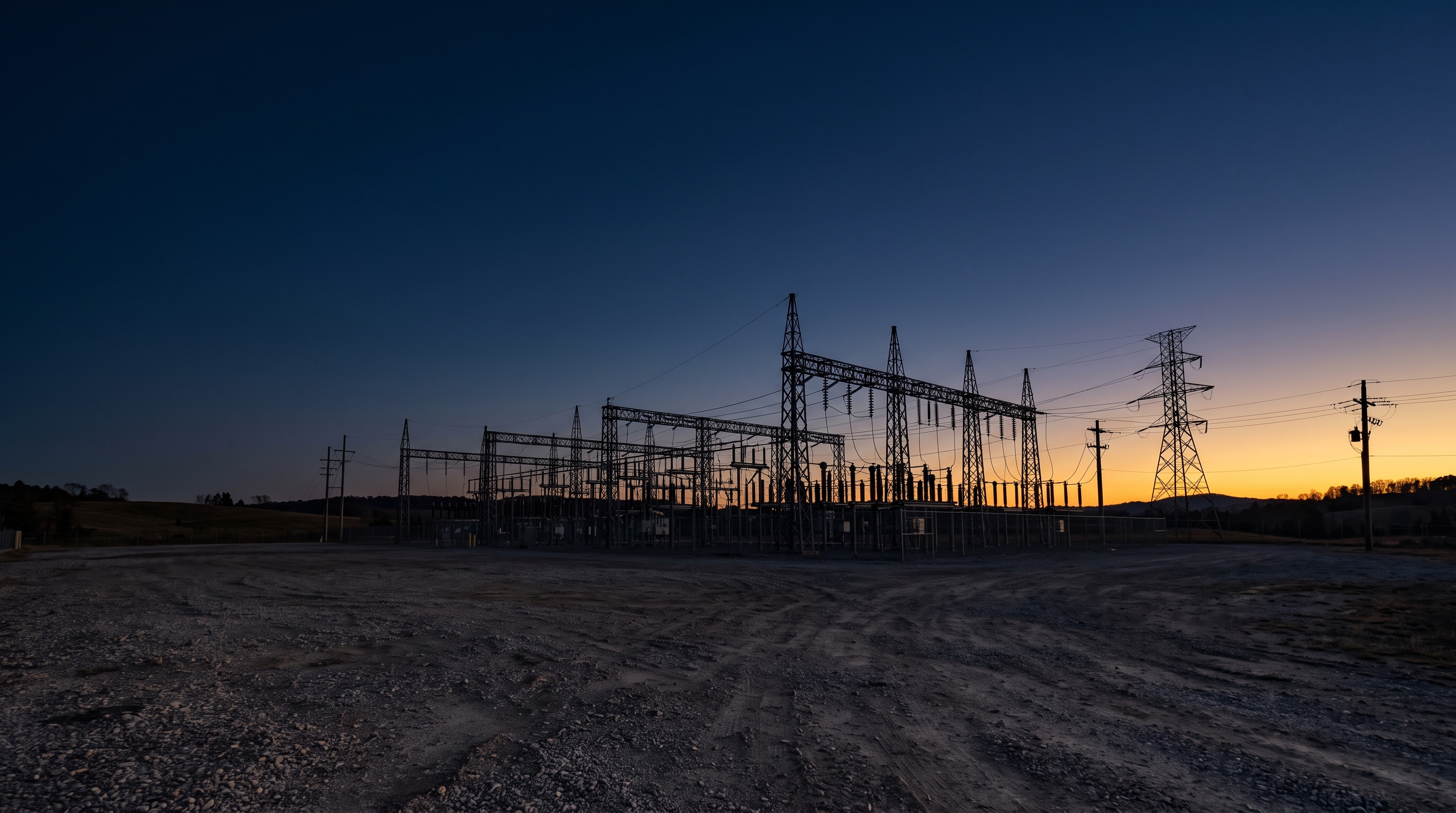
PJM Large Load Curtailment Rule: The Gear It Requires
The PJM large load curtailment rule makes curtail on command a condition of connecting. The registry, the telemetry, and the procurement read.
PJM’s board is sending two filings to FERC before the end of July, and the smaller one is the one that changes what gets bought. Alongside an emergency capacity auction, PJM is filing an Interim Resource Adequacy Service. Under it, new large loads that arrive without dedicated supply have to reduce load or switch to on site backup when the system approaches emergency conditions. The PJM large load curtailment rule takes effect June 1, 2027, and it comes with a registry capturing each facility’s location, ramp schedules and capacity details.
The auction is the headline. Reliability Backstop Procurement runs September 30 through October 21, targets 6.8 GW, and pays on a 15 year commitment with an online deadline of June 1, 2032. The 6.8 GW is the amount by which the most recent Base Residual Auction missed PJM’s 20% reserve margin. Across PJM’s 13 states and the District of Columbia, large load is projected to grow 70 GW by 2038 while roughly 15 GW of generation has retired since 2022.
The number that tells you how serious PJM is about the shortfall is the price cap. The backstop is capped at $555 per MW-day against the $325 per MW-day cap that bound the last auction. That is not a cautious step up, and the reason is in the auction results PJM published two weeks ago.
Nothing procures until FERC rules. But the filing has a roughly ten week runway to an October auction, which is an aggressive schedule PJM would only propose if it expected an expedited order. The planning question for anyone selling into or buying for the footprint is what the curtailment obligation costs to satisfy, and whose purchase order it lands on.
What the PJM large load curtailment rule actually requires
The Interim Resource Adequacy Service is not a demand response program. It is a condition of service. A large load that shows up without its own dedicated supply agrees, as a term of connecting, that PJM can call for a reduction when the system nears emergency conditions. Individual utilities write the curtailment rules, subject to their own state and local regulators, so the mechanism will vary across the footprint while the obligation does not.
The registry is the part with an equipment bill attached. Facility location is a form field. Ramp schedules and capacity details are not. A ramp schedule is a claim about how fast a facility can shed and restore load, and a registry that collects it implies somebody can verify it. That requires measurement at the point of delivery at a resolution most large loads do not have today, plus a path for a dispatch signal to reach equipment that can act on it.
This is the same instrument, arriving in the same month, that Duke Energy has built into its Customer Protection Plus framework as a temporary curtailment provision, and that federal regulators have been pushing at every RTO since the June show cause orders on large load tariffs. A vertically integrated utility’s tariff and an RTO’s market rule landing on the same requirement independently is the strongest available signal that conditional, curtailable large load service is becoming the default rather than a concession.
Why the $555 backstop cap is not a step up from $325
PJM’s 2028/2029 Base Residual Auction, whose results published July 14, procured 138,318 MW and cleared at the $325 per MW-day cap across all four load zones with no locational separation. It was not the first auction to end that way. The cap has bound the outcome in consecutive auctions now, which is the context the backstop price has to be read against.
Absent the cap, according to Modo Energy’s analysis of the same results, that auction would have cleared at $555 per MW-day, roughly 71% above the cap, with ComEd separating out to $777 per MW-day. The uncapped market would have cost $29.7 billion against the $16.4 billion buyers will actually pay.
So the backstop cap is not a number PJM picked by stepping up from $325. It is the price the capped market has been suppressing auction after auction. Read plainly, PJM is conceding the real clearing price and agreeing to pay it, in a targeted auction, on a 15 year term, to get steel in the ground.
That matters to a procurement calendar more than it matters to a market analyst. A 15 year commitment at that price with a 2032 online deadline is a financeable revenue stream. Projects that penciled out only above the cap become buildable, which pulls substation, interconnection and step up scope forward onto a known clock: award in the fourth quarter of 2026, energized by mid 2032.
The counter argument is live and it comes from PJM’s own market monitor. Joseph Bowring of Monitoring Analytics argues that keeping data center load in the capacity auctions is itself what raised capacity costs by $29.4 billion over the last four auctions. If FERC accepts that cost causation framing, the remedy tilts away from paying more for capacity and toward removing large loads from the auction entirely. Julia Hoos of Aurora Energy Research reads the backstop as addressing an immediate gap while the underlying build challenges persist.
What the rest of this piece answers
Four bodies are writing large load rules at the same time through four different instruments, and they do not use the same words for the same obligation. PJM is conditioning service on curtailment. ERCOT is gating the queue on study maturity and financial commitment. Duke is doing it contract by contract. North Carolina is fighting over whether any of it should be voluntary. If you sell into or buy for more than one of those footprints, the obligation converges and the paperwork does not, and the comparison is not published anywhere.
The rest of this piece is that comparison, laid out term by term across all four, plus three things that fall out of it. There is a fork that decides whether the telemetry and control scope lands on the utility’s purchase order or the customer’s, which is the only question that changes what you quote. A method follows for discounting a utility’s announced load pipeline down to the share you can actually bid against, because a 70 GW projection and a bid list are not the same document. And there are seven dated triggers running from this month to June 2032, ending in five things worth doing in the next ninety days, written as actions rather than themes.
Here is the part most likely to catch a distribution buyer flat. Ramp schedules and capacity details are not disclosures. They are a metering and control specification arriving in the shape of a regulatory form, and the cost of satisfying it is already sitting in somebody’s project budget. Deciding whose is a 2026 conversation. It stops being negotiable once the registry takes effect.
Insider membership is $9.99 a month. It opens the rest of this piece, the topic deep dives and utility dossiers behind it, the RFQ and specification templates, and the full report archive.
The rest of this analysis is for Insiders.
Unlock the full breakdown, the data behind it, and every Insider report and dossier.
- The full premium analysis
- The data tables and the sources
- Every dossier and report in the library
- New intelligence every week
$9.99 / month. Cancel anytime.
Already a member? Sign in
Read by procurement and engineering teams across US utilities and distributors.