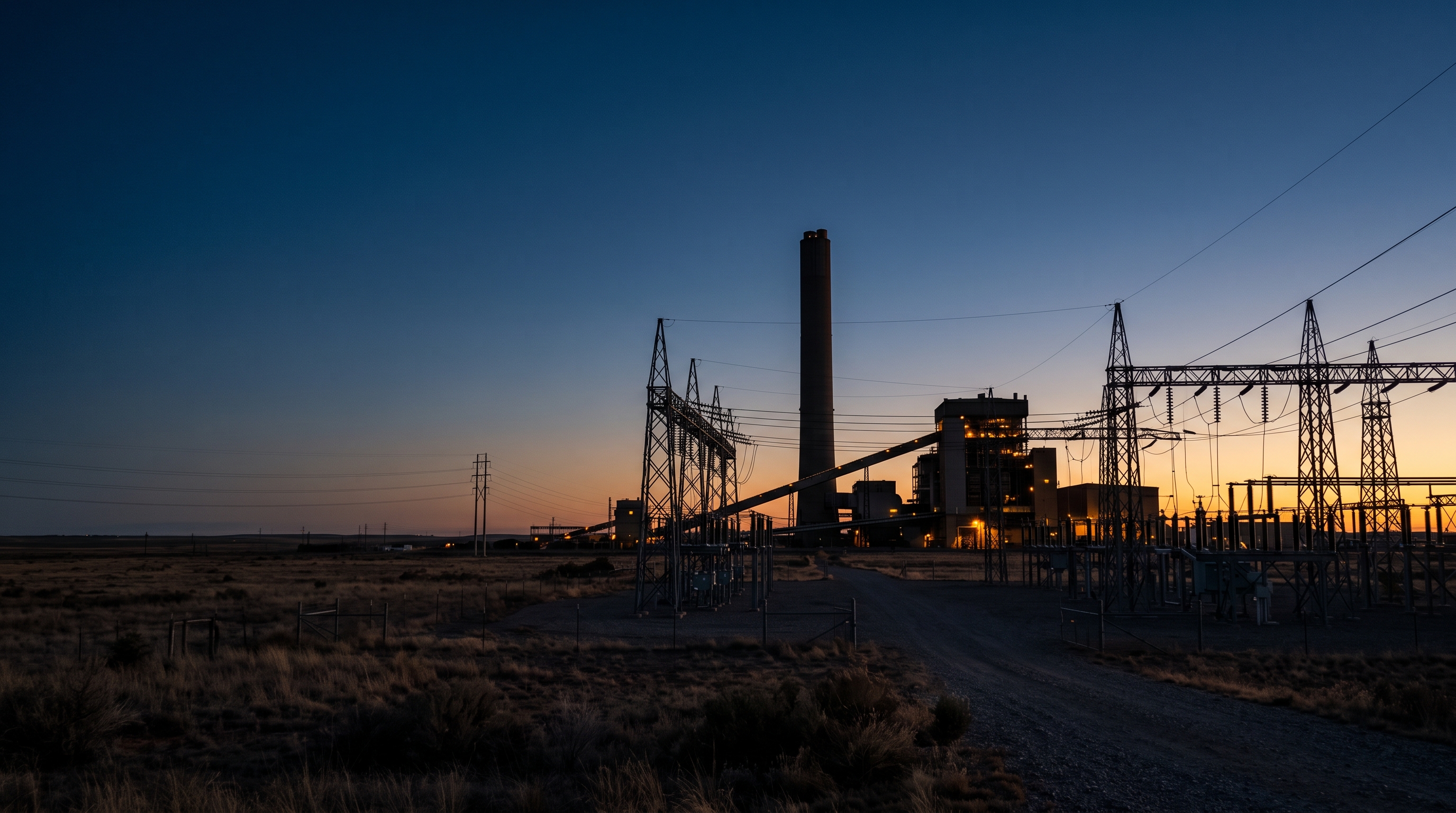
Section 202(c) Must-Run Orders Defer Seven Retirements
Seven plants sit under rolling Section 202(c) must-run orders deferring retirement. The renewal dates are public, and the first one falls August 16.
On August 16, the federal order holding a 1,420 MW coal plant open in western Michigan runs out. It is the fifth Section 202(c) must-run order on the J.H. Campbell plant since Consumers Energy planned to shut it on May 31, 2025, and on the record of the last fifteen months, a sixth will land within days of the fifth expiring. None of the four before it was allowed to lapse.
Campbell gets the headlines because Michigan’s attorney general has fought the renewals in court, most recently with a rehearing request in June. The more useful document is the one nobody reads: DOE’s own running index of Section 202(c) orders, which listed 38 issued in 2026 as of August 5. Most of those are three-day heat orders that expire before anyone can act on them. Buried in the middle of the list is something else entirely, and it has a calendar attached.
Seven Plants on a Rolling 202(c) Order Renewal Cycle
A distinct class of order emerged in 2026 that has nothing to do with a heat wave. These are 90-day, unit-specific orders directing a named plant to stay available, issued to a plant whose owner had already scheduled its retirement, and renewed on expiry. Seven generating stations sit under one right now.
| Plant | Owner | Region | Order | Expires |
|---|---|---|---|---|
| J.H. Campbell (1,420 MW) | Consumers Energy | MISO | 202-26-22 | Aug 16, 2026 |
| Eddystone Units 3 and 4 (380 MW ea.) | Constellation | PJM | 202-26-24 | Aug 22, 2026 |
| Stanton Unit 1 (464.5 MW) | Orlando Utilities Commission | FRCC | 202-26-26 | Sep 1, 2026 |
| Centralia (730 MW) | TransAlta | WECC | 202-26-28 | Sep 12, 2026 |
| Schahfer (847 MW) | NIPSCO | MISO | 202-26-29 | Sep 19, 2026 |
| F.B. Culley Unit 2 (104 MW) | CenterPoint | MISO | 202-26-30 | Sep 19, 2026 |
| Craig Unit 1 (446 MW) | Tri-State G&T | SPP | 202-26-31 | Sep 26, 2026 |
Read the owner column before the capacity column. This is not an investor-owned utility phenomenon. Tri-State is a generation and transmission cooperative, and the Orlando Utilities Commission is a municipal utility whose board voted in 2021 to retire Stanton Unit 1. Both are now operating a plant they had finished planning around, under federal order, on a schedule set in Washington.
One case that looks like it belongs on that list does not. H.A. Wagner Unit 4 (Talen Energy, PJM) carries order 202-26-25 through August 19, but Wagner Units 3 and 4 were already held open by a PJM reliability-must-run agreement running to May 31, 2029. Its 202(c) order does different work. Counting it as an eighth deferral overstates the pattern, and the distinction matters if you are using this list to plan anything.
These Orders Buy Availability, Not Electricity
Here is where the trade coverage and the procurement read come apart.
The prevailing story about these orders is that they are not accomplishing much, and on generation the evidence is real. Across five of these plants, output fell to 1.5 million MWh in the first quarter of 2026 from 4.3 million MWh a year earlier, a 65 percent drop, per EIA data compiled by Utility Dive. Centralia produced no electricity at all after its order took effect at the start of the year. Craig Unit 1 ran for about two weeks in April and otherwise sat. Eddystone posted a 0.5 percent capacity factor.
Treat that as the finding rather than the disappointment. A Section 202(c) must-run order does not purchase megawatt-hours. It purchases the condition of being able to produce them, and that condition is a maintenance and spares product rather than a fuel product. A plant running at a 0.5 percent capacity factor still needs its station service, its switchyard, its protective relaying, its breakers and its controls kept in working order, inspected, and staffed. The lower the output, the more clearly the entire cost of the order is availability cost.
That reframing is what makes the list above worth a buyer’s attention. Idle is not the same as inactive.
What the Order Text Actually Requires
The ordering paragraphs are nearly identical across the series, and four of them are worth reading closely.
The first directs the operator to “take all measures necessary to ensure that the Campbell Plant is available to operate.” Not to generate. To be able to.
The next one is the one that moves equipment. Every order in this class gives the recipient roughly two weeks to report back to DOE “information concerning the measures it has taken and is planning to take to ensure the operational availability” of the unit. That is a written availability plan, compelled by federal order, filed within a fortnight of issuance, at a plant whose capital budget was zeroed out for retirement. Campbell’s was due June 2. Stanton’s was due June 18.
Then the economics. Each order states that the plant “shall not be considered a capacity resource,” so the unit earns nothing in the capacity market it is propping up. The same order directs the owner to file tariff revisions with FERC as needed, and notes that “rate recovery is available” under the statute. A cost with a recovery mechanism attached and no revenue offset behaves differently from ordinary deferred maintenance, and it does not compete for budget the same way.
CenterPoint has put a number on what compliance can cost at a single small unit: roughly $20.5 million and a 14-week outage for repairs needed to keep Culley Unit 2 in compliance. That is 104 MW of nameplate running at a 14 percent capacity factor.
DOE has been explicit about why it keeps renewing rather than letting these units go. In a footnote to the Stanton order, the department reasons that restarting a decommissioned plant “would presumably cost the same as decommissioning in dollars and time, if not more,” and concludes that “continuous operation is required in such cases so long as the Secretary determines a shortage exists and is likely to persist.” That is not the language of a temporary measure.
Deferred Maintenance on an Emergency Timeline: What It Means for Buyers
Three consequences follow, and none of them requires guessing at DOE’s next move.
The first is that a Section 202(c) must-run order creates off-cycle demand with an unusual urgency profile. Life-extension work at a plant that expected to be gone does not follow a planned outage schedule or a multi-year capital plan. It gets specified against whatever is available, which is the same behavior we described in refurbishment versus replacement decisions driven by federal signals, and it lands on the same suppliers already quoting long lead times to everyone else.
The second is that the buyer set is broader than the retirement debate suggests. A municipal utility and a G&T cooperative are on that list, and neither has the procurement staff or the balance sheet of Consumers Energy. Public power buyers competing for the same switchgear and relay capacity as an investor-owned utility, on a 90-day federal clock, is a genuinely different position than the one they planned for.
The third is that the renewal dates are the only forward-looking part of any of this that is actually public. Every other input into this market requires an inference. These are order numbers on a federal index with expiry dates printed on them, and every order in this class that has reached its expiry has so far been renewed. Stanton is the one unit on the list that has not yet faced that test.
Our grid modernization procurement guide tracks the reliability mechanisms shaping equipment demand through the 2026 buying window, including how this sits alongside the capacity-market response we covered in PJM’s cap-clearing auction that summoned no new steel.
What to Watch: The Next Three Renewal Dates
Campbell on August 16 is the near-term test, and it is the most litigated order in the set, which makes it the least representative one. Eddystone on August 22 is the cleaner read, because nothing about it is contested and its retirement date has now slipped by nearly fifteen months without much comment.
The one to watch after that is Stanton on September 1. It is the newest name on the list, the only municipal one, and its order carries a paragraph the others do not: OUC must give DOE fifteen days’ written notice before any change in the operational status of Stanton Unit 2, the sister unit that is not currently under an order. DOE wrote a tripwire into a plant it has not ordered yet. Whether that unit joins the list this year will say more about where this mechanism is heading than any single renewal will.
The Feeder is our free monthly read on the regulatory and reliability actions that move equipment demand before they show up in lead times. Subscribe to The Feeder and get the next renewal calendar ahead of the cycle.
Related Reading
- PJM Capacity Auction Results: A Cap-Clear, No New Steel
- Switchgear Refurbishment vs Replacement: Federal Signal
- DOE PJM Data Center Curtailment Order: Procurement Impact
- MISO’s Anti-PJM Auction: 141 GW Cleared, Prices Halved
- NYISO Summer 2026 Reserve Margin: 417 MW and Falling
Know what changed before your next quote
Free Member tier. Pick your topics. Get a weekly digest filtered to what you actually buy.