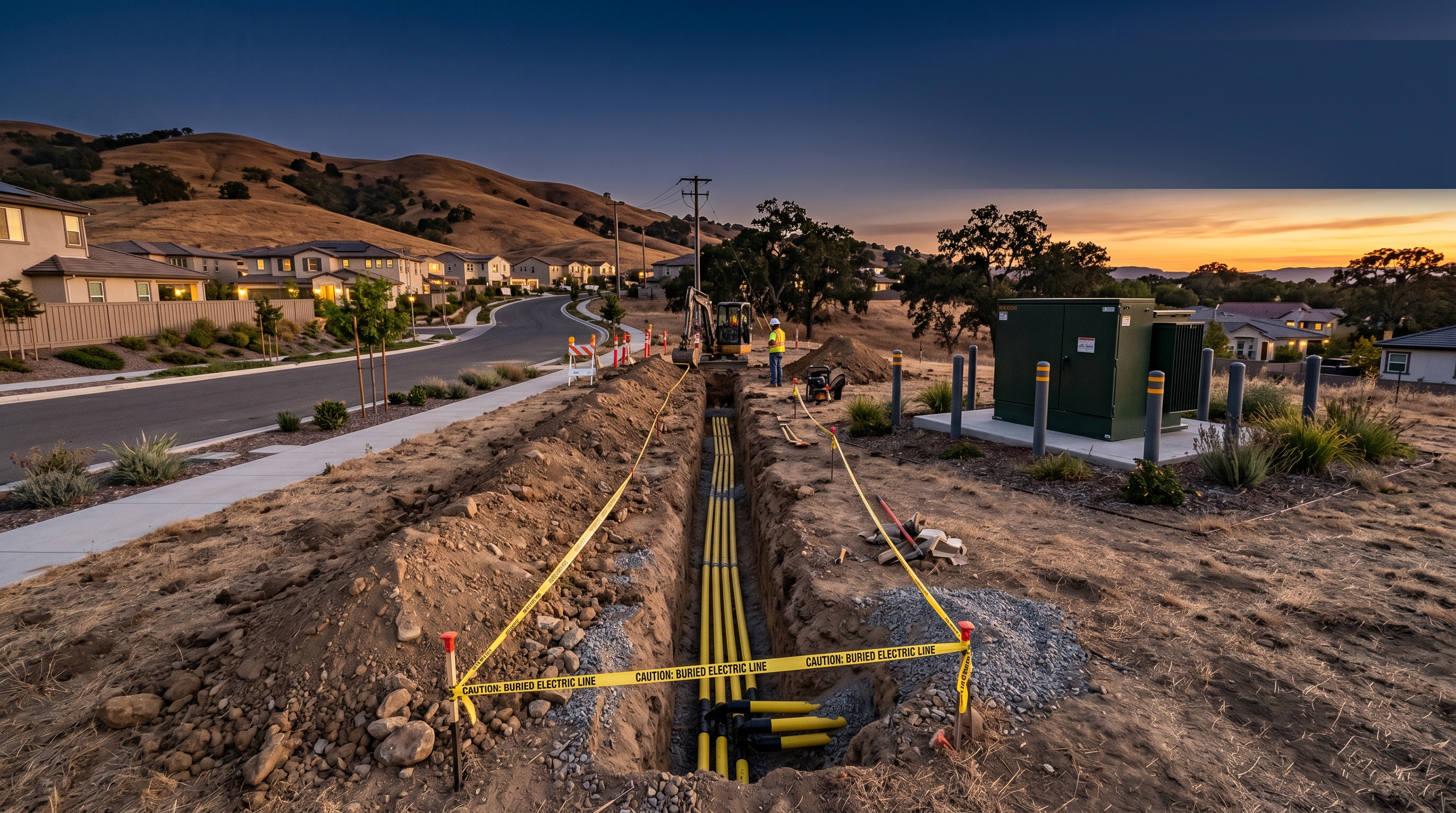
Western Distribution Hardening Super-Cycle: 2026 Procurement Through 2037
PG&E undergrounding, Idaho Power weather sensing, Denton GIS, and DPA Section 303 define a Western distribution hardening super-cycle. What the procurement frame looks like through 2037.
Four signals in the last ten days of April 2026 finished drawing the shape of western distribution hardening as a multi-decade procurement super-cycle. PG&E filed for 9,000 miles of work through 2037. Idaho Power doubled its weather-sensing fleet. Denton Municipal Electric publicized a 138/13.2 kV GIS substation that fits in 30% of the footprint of the air-insulated alternative. And the federal government invoked Defense Production Act Section 303 over transformers, switchgear, substations, and high-voltage breakers. Each is a separate news story. Read together they describe a single procurement frame that will lock equipment categories, vendor relationships, and lead times across the entire West for the next twelve years.
The pattern matters more than any one filing. Western and Sun Belt utilities are simultaneously hardening overhead lines, burying high-risk circuits, deploying distributed sensing, and modernizing protection. Each activity has a different equipment demand profile. Together they form a sustained capital program that will absorb domestic manufacturing capacity, reshape supplier relationships, and define what western distribution hardening actually procures.
The four signals
PG&E, 2028 to 2037: CEO Patti Poppe disclosed on the Q1 2026 earnings call that PG&E will file its next wildfire mitigation plan with California’s Office of Energy Infrastructure Safety in Q3 2026. The plan covers 5,000 miles of underground distribution at roughly $1B per year, plus 4,000 miles of overhead hardening, over a decade. Wrap that into the $73B five-year capital plan PG&E has already published, of which 80% flows to T&D, and the procurement signal is unambiguous: the largest single sustained distribution-equipment demand program in the U.S. market. Full equipment-class breakdown is in the dedicated PG&E undergrounding filing analysis.
Idaho Power, 100-plus stations going to 160: Idaho Power profiled its weather-monitoring program in T&D World on April 30. The utility has installed more than 100 hyperlocal weather stations since 2023, with 60 more planned in 2026. Each station carries temperature, humidity, and anemometer sensors. The data feeds three operational decisions on the distribution system: disabling reclosers during high fire risk, increasing line sensitivity by lowering fault thresholds, and triggering Public Safety Power Shutoffs. IDACORP’s Q1 2026 earnings disclosure puts annual capex at $1.3 to $1.5B and O&M at $525 to $535M, with the Idaho Wildfire Standard of Care Act now providing regulatory cost-recovery backbone. Industrial load is growing 5.7% driven by Micron and Meta ramps.
Denton, Texas, a 2.1-acre substation: Denton Municipal Electric energized its Hickory 138/13.2 kV GIS substation in March 2025 and circulated the case study through T&D World in April. Siemens supplied the gas-insulated switchgear, Beta Engineering ran the EPC. Two 25 MVA transformers initial, expandable to four for 100 MVA total. The 2.1-acre footprint is roughly 70% smaller than the seven acres the equivalent air-insulated substation would have required. The Hickory project replaced a 1960s 69 kV AIS and deferred another planned substation to 2034, recovering about $17.4M in deferred capex. DME serves 64,000-plus customers in the fast-growing north Dallas corridor.
Federal Section 303, signed April 20: Presidential Determination 2026-10 invoked DPA Section 303 over grid infrastructure equipment and supply chain capacity, classifying transformers, transmission conductors, substations, high-voltage circuit breakers, power control electronics, protective relay systems, capacitor banks, and electrical core steel as essential to national defense. DOE is the implementing agency. APPA reports DOE has access to roughly $1B from the One Big Beautiful Bill Act, with about $323M of FY2026 DPA Title III balance still available. The funding is small against a $9 to $11B annual U.S. distribution transformer market. The legal authority to subsidize, purchase-commit, and install equipment at private manufacturers is the bigger lever. Treatment of the policy mechanics sits in our DPA Section 303 wartime powers analysis.
Western distribution hardening, as a single buyer-side problem, runs across all four.
The equipment categories the super-cycle locks in
Reading the four filings together produces a category map that distribution buyers across the West and Sun Belt should treat as the procurement backbone for the next decade.
Basis of the PG&E-derived figures below, and its status as of September 2026. The PG&E volumes in this section derive from the company’s 2028-2037 wildfire plan: 5,000 miles of undergrounding plus 4,000 miles of overhead hardening at roughly $1B per year, as described ahead of its Q3 2026 OEIS filing. On September 2, 2026 PG&E announced it will defer approximately $2 billion of planned 2027 investment and re-evaluate its 2028-2030 capital investment and rate-base outlooks. The plan itself has not changed and PG&E named its Wildfire Mitigation Plan and safety-certification obligations as continuing to be funded; what it is deferring is growth work: renewable and housing interconnections, EV charging, and transmission and substation projects. Treat the PG&E numbers below as an estimate against a 2028-2037 plan whose funding years the issuer has publicly reopened.
Underground primary cable, 15 kV and 25 kV class. Underground primary is concentric-neutral cable: one cable per phase, with the neutral integral to each cable rather than pulled separately. A three-phase mile therefore takes three conductor-miles and a single-phase lateral takes one, which across a realistic backbone-to-lateral mix blends to roughly 1.5 to 2.5 conductor-miles per circuit-mile. PG&E’s 5,000 miles of undergrounding (2028-2037 plan; see the basis note above) therefore implies 8,000 to 12,000 conductor-miles of MV-90 or TR-XLPE-jacketed primary cable. At industry sourcing patterns, that is a meaningful share of national cable production from Prysmian, Southwire, Okonite, and Encore Wire over the program’s life. Texas munis pursuing the Denton GIS playbook also underground distribution circuits exiting the substation. Western cable allocation will tighten earlier than buyers outside California expect.
Padmount distribution transformers. Undergrounding converts pole-mounted units to padmount, and the count scales with customer density rather than mileage alone. PG&E’s own Enhanced Powerline Safety Settings disclosures put about 1.8 million customers across 44,000 line-miles of high fire-threat district, or roughly 41 customers per line-mile. At 5 to 10 customers per padmount unit, that works out to 4 to 8 transformers per undergrounded circuit-mile. The PG&E program alone (2028-2037 plan; see the basis note above) implies 20,000 to 40,000 padmount transformers spread across 10 years, against a national market where lead times still run 12 months. ERMCO, Howard Industries, Eaton/Cooper, Central Moloney, Hitachi Energy USA, and Prolec GE all have stake in this pipeline. The structural shortage analysis is in our padmount transformer procurement crisis coverage.
Padmount and submersible switchgear. Sectionalizing points, separable connectors, polymer-concrete vaults, fault indicators, and the underground residential distribution gear that comes with burying circuits. Eaton, S&C, G&W, Hubbell, and ABB share this opportunity.
Gas-insulated switchgear for urban substations. Denton is the visible signal of GIS becoming the default for footprint-constrained urban substations. A 145 kV-class GIS bay runs $3 to $5M in current pricing, with a complete 138 kV GIS substation landing between $25 and $50M. Siemens, Hitachi Energy, GE Vernova, and Mitsubishi Electric dominate the U.S. market. GIS lead times are running 24 to 36 months, comparable to large power transformers. SF6-free variants from each major manufacturer are commercializing fast, which converts what used to be a five-year qualification cycle into an active procurement decision today. The breaker-by-breaker view is in our SF6-free switchgear procurement coverage.
Intelligent reclosers and microprocessor protection relays. The Idaho Power workflow (“disable reclosers when fire risk is high, increase line sensitivity, trigger PSPS”) only runs on modern intelligent reclosers with remote command and on protection relays with remotely settable parameters. Older hydraulic and oil-circuit reclosers do not support remote disable. Utilities replicating the Idaho Power playbook are forced into recloser-fleet refresh and protection-relay upgrades. SEL, ABB, Siemens, GE Multilin, and Schneider dominate the relay segment. S&C, G&W, Eaton/Cooper, Hubbell, and ABB dominate intelligent reclosers.
Hyperlocal weather sensing. New procurement category. Each station runs $5,000 to $15,000 all-in, including hardware, install, and communications. Idaho Power adding 60 stations in 2026 is roughly $0.5 to $1M of sensor capex. Campbell Scientific, Davis Instruments, Vaisala, NovaLynx, and All-Weather Inc. are the active vendors. Smaller cooperatives in fire-prone zones face the same insurability pressure and will deploy at 10 to 30 stations per service area.
Communications backhaul. Sixty new weather stations plus a recloser fleet capable of remote disable adds up to a serious comms requirement. Fiber, RF mesh from Tantalus or Itron, and LTE-M cellular telemetry are all in scope. Comms gear is the ancillary spend that most procurement plans for distributed sensing programs underestimate.
Composite poles, covered conductor, and fire-resistant hardware. PG&E’s 4,000 miles of overhead hardening implies covered conductor demand (TPC Wire & Cable, Hendrix Aerial Cable), composite poles (RS Technologies, Resilient Composites, Valmont Newmark), distribution-class arresters, polymer crossarms, and TripSaver-style smart fuses placed at fault-prone locations.
The combined picture is not “buy more transformers.” It is a multi-category, multi-vendor procurement pattern that western distribution hardening absorbs into frame contracts for the next decade.
Distributed sensing is now a procurement category
The Idaho Power filing is the clearest single signal that distributed sensing has moved out of the “smart grid pilot” budget bucket and into the recurring distribution procurement line. The mechanics force it. A utility cannot legally invoke the “disabling reclosers reduced ignition risk” defense in a wildfire-liability case unless the reclosers actually support remote disable and the decision was driven by real-time, location-specific weather data. That requires sensors, comms, intelligent reclosers, and the modern protection relays they coordinate with.
The same regulatory logic is propagating. The Idaho Wildfire Standard of Care Act passed in 2025 and now anchors Idaho Power’s wildfire mitigation plan with explicit rate-base recovery. Nevada, Arizona, Colorado, and Montana are watching for legal-shield templates that convert wildfire mitigation from discretionary spending into rate-supported capital. Once those statutes pass, the equipment demand profile follows on a one-to-three-year lag. Distribution buyers in those service territories should be building sensor, recloser, and relay budgets for the 2027 to 2030 window now, not after the legislation lands.
The vendor implication is overlooked. Traditional electrical distributors typically serve the recloser, relay, and conductor demand but not the weather-sensor demand. Equipment-savvy distributors who can bundle weather stations, intelligent reclosers, comms hardware, and protection relays into integrated packages have a clear opportunity to capture incremental wallet share inside utility customer accounts.
GIS substations and the urban-siting math
Denton Municipal Electric is the visible signal of a procurement shift happening across every fast-growing Sun Belt and West Coast city. The underlying math is straightforward. At commercial-corridor land prices of $1 to $3M per acre in suburban Dallas, Phoenix, Las Vegas, or the Bay Area edge, the five-acre footprint reduction GIS delivers translates to $5 to $15M in land-cost avoidance. That figure approaches or exceeds the cost premium of GIS over an air-insulated alternative. When you add the deferred-capex savings of higher capacity density (DME deferred a future substation to 2034 and recovered roughly $17.4M), the lifecycle math tilts toward GIS for any urban or suburban site.
Permitting velocity is the second driver and often the binding constraint. The smaller GIS footprint plus aesthetic flexibility (Denton wrapped its substation in a 22-foot custom brick facade matching downtown historic storefronts) accelerates city-council approvals. Equipment lead time becomes irrelevant if the siting fight kills the project. A 33-month construction timeline with GIS beats a 60-month timeline if the AIS version is fighting a neighborhood association at every step.
The procurement consequence for smaller munis and cooperatives in fast-growing markets: stop treating GIS as the exotic option that requires special justification. Request GIS-versus-AIS lifecycle cost analyses on every new urban or suburban substation. Plan for 36 to 42 months of GIS lead time given current backlog. Build relationships with Siemens, Hitachi Energy, GE Vernova, and Mitsubishi Electric now rather than waiting for the project award.
What this means if your service territory is not in the West
Western and Sun Belt utilities will absorb domestic manufacturing capacity for the next decade. That has direct procurement implications for utilities in the Midwest, Mid-Atlantic, Southeast, and Northeast that are not running multi-billion-dollar hardening programs.
Padmount transformer and cable allocation tightens nationally. The PG&E program alone takes roughly 2,000 to 4,000 padmount transformers per year off the available production from major U.S. manufacturers (2028-2037 plan; see the basis note above). National lead times do not improve from here through at least 2028.
Distributed-sensing vendors run capacity-constrained. As Western utilities scale weather-station deployments and southeastern utilities respond to hurricane storm-hardening pressure, the small set of utility-grade weather-sensor vendors will face order-book stretch. Buyers placing 2027 orders need to commit by mid-2026.
SF6-free GIS qualification windows close. Hitachi EconiQ at 420 kV passed 65-plus North American orders earlier this year. Siemens Clean Air and GE Vernova g³ are commercializing on parallel timelines. Utilities that delay qualification will be paying premium pricing on tail-end inventory of SF6 equipment for the next decade. Specification work that gets done in 2026 sets the cost basis through 2035.
Federal DPA-financed capacity tilts toward incumbents. The $1B-plus in DOE-deployable capital from OBBBA and FY2026 DPA Title III will flow to existing domestic manufacturers (Eaton, Hitachi Energy USA, Howard Industries, Central Moloney, ERMCO, Prolec GE). New entrants face higher barriers. Procurement officers writing 2027 RFPs should explicitly ask manufacturers what DPA Title III financial support they expect to receive and what production commitments they make in exchange.
The procurement clock
PG&E’s filing process is the visible procurement clock for the entire super-cycle. Q3 2026 filing to OEIS, CPUC review through 2027, program start 2028. Manufacturers will be racing to lock in 5- to 10-year frame supply agreements with PG&E during the 2026 to 2027 window. Idaho Power and Denton-pattern utilities are operating on shorter procurement cycles but the same supplier-relationship logic applies: the supplier conversations that happen in 2026 set who serves the program through 2030.
The action set is unambiguous for any procurement officer whose service territory is in the wildfire, hurricane, or fast-growth corridor. Get GIS-versus-AIS lifecycle analyses on every new urban substation. Audit recloser fleets for remote-disable capability and budget the refresh. Build a weather-station vendor relationship now. Lock cable, padmount, and switchgear allocation through 2028. Read every upcoming RFP through the DPA-financed-incumbent lens. And get a procurement-intelligence read on which manufacturers expect to receive DPA Title III support so you understand whose order book is going to lengthen and whose is going to compress.
The full procurement picture that western distribution hardening sits inside, including federal funding mechanics, BABA interactions, and regional supplier capacity, is what our DistroForge reports cover for individual utility procurement teams.
The monthly read on where this is heading
A hardening super-cycle running from 2026 into the 2037 horizon locks cable, padmount, and switchgear allocation years before any single project breaks ground. The Feeder is our free monthly digest of the procurement signals that move utility and distribution equipment buyers: lead-time shifts, supplier capacity, federal funding, and the RFP language that follows. One email a month, no filler.
Related Reading
- PG&E Undergrounding Filing: 9,000 Miles, $1B/Year to 2037
- Trump’s Wartime Powers on the Transformer Shortage
- SF6-Free Switchgear: Procurement and Specification
- Pad-Mount Transformer Procurement Crisis
Know what changed before your next quote
Free Member tier. Pick your topics. Get a weekly digest filtered to what you actually buy.